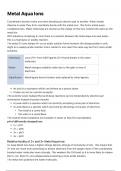
Metal Aqua Ions
Coordination bonds involve one atom donating an electron pair to another. When metals
dissolve in water they form coordinate bonds with the metal ions. This forms metal-aqua
complexed ions. Water molecules are neutral so the charge on the ions remains the same as the
metal ion.
With solutions containing 2+ ions there is a reaction between the metal aqua ions and water -
this is a hydrolysis or acidity reaction.
The metal 2+ ions release H+ so an acidic solution forms however the disassociation is only
slight so a weakly acidic solution forms. Metal 3+ ions react the same way but form more acidic
solutions.
Hydrolysis Loss of H+ from H2O ligands (O-H bond breaks in the water
molecule)
Redox Metal changes oxidation state due to the gain or loss of
electrons.
Substitution Metal ligand bond is broken and replaced by other ligands.
An acid is a substance which can behave as a proton donor.
A base can act as a proton acceptor.
The scientist Lewis realised that acid-base reactions can be interpreted by electron pair
movements instead of proton transfer.
A Lewis Acid is a species which can bond by accepting a lone pair of electrons.
A Lewis Base is a species which can bond by attracting a lone pair of electrons.
The metal is a Lewis Acid.
The water is a Lewis Base.
The neutral metal complexes are insoluble in water as they form precipitates.
pH of differently charged ions
1+ = pH7
2+ = pH6
3+ = pH3
4+ = pH0
Relative Acidity of 2+ and 3+ Metal Aqua Ions
3+ Aqua Metal Ions have a higher charge density (charge of ion/volume of ion). This means that
3+ ions are much more polarising so attract electrons from the oxygen atom of the coordinately
bonded water molecules more strongly. This weakens the OH bond so it is more likely to release
the H+ ion. More H+ ions disassociate producing a more acidic solution.
The metal ions polarises the water molecules.
, Reactions with limited NH3 and OH-
All 4 metal aqua ions form precipitates with sodium hydroxide but only the aluminium
hydroxide precipitate dissolves in excess hydroxide ions because it is amphoteric. The
metal ions act as acids in a neutralisation reaction to form a salt and water. The result
products are usually insoluble metal hydroxide precipitates.
All 4 metal aqua ions form precipitates with ammonia but only the copper hydroxide
precipitates dissolve in excess ammonia. This is because it undergoes a ligand exchange
with ammonia.
Reactions with excess NH3
Copper reacts with excess ammonia to form a deep blue solution.
Reactions with excess OH-
Aluminium reacts with excess OH- to form a colourless solution.
Hydrolysis of Metal Aqua Ions with Na2CO3
Metal 3+ ions are stronger acids so form hydroxide precipitates instead. Carbonate ions react
with H3O+ ions removing them from the solution to form CO2 bubbles.
The reaction between 3+ ions and water exists at equilibrium. Removal of the hydronium ions by
carbonate ions pushes the equilibrium to the right and precipitates out the hydrated metal
hydroxide. This causes CO2 to be produced.
The difference is because the 3+ ions are acidic enough to react in an acid-base reaction with
carbonate ions while 2+ ions are not.
Tests for Metal Ions
1. Measure out samples of the unknown metal ions into three separate test tubes.
2. In the first test tube add sodium hydroxide solution using a dropping pipette and record
any changes seen.
3. Then add NaOH so that it is in excess and record any changes that are seen.
4. In the second test tube add ammonia solution drop wise and record any changes seen.
5. Then add it in excess and record any changes seen.
6. In the third test tube add Na2CO3 and record any changes seen.
7. The observations recorded can determine the identity of the metal ions:
Coordination bonds involve one atom donating an electron pair to another. When metals
dissolve in water they form coordinate bonds with the metal ions. This forms metal-aqua
complexed ions. Water molecules are neutral so the charge on the ions remains the same as the
metal ion.
With solutions containing 2+ ions there is a reaction between the metal aqua ions and water -
this is a hydrolysis or acidity reaction.
The metal 2+ ions release H+ so an acidic solution forms however the disassociation is only
slight so a weakly acidic solution forms. Metal 3+ ions react the same way but form more acidic
solutions.
Hydrolysis Loss of H+ from H2O ligands (O-H bond breaks in the water
molecule)
Redox Metal changes oxidation state due to the gain or loss of
electrons.
Substitution Metal ligand bond is broken and replaced by other ligands.
An acid is a substance which can behave as a proton donor.
A base can act as a proton acceptor.
The scientist Lewis realised that acid-base reactions can be interpreted by electron pair
movements instead of proton transfer.
A Lewis Acid is a species which can bond by accepting a lone pair of electrons.
A Lewis Base is a species which can bond by attracting a lone pair of electrons.
The metal is a Lewis Acid.
The water is a Lewis Base.
The neutral metal complexes are insoluble in water as they form precipitates.
pH of differently charged ions
1+ = pH7
2+ = pH6
3+ = pH3
4+ = pH0
Relative Acidity of 2+ and 3+ Metal Aqua Ions
3+ Aqua Metal Ions have a higher charge density (charge of ion/volume of ion). This means that
3+ ions are much more polarising so attract electrons from the oxygen atom of the coordinately
bonded water molecules more strongly. This weakens the OH bond so it is more likely to release
the H+ ion. More H+ ions disassociate producing a more acidic solution.
The metal ions polarises the water molecules.
, Reactions with limited NH3 and OH-
All 4 metal aqua ions form precipitates with sodium hydroxide but only the aluminium
hydroxide precipitate dissolves in excess hydroxide ions because it is amphoteric. The
metal ions act as acids in a neutralisation reaction to form a salt and water. The result
products are usually insoluble metal hydroxide precipitates.
All 4 metal aqua ions form precipitates with ammonia but only the copper hydroxide
precipitates dissolve in excess ammonia. This is because it undergoes a ligand exchange
with ammonia.
Reactions with excess NH3
Copper reacts with excess ammonia to form a deep blue solution.
Reactions with excess OH-
Aluminium reacts with excess OH- to form a colourless solution.
Hydrolysis of Metal Aqua Ions with Na2CO3
Metal 3+ ions are stronger acids so form hydroxide precipitates instead. Carbonate ions react
with H3O+ ions removing them from the solution to form CO2 bubbles.
The reaction between 3+ ions and water exists at equilibrium. Removal of the hydronium ions by
carbonate ions pushes the equilibrium to the right and precipitates out the hydrated metal
hydroxide. This causes CO2 to be produced.
The difference is because the 3+ ions are acidic enough to react in an acid-base reaction with
carbonate ions while 2+ ions are not.
Tests for Metal Ions
1. Measure out samples of the unknown metal ions into three separate test tubes.
2. In the first test tube add sodium hydroxide solution using a dropping pipette and record
any changes seen.
3. Then add NaOH so that it is in excess and record any changes that are seen.
4. In the second test tube add ammonia solution drop wise and record any changes seen.
5. Then add it in excess and record any changes seen.
6. In the third test tube add Na2CO3 and record any changes seen.
7. The observations recorded can determine the identity of the metal ions: