Discuss the nature-nurture debate in psychology [16 marks]
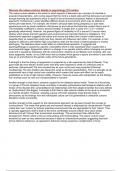
The nature-nurture debate is the extent to which aspects of behaviour are a product of inherited or
acquired characteristics. John Locke argued that the mind is a blank slate and that behaviours are learnt
through learning and experience which is result of the environment [important feature of behaviourist
approach]. Furthermore, Lerner identified different levels of environment which may be defined in
narrow pre-natal terms. For example, the mother’s physical state during pregnancy or post-natal
experiences such as social conditions child grows up and cultural and historical context they’re part of.
The heritability coefficient is used to assess heredity. It ranges from a scale of 0-1.0 [1 = entirely
genetically determined]. However, the general figure of heritability in IQ is around 0.5 across many
studies which shows that both genetics and environment are important factors in intelligence. The
interactionist approach suggests that nature and nurture are linked and it doesn’t make sense to
separate them so researchers study how they interact and influence each other. For example, in twin
studies it’s difficult to tell whether high concordance rates are the result of shared genetics or shared
upbringing. The diathesis-stress model offers an interactionist approach. It suggests that
psychopathology is caused by a genetic vulnerability which is only expressed when coupled with a
environmental trigger. Epigenetics refers to a change in our genetic activity without changing our genetic
code and is caused by interaction with the environment. Aspects of our lifestyle such smoking, diet, war
leave epigenetic ‘marks’ on our DNA which tell our bodies which genes to ignore and which to use which
may go on and influence the genetic codes of the future generations.
A strength is that the theory of epigenetics is supported by a lab experiment by Dias & Ressler. They
gave male lab mice electric shocks every time they were exposed to smell of a chemical used in
perfumes. [behaviourist] The mice showed fear as soon as the sent was presented [Classical
conditioning]. The rat’s children also feared the smell so did their grandchildren. This is a strength as lab
experiments have a high control over variables which means that cause and effect can be easily
established so it has a high internal validity. However, there are issues with extrapolation as the findings
from animals such as mice can’t be generalised to humans.
Another strength is that there’s research support for the diathesis-stress model. Tienari et al found that
in a group of Finnish adoptees those most likely to develop schizophrenia had biological relatives with a
history of the disorder [the vulnerability] & had relationships with their adoptive families that were defined
as ‘dysfunctional’ [the trigger]. A strength is that there’s high external validity as the study is conducted
in a real life situation. However, studying a group of Finnish adoptees meas that the study is
ethnocentric as the findings from the individualist culture can’t be generalised to collectivist cultures
therefore it lacks universality.
Another strength is that support for the interactionist approach can be seen through the concept of
constructivism. The notion that genes and environment interact is elaborated by constructivism. People
create their own 'nurture' by actively selecting environments that are appropriate for their 'nature'. Thus,
a naturally aggressive child is likely to feel more comfortable around children who show similar
behaviours & will 'choose' their environment accordingly. This environment then affects their
development. Plomin refers to this as niche-picking and niche-building. The nature–nurture could
therefore be seen as less determinist because it takes an interactionist position suggesting that both
forces influence behaviour, as opposed to behaviour being caused by a single factor or force.
The nature-nurture debate is the extent to which aspects of behaviour are a product of inherited or
acquired characteristics. John Locke argued that the mind is a blank slate and that behaviours are learnt
through learning and experience which is result of the environment [important feature of behaviourist
approach]. Furthermore, Lerner identified different levels of environment which may be defined in
narrow pre-natal terms. For example, the mother’s physical state during pregnancy or post-natal
experiences such as social conditions child grows up and cultural and historical context they’re part of.
The heritability coefficient is used to assess heredity. It ranges from a scale of 0-1.0 [1 = entirely
genetically determined]. However, the general figure of heritability in IQ is around 0.5 across many
studies which shows that both genetics and environment are important factors in intelligence. The
interactionist approach suggests that nature and nurture are linked and it doesn’t make sense to
separate them so researchers study how they interact and influence each other. For example, in twin
studies it’s difficult to tell whether high concordance rates are the result of shared genetics or shared
upbringing. The diathesis-stress model offers an interactionist approach. It suggests that
psychopathology is caused by a genetic vulnerability which is only expressed when coupled with a
environmental trigger. Epigenetics refers to a change in our genetic activity without changing our genetic
code and is caused by interaction with the environment. Aspects of our lifestyle such smoking, diet, war
leave epigenetic ‘marks’ on our DNA which tell our bodies which genes to ignore and which to use which
may go on and influence the genetic codes of the future generations.
A strength is that the theory of epigenetics is supported by a lab experiment by Dias & Ressler. They
gave male lab mice electric shocks every time they were exposed to smell of a chemical used in
perfumes. [behaviourist] The mice showed fear as soon as the sent was presented [Classical
conditioning]. The rat’s children also feared the smell so did their grandchildren. This is a strength as lab
experiments have a high control over variables which means that cause and effect can be easily
established so it has a high internal validity. However, there are issues with extrapolation as the findings
from animals such as mice can’t be generalised to humans.
Another strength is that there’s research support for the diathesis-stress model. Tienari et al found that
in a group of Finnish adoptees those most likely to develop schizophrenia had biological relatives with a
history of the disorder [the vulnerability] & had relationships with their adoptive families that were defined
as ‘dysfunctional’ [the trigger]. A strength is that there’s high external validity as the study is conducted
in a real life situation. However, studying a group of Finnish adoptees meas that the study is
ethnocentric as the findings from the individualist culture can’t be generalised to collectivist cultures
therefore it lacks universality.
Another strength is that support for the interactionist approach can be seen through the concept of
constructivism. The notion that genes and environment interact is elaborated by constructivism. People
create their own 'nurture' by actively selecting environments that are appropriate for their 'nature'. Thus,
a naturally aggressive child is likely to feel more comfortable around children who show similar
behaviours & will 'choose' their environment accordingly. This environment then affects their
development. Plomin refers to this as niche-picking and niche-building. The nature–nurture could
therefore be seen as less determinist because it takes an interactionist position suggesting that both
forces influence behaviour, as opposed to behaviour being caused by a single factor or force.