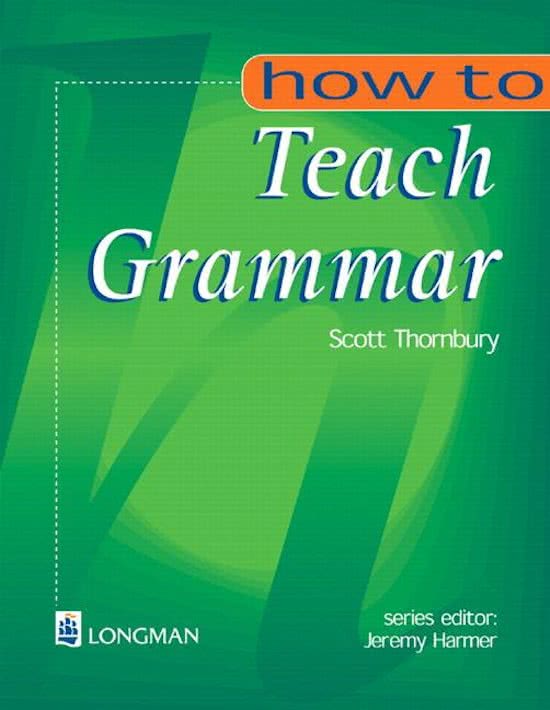
CHAPTER 1 WHAT IS GRAMMAR?
Many different ways of teaching grammar - no ideal way
à PURPOSE: trigger classroom experimentation and reflection
(taking into account the features of every individual teaching situation)
The Rule of Appropriacy: Interpret any suggestions according to the level, needs,
interests, expectations and learning styles of your students.
The forms language takes: text, sentence, word and sound (*grammar: how these
forms are arranged and patterned)
Grammar: a description of the rules that govern how a language’s sentences are formed
à study of the syntax and morphology of sentences: study of the way words are chained
together in a particular order and of what kind of words can slot into any one link in the
chain.
Syntax: the system of rules that cover the order of words in a sentence.
Morphology: the system of rules that cover the formation of words.
Different languages have different constraints on the way chains are ordered and slots
are filled (=rules of the language) à second language learner errors because of
overgeneralisation of the rules of their mother tongue.
Problems concerning the ability to recognise ánd to produce well-formed sentences:
1. Great deal of debate as to how this ability is best developed
2. Not clear what ‘well-formed’ really means (naturally occurring speech violates strict
grammatical rules: ‘ain’t’ – ‘is not)
3. Risks of under-equipping learner for real language use by exclusively focusing on
sentences (and not on texts or words).
*Another feature of grammar: meaning-making potential
à grammar & vocabulary communicate meanings
(“Tickets!”) à lexical/word level
à little/no grammar (no morphology & syntax)
Situational factors (expectation of getting tickets checked) help to make meaning clear.
Rule of thumb: the more context, the less grammar
> learners need to learn: 1. The forms of the language
2. The meanings these forms convey
Main purposes of language:
1. Representational function: represent the world as we experience and perceive
it/describe it in terms of how, when, where things happen à SVOCA does this too !
2. Interpersonal function: influence how things happen in the world, specifically in our
relations with other people/how we interact with other people when, e.g. we need to get
things done
Many different ways of teaching grammar - no ideal way
à PURPOSE: trigger classroom experimentation and reflection
(taking into account the features of every individual teaching situation)
The Rule of Appropriacy: Interpret any suggestions according to the level, needs,
interests, expectations and learning styles of your students.
The forms language takes: text, sentence, word and sound (*grammar: how these
forms are arranged and patterned)
Grammar: a description of the rules that govern how a language’s sentences are formed
à study of the syntax and morphology of sentences: study of the way words are chained
together in a particular order and of what kind of words can slot into any one link in the
chain.
Syntax: the system of rules that cover the order of words in a sentence.
Morphology: the system of rules that cover the formation of words.
Different languages have different constraints on the way chains are ordered and slots
are filled (=rules of the language) à second language learner errors because of
overgeneralisation of the rules of their mother tongue.
Problems concerning the ability to recognise ánd to produce well-formed sentences:
1. Great deal of debate as to how this ability is best developed
2. Not clear what ‘well-formed’ really means (naturally occurring speech violates strict
grammatical rules: ‘ain’t’ – ‘is not)
3. Risks of under-equipping learner for real language use by exclusively focusing on
sentences (and not on texts or words).
*Another feature of grammar: meaning-making potential
à grammar & vocabulary communicate meanings
(“Tickets!”) à lexical/word level
à little/no grammar (no morphology & syntax)
Situational factors (expectation of getting tickets checked) help to make meaning clear.
Rule of thumb: the more context, the less grammar
> learners need to learn: 1. The forms of the language
2. The meanings these forms convey
Main purposes of language:
1. Representational function: represent the world as we experience and perceive
it/describe it in terms of how, when, where things happen à SVOCA does this too !
2. Interpersonal function: influence how things happen in the world, specifically in our
relations with other people/how we interact with other people when, e.g. we need to get
things done