Telos
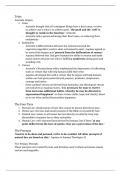
Aristotle Origins
1. Telos
- Aristotle thought that all contingent things have a final cause, or telos
to achieve one’s telos is to achieve good, ‘the good and the ‘well’ is
thought to reside in the function.’ Aristotle
- Aristotle calls a person achieving their final cause, as achieving their
eudaimonia
2. Rationality
- Aristotle’s differentiation between the rational soul and the
vegetative/appetitive souls is what set humanity apart. Aquinas agreed as
he stated that human acts ‘proceed from the deliberation of reason.’
- Aquinas believed that God gave humans the ability to reason and make
moral choices because our telos is fulfilling synderesis (doing good and
avoiding evil).
3. Virtues
- Aristotle’s Nicomachean ethics emphasised the importance of cultivating
traits or virtues that will help humans fulfil their telos
- Aquinas developed this with 4 virtues that he argues will help humans
realise our God-given potential and purpose: prudence, temperance,
courage and justice.
- these cardinal virtues are derived from humanity, but theological virtues
are God given as Aquinas states, ‘it is necessary for man to receive
from God some additional habits, whereby he may be directed to
supernatural happiness’ so these virtues (faith, hope and charity) direct
us to our telos and facilitate perfect happiness.
The Four Tiers
1. Eternal Law: mind/reason of God, this cannot be known directly by man
2. Divine Law: the laws and moral precepts of the Bible as revealed by God
3. Natural Law: innate to all nature but not directly revealed by God, only
discernible to humans due to their rationality
4. Human Law: well-reasoned laws devised by humans, but if these ‘at any
point deflect from the laws of nature, they are a perversion of the law.’
The Precepts
‘Good is to be done and pursued, evil is to be avoided. All other precepts of
natural law are based on this.’ Aquinas in Summa Theologica II
Five Primary Precepts
These precepts are revealed by God, and therefore aren’t reliant on human reason
and are unchangeable.
Aristotle Origins
1. Telos
- Aristotle thought that all contingent things have a final cause, or telos
to achieve one’s telos is to achieve good, ‘the good and the ‘well’ is
thought to reside in the function.’ Aristotle
- Aristotle calls a person achieving their final cause, as achieving their
eudaimonia
2. Rationality
- Aristotle’s differentiation between the rational soul and the
vegetative/appetitive souls is what set humanity apart. Aquinas agreed as
he stated that human acts ‘proceed from the deliberation of reason.’
- Aquinas believed that God gave humans the ability to reason and make
moral choices because our telos is fulfilling synderesis (doing good and
avoiding evil).
3. Virtues
- Aristotle’s Nicomachean ethics emphasised the importance of cultivating
traits or virtues that will help humans fulfil their telos
- Aquinas developed this with 4 virtues that he argues will help humans
realise our God-given potential and purpose: prudence, temperance,
courage and justice.
- these cardinal virtues are derived from humanity, but theological virtues
are God given as Aquinas states, ‘it is necessary for man to receive
from God some additional habits, whereby he may be directed to
supernatural happiness’ so these virtues (faith, hope and charity) direct
us to our telos and facilitate perfect happiness.
The Four Tiers
1. Eternal Law: mind/reason of God, this cannot be known directly by man
2. Divine Law: the laws and moral precepts of the Bible as revealed by God
3. Natural Law: innate to all nature but not directly revealed by God, only
discernible to humans due to their rationality
4. Human Law: well-reasoned laws devised by humans, but if these ‘at any
point deflect from the laws of nature, they are a perversion of the law.’
The Precepts
‘Good is to be done and pursued, evil is to be avoided. All other precepts of
natural law are based on this.’ Aquinas in Summa Theologica II
Five Primary Precepts
These precepts are revealed by God, and therefore aren’t reliant on human reason
and are unchangeable.