

E-learning Notes
woensdag 22 maart 2017
8:41
Introduction
Detailed learning goals of the module
After studying the module you will be able to
• choose the appropriate design,
• choose the appropriate analysis method,
• conduct the analysis,
• interpret results,
of reproducibility and validation studies.
To become able to do this, you will learn to discuss the concepts,
principles and aims of reproducibility and validity of exposure
assessment at the level of both the individual and the population. This
includes quantification of random and systematic errors and implications
for observed levels of intake, for ranking people according to their intake
and for measures of association.
Exercise: Exposure assessment dilemma
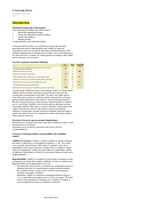
For this study a FFQ was used to assess dietary intake. To decide which
method will be used the researchers took all the pros and cons into
account that are mentioned in the table. Of course, also other aspects
were taken into account e.g. reference period, characteristics of target
group, desired information with respect to specific nutrients/foods etc.
Because of practical reasons (time, money, required number of subjects
etc) it is not always feasible to use the most precise and most accurate
assessment method. Often there is a kind of dilemma: Doing large scale
studies and using less precise and accurate exposure assessment
methods, or using more accurate and precise methods and performing a
small scale study. For now it is important to realize that dietary intake is
often assessed with error.
Exercises: Errors in expo assessment (implications)
Random errors in dietary assessment may lead to dilution (in other words
attenuation) of associations.
Systematic errors in dietary assessment may lead to flawed
recommendations.
Exercises: Evaluation studies (reproducibility and validation
studies)
Validity (or accuracy) Degree to which a method accurately measures
the aspect of dieat that it was designed to measure, i.e. the "true value
over a specific period of time. This refers to systematic error (bias).
Depending on the research question, validity refers to validity of mean
intake of a population, validity of usual intake of an individual, validity
of ranking of individuals or validity of associations between intake and a
health parameter.
Reproducibility: Ability of a method to yield similar (consistent) results
on repeated occasions under similar conditions. It refers to random error.
Reproducibility can be quantified in two ways:
- Precision: this refers to lack of random error, quantified in terms of
standard deviation of a measurement (variance around estimate).
For example because of day-to-day variation, between person
variation and sample variability
- Reliability: Ability of a method to distinguish between subjects
(i.e. to rank them consistently on two or more occasions). Thus this
refers to the consistency of ranking, not to validity of ranking. It
can be quantified in terms of correlation coefficients
HNE-32806 Pagina 1
woensdag 22 maart 2017
8:41
Introduction
Detailed learning goals of the module
After studying the module you will be able to
• choose the appropriate design,
• choose the appropriate analysis method,
• conduct the analysis,
• interpret results,
of reproducibility and validation studies.
To become able to do this, you will learn to discuss the concepts,
principles and aims of reproducibility and validity of exposure
assessment at the level of both the individual and the population. This
includes quantification of random and systematic errors and implications
for observed levels of intake, for ranking people according to their intake
and for measures of association.
Exercise: Exposure assessment dilemma
For this study a FFQ was used to assess dietary intake. To decide which
method will be used the researchers took all the pros and cons into
account that are mentioned in the table. Of course, also other aspects
were taken into account e.g. reference period, characteristics of target
group, desired information with respect to specific nutrients/foods etc.
Because of practical reasons (time, money, required number of subjects
etc) it is not always feasible to use the most precise and most accurate
assessment method. Often there is a kind of dilemma: Doing large scale
studies and using less precise and accurate exposure assessment
methods, or using more accurate and precise methods and performing a
small scale study. For now it is important to realize that dietary intake is
often assessed with error.
Exercises: Errors in expo assessment (implications)
Random errors in dietary assessment may lead to dilution (in other words
attenuation) of associations.
Systematic errors in dietary assessment may lead to flawed
recommendations.
Exercises: Evaluation studies (reproducibility and validation
studies)
Validity (or accuracy) Degree to which a method accurately measures
the aspect of dieat that it was designed to measure, i.e. the "true value
over a specific period of time. This refers to systematic error (bias).
Depending on the research question, validity refers to validity of mean
intake of a population, validity of usual intake of an individual, validity
of ranking of individuals or validity of associations between intake and a
health parameter.
Reproducibility: Ability of a method to yield similar (consistent) results
on repeated occasions under similar conditions. It refers to random error.
Reproducibility can be quantified in two ways:
- Precision: this refers to lack of random error, quantified in terms of
standard deviation of a measurement (variance around estimate).
For example because of day-to-day variation, between person
variation and sample variability
- Reliability: Ability of a method to distinguish between subjects
(i.e. to rank them consistently on two or more occasions). Thus this
refers to the consistency of ranking, not to validity of ranking. It
can be quantified in terms of correlation coefficients
HNE-32806 Pagina 1



