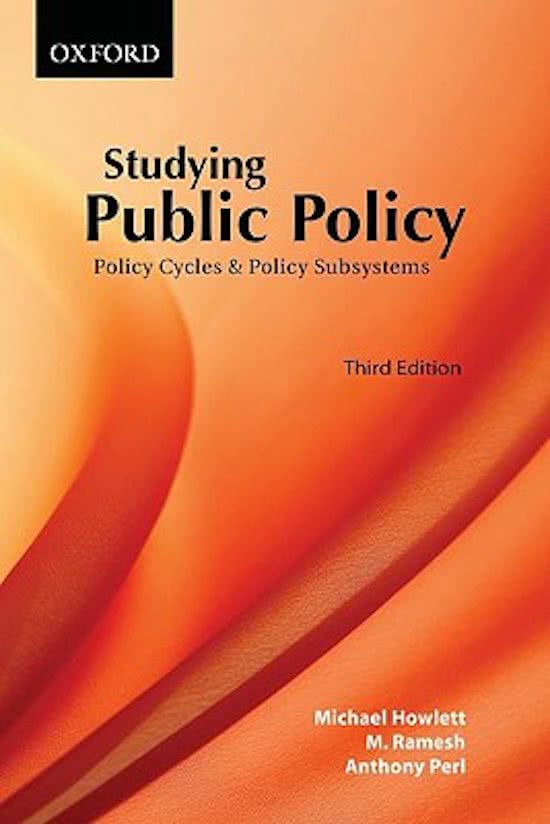
Public Policy summary
WEEK 1
Howlett: chapter 1, 2, 3
Article: Downs
Howlett chapter 1 – Introduction: why study public policy?
Simple answer: because we have to for this pre-master and nobody likes it.
Answer according to Howlett: to gain understanding of the process of governmental decision making.
The process of matching goals and means has two dimensions;
1. technical dimension, which seeks to identify the optimal relationship between goals and tools
2. political dimension, as not all actors typically agree on what a policy problem entails and/or
what an appropriate solution might be
Definitions of ‘public policy’:
Thomas Dye (1972): “anything a government chooses to do, or not do”. This definition
indicates public policy is a conscious choice and that the primary agent is the government;
William Jenkins (1978): “public policy is a set of interrelated decisions taken by a political
actor, or by a group of actors, concerning the selection of goals and the means of achieving
them within a specified situation where those decision should, in principle, be within the
power of those actors to achieve”. This definition indicates that public policy is a dynamic
process and a result of cumulative decisions which contribute to the government capacity to
implement. Public policy shows goal oriented behaviour.
Harold Laswell (1958), the (fore)father of Public Policy research, dived the process into seven stages:
1) intelligence, 2) promotion, 3) prescription, 4) invocation, 5) application, 6) termination and 7)
appraisal. This method (wrongly) assumed that policy making was limited to a small number of
government officials, plus it places appraisal after (possible) termination of the policy.
Gary Brewer (1974) introduced the earliest ‘policy cycle’, an ongoing process, which evolved to the
current model:
1. agenda setting (recognition of the problem)
2. policy formulation (proposal for a solution to the problem)
3. decision making (choice of the most adequate solution)
4. policy implementation (putting the solution into effect)
5. policy evaluation (monitoring the results of the implemented solution)
The current Policy Cycle Model has several advantages and disadvantages:
Advantages of the Policy Cycle model Disadvantages of the Policy Cycle model
- Facilitates an understanding of a complex - Suggests that policy is created in a very
process by dividing it into (sub)stages organised and systematic way
- The model can be used at all levels of policy - The model lacks any notion of causation
making
WEEK 1
Howlett: chapter 1, 2, 3
Article: Downs
Howlett chapter 1 – Introduction: why study public policy?
Simple answer: because we have to for this pre-master and nobody likes it.
Answer according to Howlett: to gain understanding of the process of governmental decision making.
The process of matching goals and means has two dimensions;
1. technical dimension, which seeks to identify the optimal relationship between goals and tools
2. political dimension, as not all actors typically agree on what a policy problem entails and/or
what an appropriate solution might be
Definitions of ‘public policy’:
Thomas Dye (1972): “anything a government chooses to do, or not do”. This definition
indicates public policy is a conscious choice and that the primary agent is the government;
William Jenkins (1978): “public policy is a set of interrelated decisions taken by a political
actor, or by a group of actors, concerning the selection of goals and the means of achieving
them within a specified situation where those decision should, in principle, be within the
power of those actors to achieve”. This definition indicates that public policy is a dynamic
process and a result of cumulative decisions which contribute to the government capacity to
implement. Public policy shows goal oriented behaviour.
Harold Laswell (1958), the (fore)father of Public Policy research, dived the process into seven stages:
1) intelligence, 2) promotion, 3) prescription, 4) invocation, 5) application, 6) termination and 7)
appraisal. This method (wrongly) assumed that policy making was limited to a small number of
government officials, plus it places appraisal after (possible) termination of the policy.
Gary Brewer (1974) introduced the earliest ‘policy cycle’, an ongoing process, which evolved to the
current model:
1. agenda setting (recognition of the problem)
2. policy formulation (proposal for a solution to the problem)
3. decision making (choice of the most adequate solution)
4. policy implementation (putting the solution into effect)
5. policy evaluation (monitoring the results of the implemented solution)
The current Policy Cycle Model has several advantages and disadvantages:
Advantages of the Policy Cycle model Disadvantages of the Policy Cycle model
- Facilitates an understanding of a complex - Suggests that policy is created in a very
process by dividing it into (sub)stages organised and systematic way
- The model can be used at all levels of policy - The model lacks any notion of causation
making