Human Resources
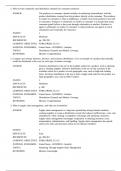
1. Define human resources management (HRM), and discuss the overall activities involved in each of its three main phases. ANSWER: Human resources management consists of all activities that involve acquiring, maintaining, and developing an organization’s human resources. Acquiring people for the organization includes planning and other activities that lead to hiring new personnel. Maintaining employees includes employee relations and adequate compensation and benefits that help retain people. The development phase includes training and development and performance appraisals. POINTS: 1 DIFFICULTY: Easy REFERENCES: pp. 239-240 LEARNING OBJECTIVES: FOBU.PRIDE.15.9-1 NATIONAL STANDARDS: United States - BUSPROG: Analytic TOPICS: Human Resources Management: An Overview KEYWORDS: Bloom's: Knowledge 2. How does a replacement chart differ from a skills inventory? What is the purpose of each? ANSWER: A replacement chart is a list of key personnel and possible replacements within a firm while a skills inventory is a computerized data bank of information of all employees. The replacement chart is used to ensure that top-management positions can be filled in a timely manner. The skills inventory can be useful to pull employees into a project based on their special skills or used to make the best use of skills within a company in the right key slots. POINTS: 1 DIFFICULTY: Easy REFERENCES: p. 242 LEARNING OBJECTIVES: FOBU.PRIDE.15.9-2 NATIONAL STANDARDS: United States - BUSPROG: Analytic TOPICS: Human Resources Planning KEYWORDS: Bloom's: Knowledge 3. There are at least four methods for reducing the number of employees when sales demand is really down. Name each and define the term. ANSWER: Reduction of employees may take four forms: (1) lay off--a dismissal from the workforce until employees might be needed again; (2) attrition--a normal, standard reduction in the workforce that occurs when employees leave; (3) early retirement-- employees close to retirement may be encouraged to take early retirement with full benefits; and (4) fired--dismissing employees for job performance or some other negative situation. POINTS: 1 DIFFICULTY: Moderate REFERENCES: pp. 242-243 LEARNING OBJECTIVES: FOBU.PRIDE.15.9-2 NATIONAL STANDARDS: United States - BUSPROG: Analytic TOPICS: Human Resources Planning KEYWORDS: Bloom's: Comprehension 4. What is cultural diversity, and why is it an important issue? ANSWER: Answers will vary. Cultural diversity refers to the differences among people in a workforce owing to race, ethnicity, and gender. Businesses have an opportunity to expand viewpoints, skills, creativity, and gain a marketing edge with an intentionally diverse workforce. A company that manages diversity well can develop cost advantages over other firms. POINTS: 1 DIFFICULTY: Moderate REFERENCES: pp. 243-244 LEARNING OBJECTIVES: FOBU.PRIDE.15.9-3 NATIONAL STANDARDS: United States - BUSPROG: Analytic TOPICS: Cultural Diversity in Human Resources KEYWORDS: Bloom's: Comprehension 5. Discuss the challenges and advantages of a culturally diverse workforce. ANSWER: A diversity program will be successful only if it is systematic, is ongoing, and has a strong, sustained commitment from top leadership. It is important that an organization understand that diversity can be a great advantage to an organization and that the impact is widespread. POINTS: 1 DIFFICULTY: Moderate REFERENCES: p. 244 LEARNING OBJECTIVES: FOBU.PRIDE.15.9-3 NATIONAL STANDARDS: United States - BUSPROG: Analytic TOPICS: Cultural Diversity in Human Resources KEYWORDS: Bloom's: Comprehension 6. To learn the exact nature of a job, we may use job analysis, a job description, and a job specification. For what purpose is each used? ANSWER: Job analysis is a systematic procedure for studying jobs to determine various elements and requirements. A job description is a list of the elements that make up a particular job--duties, working conditions, responsibilities, and tools and equipment used on the job. A job specification is a list of the qualifications required to perform a particular job--skills, abilities, education, and experience. POINTS: 1 DIFFICULTY: Moderate REFERENCES: p. 245 LEARNING OBJECTIVES: FOBU.PRIDE.15.9-4 NATIONAL STANDARDS: United States - BUSPROG: Analytic TOPICS: Job Analysis KEYWORDS: Bloom's: Knowledge

Geschreven voor
- Instelling
- Rtf
- Vak
- Rtf
Documentinformatie
- Geüpload op
- 5 juli 2023
- Aantal pagina's
- 99
- Geschreven in
- 2022/2023
- Type
- Tentamen (uitwerkingen)
- Bevat
- Vragen en antwoorden
Onderwerpen
-
rtf