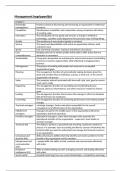
Management begrippenlijst
Chapter 1
Knowledge Practices aimed at discovering and harnessing an organization’s intellectual
management resources
Coopetition Simultaneous competition and cooperation among companies with intent
of creating value
Innovation The introduction of new goods and services; a change in method or
technology; a positive useful departure from previous ways of doing things
Quality The excellence of your product (goods or services)
Service The speed and dependability with which an organization delivers what
customers want
Speed Fast and timely execution, response and delivery of products
Cost Keeping costs low to achieve profits and be able to offer prices that are
competitiveness attractive to consumers
Sustainability A long-term perspective on sustaining the natural environment and building
tomorrow’s business opportunities while effectively managing today’s
business
Management The process of working with people and resources to accomplish
organizational goals
Planning The management function of systematically making decisions about the
goals and activities that an individual, a group, a work unit, or the overall
organization will pursue
Value The monetary amount associated with how well a job, task, good or service
meet users’ needs
Organizing The management function of assembling and coordinating human,
financial, physical, informational, and other resources needed to achieve
goals
Leading The management function that involves the manager’s efforts to stimulate
high performance by employees
Controlling The management function of monitoring performance and making needed
changes
Top-level managers =strategic manager. Senior executives responsible for the overall
management and effectiveness of the organization
Middle-level Managers located in the middle layers of the organizational hierarchy
managers reporting to top-level executives
Frontline managers Operational managers. Lower-level managers who supervise the
operational activities of the organization – supervisor, team leader or
assistant manager.
Technical skill The ability to perform a specialized task involving a particular method or
process. For example: your accounting and finance courses will develop the
technical skills you need to understand and manage the financial resources
of an organization
Conceptual and Skills pertaining to abilities that help identify and resolve problems for the
decision skills benefit of the organization and its members
Interpersonal and = people skills; the ability to lead, motivate and communicate effectively
communication with other
skills
Emotional Skills of understanding yourself, managing yourself, and dealing effectively
intelligence (EQ) with other
Social capital Goodwill stemming from your social relationships; a competitive advantage
, in the form of relationships with other people and the image other people
have of you
p. 21
Appendix A
Administrative A classical management approach that attempted to identify major
management principles and functions that managers could use to achieve superior
organizational performance
Bureaucracy A classical management approach emphasizing a structured, formal
network of relationships among specialized positions in the organization
Contingencies Factors that determine the appropriateness of managerial a ctions
Contingency An approach to the study of management proposing that the managerial
perspective strategies, structures, and processes that result in high performance
depend on the characteristics, or important contingencies, of the situation
in which they are applied
Economies of scale Reductions in the average cost of a unit of production as the total volume
produced increases,
Hawthorne effect People’s reactions to being observed or studied resulting in superficial
rather than meaningful changes in behavior
Human relations A classical management approach that attempted to understand and
explain how human psychological and social processes interact with the
formal aspects of the work situation to influence performance
Organizational A contemporary management approach that studies and identifies
behavior management activities that promote employee effectiveness by examining
the complex and dynamic nature of individual, group, and organizational
processes
Quantitative A contemporary management approach that emphasizes the application of
management quantitative analysis to managerial decisions and problems
Scientific A classical management approach that applied scientific methods to
management analyze and determine the one best way to complete production tasks,
Systematic A classical management approach that attempted to build into operations
management the specific procedures and processes that would ensure coordination of
effort to achieve established goals and plans,
Systems theory A theory stating that an organization is a managed system that changes
inputs into outputs,
p. 36
Chapter 2: The external and internal environments
Open systems Organizations that are affected by, and that affect, their environment
Inputs Goods and services organizations take in and use to create products or
services
Outputs The products and services organizations create
External All relevant forces outside a firm’s boundaries, such as competitors,
environment customers, the government, and the economy
Competitive The immediate environment surrounding a firm; includes suppliers, buyers
environment (customers), new entrants, and substitute or complementary products
Macroenvironment The general environment which affects all organizations; includes
economic, technological, legal, demographics, and natural environment
factors
Demographics Measures of various characteristics of the people who make up groups or
other social units
Barriers to entry Conditions that prevent new companies from entering an industry
Switching costs Fixed costs buyers face when they change suppliers
Chapter 1
Knowledge Practices aimed at discovering and harnessing an organization’s intellectual
management resources
Coopetition Simultaneous competition and cooperation among companies with intent
of creating value
Innovation The introduction of new goods and services; a change in method or
technology; a positive useful departure from previous ways of doing things
Quality The excellence of your product (goods or services)
Service The speed and dependability with which an organization delivers what
customers want
Speed Fast and timely execution, response and delivery of products
Cost Keeping costs low to achieve profits and be able to offer prices that are
competitiveness attractive to consumers
Sustainability A long-term perspective on sustaining the natural environment and building
tomorrow’s business opportunities while effectively managing today’s
business
Management The process of working with people and resources to accomplish
organizational goals
Planning The management function of systematically making decisions about the
goals and activities that an individual, a group, a work unit, or the overall
organization will pursue
Value The monetary amount associated with how well a job, task, good or service
meet users’ needs
Organizing The management function of assembling and coordinating human,
financial, physical, informational, and other resources needed to achieve
goals
Leading The management function that involves the manager’s efforts to stimulate
high performance by employees
Controlling The management function of monitoring performance and making needed
changes
Top-level managers =strategic manager. Senior executives responsible for the overall
management and effectiveness of the organization
Middle-level Managers located in the middle layers of the organizational hierarchy
managers reporting to top-level executives
Frontline managers Operational managers. Lower-level managers who supervise the
operational activities of the organization – supervisor, team leader or
assistant manager.
Technical skill The ability to perform a specialized task involving a particular method or
process. For example: your accounting and finance courses will develop the
technical skills you need to understand and manage the financial resources
of an organization
Conceptual and Skills pertaining to abilities that help identify and resolve problems for the
decision skills benefit of the organization and its members
Interpersonal and = people skills; the ability to lead, motivate and communicate effectively
communication with other
skills
Emotional Skills of understanding yourself, managing yourself, and dealing effectively
intelligence (EQ) with other
Social capital Goodwill stemming from your social relationships; a competitive advantage
, in the form of relationships with other people and the image other people
have of you
p. 21
Appendix A
Administrative A classical management approach that attempted to identify major
management principles and functions that managers could use to achieve superior
organizational performance
Bureaucracy A classical management approach emphasizing a structured, formal
network of relationships among specialized positions in the organization
Contingencies Factors that determine the appropriateness of managerial a ctions
Contingency An approach to the study of management proposing that the managerial
perspective strategies, structures, and processes that result in high performance
depend on the characteristics, or important contingencies, of the situation
in which they are applied
Economies of scale Reductions in the average cost of a unit of production as the total volume
produced increases,
Hawthorne effect People’s reactions to being observed or studied resulting in superficial
rather than meaningful changes in behavior
Human relations A classical management approach that attempted to understand and
explain how human psychological and social processes interact with the
formal aspects of the work situation to influence performance
Organizational A contemporary management approach that studies and identifies
behavior management activities that promote employee effectiveness by examining
the complex and dynamic nature of individual, group, and organizational
processes
Quantitative A contemporary management approach that emphasizes the application of
management quantitative analysis to managerial decisions and problems
Scientific A classical management approach that applied scientific methods to
management analyze and determine the one best way to complete production tasks,
Systematic A classical management approach that attempted to build into operations
management the specific procedures and processes that would ensure coordination of
effort to achieve established goals and plans,
Systems theory A theory stating that an organization is a managed system that changes
inputs into outputs,
p. 36
Chapter 2: The external and internal environments
Open systems Organizations that are affected by, and that affect, their environment
Inputs Goods and services organizations take in and use to create products or
services
Outputs The products and services organizations create
External All relevant forces outside a firm’s boundaries, such as competitors,
environment customers, the government, and the economy
Competitive The immediate environment surrounding a firm; includes suppliers, buyers
environment (customers), new entrants, and substitute or complementary products
Macroenvironment The general environment which affects all organizations; includes
economic, technological, legal, demographics, and natural environment
factors
Demographics Measures of various characteristics of the people who make up groups or
other social units
Barriers to entry Conditions that prevent new companies from entering an industry
Switching costs Fixed costs buyers face when they change suppliers