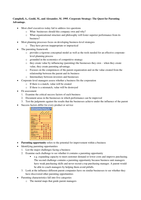
Grant, M., R. and Baden-Fuller, C. (2004). A Knowledge Accessing Theory of Strategic Alliances.
Independent companies cooperate to engage in activities and access resources outside their boundaries
These relationships
o are defined by formal contracts or by ownership
o are described as strategic alliances
o refer to “agreements characterized by the commitment of two or more firms to reach a
common goal entailing the pooling of their resources and activities” (Teece, 1992)
This study argues that strategic alliances
o Integrates greater knowledge in the production of complex goods and services
o Improves the firm’s way in which it utilizes knowledge
This is particularly true when
o There is uncertainty about future knowledge requirements
o New products provide the opportunity to earn above-average returns on investments
Contribution
o This study develops an alternative explanation of strategic alliances based on accessing
knowledge
o It outlines a theory on the efficiency advantages of strategic alliances
There is a wide-spread presumption that the goal of strategic alliances is to facilitate learning
o This view fails to recognize that the primary advantage of strategic alliances consists of
accessing knowledge
The literature distinguishes two dimensions of knowledge management
1. Knowledge generation – activities that increase an organization’s stock of knowledge; points
to alliances in which each member seeks to transfer and absorb the partner’s knowledge.
2. Knowledge application – activities that deploy existing knowledge to create value; points to
alliances in which each member seeks to access its partner knowledge to exploit
complementarities.
Literature on knowledge-based explanations of alliances is imprecise about organizational learning,
knowledge sharing, and knowledge transfer
o The key challenge is to specify under which conditions strategic alliances are superior
governance structures
Knowledge
o An important productive source in terms of market value and the primary source of Ricardian
rents
o Explicit knowledge can be articulated and easily communicated between individuals and
organizations
o Tacit knowledge is manifest only in its application; transferring it from one individual to
another is costly and slow
o Subject to economies of scale and scope
The costs of replicating knowledge are lower than those of the original creation and
discovery of knowledge
o Created by individual human beings; can only grow by means of specialization
o Individuals require many types of knowledge to produce a good or service
Efficiency in knowledge application depends upon the ability to integrate different types of
knowledge and the ability to utilize knowledge to its full capacity
Efficiency of integration: costs of combining multiple types of knowledge into goods and services
Independent companies cooperate to engage in activities and access resources outside their boundaries
These relationships
o are defined by formal contracts or by ownership
o are described as strategic alliances
o refer to “agreements characterized by the commitment of two or more firms to reach a
common goal entailing the pooling of their resources and activities” (Teece, 1992)
This study argues that strategic alliances
o Integrates greater knowledge in the production of complex goods and services
o Improves the firm’s way in which it utilizes knowledge
This is particularly true when
o There is uncertainty about future knowledge requirements
o New products provide the opportunity to earn above-average returns on investments
Contribution
o This study develops an alternative explanation of strategic alliances based on accessing
knowledge
o It outlines a theory on the efficiency advantages of strategic alliances
There is a wide-spread presumption that the goal of strategic alliances is to facilitate learning
o This view fails to recognize that the primary advantage of strategic alliances consists of
accessing knowledge
The literature distinguishes two dimensions of knowledge management
1. Knowledge generation – activities that increase an organization’s stock of knowledge; points
to alliances in which each member seeks to transfer and absorb the partner’s knowledge.
2. Knowledge application – activities that deploy existing knowledge to create value; points to
alliances in which each member seeks to access its partner knowledge to exploit
complementarities.
Literature on knowledge-based explanations of alliances is imprecise about organizational learning,
knowledge sharing, and knowledge transfer
o The key challenge is to specify under which conditions strategic alliances are superior
governance structures
Knowledge
o An important productive source in terms of market value and the primary source of Ricardian
rents
o Explicit knowledge can be articulated and easily communicated between individuals and
organizations
o Tacit knowledge is manifest only in its application; transferring it from one individual to
another is costly and slow
o Subject to economies of scale and scope
The costs of replicating knowledge are lower than those of the original creation and
discovery of knowledge
o Created by individual human beings; can only grow by means of specialization
o Individuals require many types of knowledge to produce a good or service
Efficiency in knowledge application depends upon the ability to integrate different types of
knowledge and the ability to utilize knowledge to its full capacity
Efficiency of integration: costs of combining multiple types of knowledge into goods and services