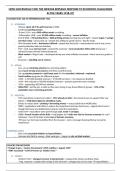
HOW SUCCESSFULLY DID THE WEIMAR REPUBLIC RESPOND TO ECONOMIC CHALLENGES
IN THE YEARS 1918-32?
FACTORS THAT LED TO HYPERINFLATION 1923
1) ECONOMIC:
- Weimar spent all of its gold reserves in WWI.
- Continued printing money.
June 1914 = over 6300 million marks circulating.
December 1918 = over 33,000 million marks circulating = severe inflation.
- End of WWI = 150 printing firms = 2000 printing presses running day and night = meant wages + savings
lost their value = prices shot up = people less willing to spend money = bad for trade.
- War disrupted trade = businesses suffered = people lost their jobs = exacerbated at end of war as war
goods production had now finished.
- TOV = took away German land = slowed the economy = farm production fell by 20% during war =
industrial output almost halved during war.
- Black market = illegal trade = developed during war when inflation increased + there were less goods to
sell.
- Economy = spiralling out of control.
2) SOCIAL:
- Gov. set up retraining schemes for returning soldiers.
- Gave loans to help army leavers until they could find work.
- Set up pension payments + paid lump sums for the wounded, widowed + orphaned.
- Social welfare programs for different groups:
- 1920 = 1,537,000 disabled veterans + 1,945,000 survivors = not classed as disabled.
- 1924 = this reduced to 768,000 disabled veterans = pension payments were working!
- 1924 = supporting 420,000 war widows.
- NEGATIVE = led the gov. in debt as they were trying to pay these different groups = 10% of the
population were receiving payments.
3) POLITICAL:
- TOV reparations created more debt = 1914 already in debt = borrowed money to support their war
efforts = 1918 debt tripled to 150 billion marks.
- Efforts to reduce debt = printing + borrowing money = unsuccessful led to MORE debt.
- 1921 = negotiations with Allies to reduce the reparations Germany had to pay = angered the French =
thought Germany was deliberately trying to avoid the reparations.
- Until 1924 = reparations were paid through coal, wood + carriages.
- 1923 = French invasion of the Ruhr = had Belgian aid = Ruhr was vital to German economy for coal +
industries = loss of the Ruhr meant loss of German economy.
France nor Germany benefited from the invasion = sent a message showing Weimar economic
weaknesses.
HYPERINFLATION:
- Ruhr crisis escalated inflation to hyperinflation.
- Germans lost faith in money + their weak gov. = began to rely on black market.
POLICIES FOR RECOVERY
*Change in gov. = Gustav Stresemann’s DVP coalition = August 1923*
*VERY successful = 1924-29 known as ‘Golden Years’*
1) MONEY:
- October 1923 = changed currency to Rentenmark = replaced the almost worthless Mark.
- Neg. response = people with savings in the old mark = unhappy due to low value hyperinflation.
IN THE YEARS 1918-32?
FACTORS THAT LED TO HYPERINFLATION 1923
1) ECONOMIC:
- Weimar spent all of its gold reserves in WWI.
- Continued printing money.
June 1914 = over 6300 million marks circulating.
December 1918 = over 33,000 million marks circulating = severe inflation.
- End of WWI = 150 printing firms = 2000 printing presses running day and night = meant wages + savings
lost their value = prices shot up = people less willing to spend money = bad for trade.
- War disrupted trade = businesses suffered = people lost their jobs = exacerbated at end of war as war
goods production had now finished.
- TOV = took away German land = slowed the economy = farm production fell by 20% during war =
industrial output almost halved during war.
- Black market = illegal trade = developed during war when inflation increased + there were less goods to
sell.
- Economy = spiralling out of control.
2) SOCIAL:
- Gov. set up retraining schemes for returning soldiers.
- Gave loans to help army leavers until they could find work.
- Set up pension payments + paid lump sums for the wounded, widowed + orphaned.
- Social welfare programs for different groups:
- 1920 = 1,537,000 disabled veterans + 1,945,000 survivors = not classed as disabled.
- 1924 = this reduced to 768,000 disabled veterans = pension payments were working!
- 1924 = supporting 420,000 war widows.
- NEGATIVE = led the gov. in debt as they were trying to pay these different groups = 10% of the
population were receiving payments.
3) POLITICAL:
- TOV reparations created more debt = 1914 already in debt = borrowed money to support their war
efforts = 1918 debt tripled to 150 billion marks.
- Efforts to reduce debt = printing + borrowing money = unsuccessful led to MORE debt.
- 1921 = negotiations with Allies to reduce the reparations Germany had to pay = angered the French =
thought Germany was deliberately trying to avoid the reparations.
- Until 1924 = reparations were paid through coal, wood + carriages.
- 1923 = French invasion of the Ruhr = had Belgian aid = Ruhr was vital to German economy for coal +
industries = loss of the Ruhr meant loss of German economy.
France nor Germany benefited from the invasion = sent a message showing Weimar economic
weaknesses.
HYPERINFLATION:
- Ruhr crisis escalated inflation to hyperinflation.
- Germans lost faith in money + their weak gov. = began to rely on black market.
POLICIES FOR RECOVERY
*Change in gov. = Gustav Stresemann’s DVP coalition = August 1923*
*VERY successful = 1924-29 known as ‘Golden Years’*
1) MONEY:
- October 1923 = changed currency to Rentenmark = replaced the almost worthless Mark.
- Neg. response = people with savings in the old mark = unhappy due to low value hyperinflation.