Summary medical biochemistry part 2
Hormonal regulation: introduction and metabolic hormones
Martini Chapter 18
– 18-1, 18-2, 18-3 (only The Posterior Lobe of the Pituitary Gland), 18-8, 18-10 (until Role of
Hormones in Growth), including Spotlights & Clinical Notes
Hormones and endocrine regulation
Homeostasis
“maintenance of the internal environment despite changes in the external environment”
Two homeostatic control centers
- Endocrine system
- Nervous system
,The brain is part of the endocrine system and nervous system
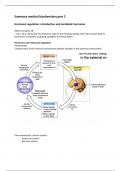
➢ Both systems communicate with each other
Types of cell-cell communication
Autocrine and paracrine> releasing substances that can be responded to
Synaptic action> A specialized form of paracrine (neurotransmitters)
Endocrine action> substances that are being released in the blood> can affect other cells at
long distance
Neuroendocrine action> is part of the endocrine system and can affect other cells at long
distances.
,Types of hormones
Transport of hormones
• Water soluble hormones circulate in free form in blood
• Lipid soluble hormones must attach to transport proteins synthesized by the liver
– Transport proteins improve transport by making hormones water-soluble
– Transport proteins prevent loss of hormones by filtration in the kidney
Another difference is signaling
Lipid soluble hormones can passively go into the cell
➢ They have intracellular or intranuclear receptors
, Hormone receptors
Steroids and steroid receptors
Hormone-bound steroid receptors are transcription factors that regulate gene expression in
a DNA sequence-specific manner
Response elements: The binding element of the sequences present in the promotors of
genes determine if a steroid can bind or not
Hormonal regulation: introduction and metabolic hormones
Martini Chapter 18
– 18-1, 18-2, 18-3 (only The Posterior Lobe of the Pituitary Gland), 18-8, 18-10 (until Role of
Hormones in Growth), including Spotlights & Clinical Notes
Hormones and endocrine regulation
Homeostasis
“maintenance of the internal environment despite changes in the external environment”
Two homeostatic control centers
- Endocrine system
- Nervous system
,The brain is part of the endocrine system and nervous system
➢ Both systems communicate with each other
Types of cell-cell communication
Autocrine and paracrine> releasing substances that can be responded to
Synaptic action> A specialized form of paracrine (neurotransmitters)
Endocrine action> substances that are being released in the blood> can affect other cells at
long distance
Neuroendocrine action> is part of the endocrine system and can affect other cells at long
distances.
,Types of hormones
Transport of hormones
• Water soluble hormones circulate in free form in blood
• Lipid soluble hormones must attach to transport proteins synthesized by the liver
– Transport proteins improve transport by making hormones water-soluble
– Transport proteins prevent loss of hormones by filtration in the kidney
Another difference is signaling
Lipid soluble hormones can passively go into the cell
➢ They have intracellular or intranuclear receptors
, Hormone receptors
Steroids and steroid receptors
Hormone-bound steroid receptors are transcription factors that regulate gene expression in
a DNA sequence-specific manner
Response elements: The binding element of the sequences present in the promotors of
genes determine if a steroid can bind or not