Med Surg: UTI - TestBank
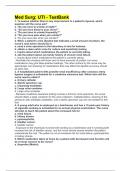
Med Surg: UTI - TestBank 1. To assess whether there is any improvement in a patient's dysuria, which question will the nurse ask? a. "Do you have to urinate at night?" b. "Do you have blood in your urine?" c. "Do you have to urinate frequently?" d. "Do you have pain when you urinate?" d. "Do you have pain when you urinate?" 2. When a patient's urine dipstick test indicates a small amount of protein, the nurse's next action should be to a. send a urine specimen to the laboratory to test for ketones. b. obtain a clean-catch urine for culture and sensitivity testing. c. inquire about which medications the patient is currently taking. d. ask the patient about any family history of chronic renal failure. c. inquire about which medications the patient is currently taking. - Normally the urinalysis will show zero to trace amounts of protein, but some medications may give false-positive readings. The other actions by the nurse may be appropriate, but checking for medications that may affect the dipstick accuracy should be done first. 3. A hospitalized patient with possible renal insufficiency after coronary artery bypass surgery is scheduled for a creatinine clearance test. Which item will the nurse need to obtain? a. Urinary catheter b. Sterile specimen cup c. Cleansing towelettes d. Large urine container d. Large urine container - Because creatinine clearance testing involves a 24-hour urine specimen, the nurse should obtain a large container for the urine collection. Catheterization, cleaning of the perineum with antiseptic towelettes, and a sterile specimen cup are not needed for this test. 4. A young adult who is employed as a hairdresser and has a 15 pack-year history of cigarette smoking is scheduled for an annual physical examination. The nurse will plan to teach the patient about the increased risk for a. renal failure. b. kidney stones. c. pyelonephritis. d. bladder cancer. d. bladder cancer. - Exposure to the chemicals involved with working as a hairdresser and in smoking both increase the risk of bladder cancer, and the nurse should assess whether the patient understands this risk. The patient is not at increased risk for renal failure, pyelonephritis, or kidney stones. 5. Which medication taken at home by a patient with decreased renal function will be of most concern to the nurse? a. ibuprofen (Motrin)

Geschreven voor
- Instelling
- Med Surg: UTI -
- Vak
- Med Surg: UTI -
Documentinformatie
- Geüpload op
- 20 juni 2023
- Aantal pagina's
- 11
- Geschreven in
- 2022/2023
- Type
- Tentamen (uitwerkingen)
- Bevat
- Vragen en antwoorden
Onderwerpen
-
med surg uti testbank 1 to assess whether ther

Ook beschikbaar in voordeelbundel