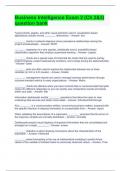
Business Intelligence Exam 2 (Ch 2&3) question bank
Typical charts, graphs, and other visual elements used in visualization-based applications usually involve ________ dimensions. - Answer- two ________ charts or network diagrams show precedence relationships among the project activities/tasks. - Answer- PERT ________ regression is a very popular, statistically sound, probability-based classification algorithm that employs supervised learning. - Answer- Logistic ________ charts are a special case of horizontal bar charts that are used to portray project timelines, project tasks/activity durations, and overlap among the tasks/activities. - Answer- Gantt ________ plots are often used to explore the relationship between two or three variables (in 2-D or 2-D visuals). - Answer- Scatter ________ management reports are used to manage business performance through outcome-oriented metrics in many organizations. - Answer- Metric ________ charts are effective when you have nominal data or numerical data that splits nicely into different categories so you can quickly see comparative results and trends within your data. - Answer- Bar Information dashboards enable ________ operations that allow the users to view underlying data sources and obtain more detail. - Answer- drill-down/drill-through A(n) ________ is a communication artifact, concerning business matters, prepared with the specific intention of relaying information in a presentable form. - Answer- report When validating the assumptions of a regression, ________ assumes that the errors of the response variable are normally distributed. - Answer- normality Dashboards present visual displays of important information that are consolidated and arranged on a single ________. - Answer- screen ________ statistics is about drawing conclusions about the characteristics of the population. - Answer- Inferential ________ series forecasting is the use of mathematical modeling to predict future values of the variable of interest based on previously observed values. - Answer- Time A(n) ________ data store (ODS) provides a fairly recent form of customer information file. - Answer- operational The ________ Model, also known as the data mart approach, is a "plan big, build small" approach. A data mart is a subject-oriented or department-oriented data warehouse. It is a scaled-down version of a data warehouse that focuses on the requests of a specific department, such as marketing or sales. - Answer- Kimball In ________ oriented data warehousing, operational databases are tuned to handle transactions that update the database. - Answer- product Given that the size of data warehouses is expanding at an exponential rate, ________ is an important issue. - Answer- scalability ________ describe the structure and meaning of the data, contributing to their effective use. - Answer- Metadata ________ is a mechanism for pulling data from source systems to satisfy a request for information. It is an evolving tool space that promises real-time data integration from a variety of sources, such as relational databases, Web services, and multidimensional databases. - Answer- Enterprise information integration (EII) A(n) ________ data mart is a subset that is created directly from the data warehouse.. - Answer- dependent The ________ data warehouse architecture involves integrating disparate systems and analytical resources from multiple sources to meet changing needs or business conditions. - Answer- federated Most data warehouses are built using ________ database management systems to control and manage the data. - Answer- relational ________ is a mechanism that integrates application functionality and shares functionality (rather than data) across systems, thereby enabling flexibility and reuse. - Answer- Enterprise application integration (EAI) Data ________ comprises data access, data federation, and change capture. - Answer- integration The three main types of data warehouses are data marts, operational ________, and enterprise data warehouses. - Answer- data stores The role responsible for successful administration and management of a data warehouse is the ________, who should be familiar with high-performance software, hardware, and networking technologies, and also possesses solid business insight. - Answer- data warehouse administrator (DWA) Online ________ is a term used for a transaction system that is primarily responsible for capturing and storing data related to day-to-day business functions such as ERP, CRM, SCM, and point of sale. - Answer- transaction processing ________ modeling is a retrieval-based system that supports high-volume query access. - Answer- Dimensional To respond to its market challenges, SiriusXM decided to focus on manufacturing efficiency. - Answer- False Visualization differs from traditional charts and graphs in complexity of data sets and use of multiple dimensions and measures. - Answer- True The data storage component of a business reporting system builds the various reports and hosts them for, or disseminates them to users. It also provides notification, annotation, collaboration, and other services. - Answer- False Google Maps has set new standards for data visualization with its intuitive Web mapping software. - Answer- True Interval data are variables that can be measured on interval scales. - Answer- True Data source reliability means that data are correct and are a good match for the analytics problem. - Answer- False Descriptive statistics is all about describing the sample data on hand. - Answer- True One of SiriusXM's challenges was tracking potential customers when cars were sold. - Answer- True Structured data is what data mining algorithms use and can be classified as categorical or numeric. - Answer- True Data is the main ingredient for any BI, data science, and business analytics initiative. - Answer- True When telling a story during a presentation, it is best to avoid describing hurdles that your character must overcome, to avoid souring the mood. - Answer- False Data is the contextualization of information, that is, information set in context. - Answer- False Dashboards provide visual displays of important information that is consolidated and arranged across several screens to maintain data order. - Answer- False Data accessibility means that the data are easily and readily obtainable. - Answer- True There are basic chart types and specialized chart types. A Gantt chart is a specialized chart type. - Answer- True Data warehouses are subsets of data marts. - Answer- False The data warehousing maturity model consists of six stages: prenatal, infant, child, teenager, adult, and sage. - Answer- True User-initiated navigation of data through disaggregation is referred to as "drill up." - Answer- False Without middleware, different BI programs cannot easily connect to the data warehouse. - Answer- True The "islands of data" problem in the 1980s describes the phenomenon of unconnected data being stored in numerous locations within an organization. - Answer- True OLTP systems are designed to handle ad hoc analysis and complex queries that deal with many data items. - Answer- False The BPM development cycle is essentially a one-shot process where the requirement is to get it right the first time. - Answer- False One way an operational data store differs from a data warehouse is the recency of their data. - Answer- True Properly integrating data from various databases and other disparate sources is a trivial process. - Answer- False The hub-and-spoke data warehouse model uses a centralized warehouse feeding dependent data marts. - Answer- True With the balanced scorecard approach, the entire focus is on measuring and managing specific financial goals based on the organization's strategy. - Answer- False With key performance indicators, driver KPIs have a significant effect on outcome KPIs, but the reverse is not necessarily true. - Answer- True Because the recession has raised interest in low-cost open source software, it is now set to replace traditional enterprise software. - Answer- False Because of performance and data quality issues, most experts agree that the federated architecture should supplement data warehouses, not replace them. - Answer- True Data warehouse administrators (DWAs) do not need strong business insight since they only handle the technical aspect of the infrastructure. - Answer- False Describe the difference between simple and multiple regression. - Answer- If the regression equation is built between one response variable and one explanatory variable, then it is called simple regression. Multiple regression is the extension of simple regression where the explanatory variables are more than one. According to Eckerson (2006), a well-known expert on BI dashboards, what are the three layers of information of a dashboard? - Answer- 1. Monitoring. Graphical, abstracted data to monitor key performance metrics.2. Analysis. Summarized dimensional data to analyze the root cause of problems.3. Management. Detailed operational data that identify what actions to take to resolve a problem. Describe the difference between descriptive and inferential statistics. - Answer- The main difference between descriptive and inferential statistics is the data used in these methods—whereas descriptive statistics is all about describing the sample data on hand, and inferential statistics is about drawing inferences or conclusions about the characteristics of the population. Describe categorical and nominal data. - Answer- Categorical data represent the labels of multiple classes used to divide a variable into specific groups. Examples of categorical variables include race, sex, age group, and educational level. Nominal data contain measurements of simple codes assigned to objects as labels, which are not measurements. For example, the variable marital status can be generally categorized as (1) single, (2) married, and (3) divorced. List and describe the three major categories of business reports. - Answer- Metric management reports. Many organizations manage business performance through outcome-oriented metrics. For external groups, these are service-level agreements (SLAs). For internal management, they are key performance indicators (KPIs). •Dashboard-type reports. This report presents a range of different performance indicators on one page, like a dashboard in a car. Typically, there is a set of predefined reports with static elements and fixed structure, but customization of the dashboard is allowed through widgets, views, and set targets for various metrics. •Balanced scorecard-type reports. This is a method developed by Kaplan and Norton that attempts to present an integrated view of success in an organization. In addition to financial performance, balanced scorecard-type reports also include customer, business process, and learning and growth perspectives. What is the definition of a data warehouse (DW) in simple terms? - Answer- In simple terms, a data warehouse (DW) is a pool of data produced to support decision making; it is also a repository of current and historical data of potential interest to managers throughout the organization. More data, coming in faster and requiring immediate conversion into decisions, means that organizations are confronting the need for real-time data warehousing (RDW). How would you define real-time data warehousing? - Answer- Real-time data warehousing, also known as active data warehousing (ADW), is the process of loading and providing data via the data warehouse as they become available. What is the definition of a data mart? - Answer- A data mart is a subset of a data warehouse, typically consisting of a single subject area (e.g., marketing, operations). Whereas a data warehouse combines databases across an entire enterprise, a data mart is usually smaller and focuses on a particular subject or department. What are the four processes that define a closed-loop BPM cycle? - Answer- 1. Strategize: This is the process of identifying and stating the organization's mission, vision, and objectives, and developing plans (at different levels of granularity—strategic, tactical and operational) to achieve these objectives.2. Plan: When operational managers know and understand the what (i.e., the organizational objectives and goals), they will be able to come up with the how (i.e., detailed operational and financial plans). Operational and financial plans answer two questions: What tactics and initiatives will be pursued to meet the performance targets established by the strategic plan? What are the expected financial results of executing the tactics?3. Monitor/Analyze: When the operational and financial plans are underway, it is imperative that the performance of the organization be monitored. A comprehensive framework for monitoring performance should address two key issues: what to monitor and how to monitor.4. Act and Adjust: What do we need to do differently? Whether a company is interested in growing its business or simply improving its operations, virtually all strategies depend on new projects—creating new products, entering new markets, acquiring new customers or businesses, or streamlining some processes. The final part of this loop is taking action and adjusting current actions based on analysis of problems and opportunities. Six Sigma rests on a simple performance improvement model known as DMAIC. What are the steps involved? - Answer- 1. Define. Define the goals, objectives, and boundaries of the improvement activity. At the top level, the goals are the strategic objectives of the company. At lower levels—department or project levels—the goals are focused on specific operational processes.2. Measure. Measure the existing system. Establish quantitative measures that will yield statistically valid data. The data can be used to monitor progress toward the goals defined in the previous step.3. Analyze. Analyze the system to identify ways to eliminate the gap between the current performance of the system or process and the desired goal.4. Improve. Initiate actions to eliminate the gap by finding ways to do things better, cheaper, or faster. Use project management and other planning tools to implement the new approach.5. Control. Institutionalize the improved system by modifying compensation and incentive systems, policies, procedures, manufacturing resource planning, budgets, operation instructions, or other management systems. When you tell a story in a presentation, all of the following are true EXCEPT - Answer- a well-told story should have no need for subsequent discussion. This technique makes no a priori assumption of whether one variable is dependent on the other(s) and is not concerned with the relationship between variables; instead it gives an estimate on the degree of association between the variables. - Answer- correlation This measure of central tendency is the sum of all the values/observations divided by the number of observations in the data set. - Answer- arithmetic mean Which characteristic of data means that all the required data elements are included in the data set? - Answer- data richness Which type of visualization tool can be very helpful when a data set contains location data? - Answer- geographic map Which type of visualization tool can be very helpful when the intention is to show relative proportions of dollars per department allocated by a university administration? - Answer- pie chart Which type of question does visual analytics seeks to answer? - Answer- Why is it happening? Benefits of the latest visual analytics tools, such as SAS Visual Analytics, include all of the following EXCEPT - Answer- they explore massive amounts of data in hours, not days. The Internet emerged as a new medium for visualization and brought all the following EXCEPT - Answer- new forms of computation of business logic. Which characteristic of data requires that the variables and data values be defined at the lowest (or as low as required) level of detail for the intended use of the data? - Answer- data granularity This plot is a graphical illustration of several descriptive statistics about a given data set. - Answer- box-and-whiskers plot Dashboards can be presented at all the following levels EXCEPT - Answer- the visual cube level. What is the management feature of a dashboard? - Answer- operational data that identify what actions to take to resolve a problem Key performance indicators (KPIs) are metrics typically used to measure - Answer- internal results. What is the fundamental challenge of dashboard design? - Answer- ensuring that the required information is shown clearly on a single screen This measure of dispersion is calculated by simply taking the square root of the variations. - Answer- standard deviation Which kind of chart is described as an enhanced version of a scatter plot? - Answer- bubble chart Why is a performance management system superior to a performance measurement system? - Answer- because measurement alone has little use without action How does the use of cloud computing affect the scalability of a data warehouse? - Answer- Hardware resources are dynamically allocated as use increases. Which of the following BEST enables a data warehouse to handle complex queries and scale up to handle many more requests? - Answer- parallel processing Which data warehouse architecture uses metadata from existing data warehouses to create a hybrid logical data warehouse comprised of data from the other warehouses? - Answer- federated architecture When representing data in a data warehouse, using several dimension tables that are each connected only to a fact table means you are using which warehouse structure? - Answer- star schema Data warehouses provide direct and indirect benefits to organizations. Which of the following is an indirect benefit of data warehouses? - Answer- improved customer service Oper marts are created when operational data needs to be analyzed - Answer- multidimensionally. ________ is an evolving tool space that promises real-time data integration from a variety of sources, such as relational databases, Web services, and multidimensional databases. - Answer- Enterprise information integration (EII) Operational or transaction databases are product oriented, handling transactions that update the database. In contrast, data warehouses are - Answer- subject-oriented and nonvolatile. In which stage of extraction, transformation, and load (ETL) into a data warehouse are anomalies detected and corrected? - Answer- cleanse Which data warehouse architecture uses a normalized relational warehouse that feeds multiple data marts? - Answer- hub-and-spoke data warehouse architecture When querying a dimensional database, a user went from summarized data to its underlying details. The function that served this purpose is - Answer- drill down. Which kind of data warehouse is created separately from the enterprise data warehouse by a department and not reliant on it for updates? - Answer- independent data mart A large storage location that can hold vast quantities of data (mostly unstructured) in its native/raw format for future/potential analytics consumption is referred to as a(n) - Answer- data lake. A Web client that connects to a Web server, which is in turn connected to a BI application server, is reflective of a - Answer- three

Geschreven voor
- Instelling
- Business Intelligence
- Vak
- Business Intelligence
Documentinformatie
- Geüpload op
- 30 mei 2023
- Aantal pagina's
- 9
- Geschreven in
- 2022/2023
- Type
- Tentamen (uitwerkingen)
- Bevat
- Vragen en antwoorden
Onderwerpen
-
typical charts
-
graphs
-
business intelligence exam 2 ch 2amp3 question bank
-
and other visual elements used in visualization based applications usually involve dimensions
-
charts

Ook beschikbaar in voordeelbundel