CHAPTER 1
‘Field problem’ is a situation in reality, which in the view of some influential stakeholders can
or should be improved.
This book focuses on design-oriented and theory-informed problem solving in organizations.
The problem solving methodology focuses on:
the design of the solution for the business problem,
the design of the change process needed to realize the solution in new or adapted
roles and procedures, and
the analyses needed to make those designs.
Process knowledge is the knowledge of approaches and methods to be used in the analysis
and design of business solutions and change plans, from problem definition to decision-
making on proposed solutions.
‘Theory-informed’ in filed problem solving means:
1. Comprehensive - Based on a systematic review of existing literature
2. Critical - Judge value and limitations of existing literature
3. Creative - Not simply use literature, but aim to build upon it
CHAPTER 2
Two main research paradigms exist in this book, namely:
Explanatory paradigm (empirical cycle)
Design science paradigm (regulative cycle)
Explanatory paradigm aims to produce descriptive and explanatory knowledge (refers to the
empirical cycle), whilst the design science paradigm aims to produce solutions to field
problems (refers to the regulative cycle).
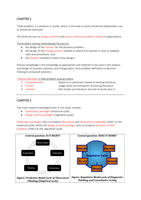
Central question: IS IT RIGHT? Central question: DOES IT WORK?
Figure: Predictive Model Cycle of Theoretical Figure: Regulative Model cycle of Diagnostic
Thinking (Empirical cycle) Thinking and Consultative Acting
,Figure 1 Another visualization of the empirical cycle.
Empirical cycle
1. Observation - Focus on a certain type of business phenomenon in the real
world and on what has been written about it in the academic
literature.
2. Induction - Possible explanations for the issue are developed. It is a theory-
developing step, in which one goes from specific observation to
a general theory, e.g. in a pond, the swans are all white,
therefore, all swans are white.
3. Theory - Based on the observations, one has developed a general theory.
4. Deduction - Most promising ideas of the induction step are transformed into
hypotheses: statements that can be verified by empirical
observation and measurement. The induction step provides a
general theory, e.g. all swans are white, which can be observed
and measured in different ponds.
5. Hypotheses - Based on the theory, deduction can transform the theory in
hypotheses.
6. Testing - Testing hypotheses empirically, is typically done through
statistical techniques.
7. Results - Testing hypotheses through statistical techniques provide
results, such as a correlation between two variables.
8. Evaluation - Outcomes of the empirical test are examined and interpreted.
This may lead to a new research question and a rerun of the
empirical cycle, e.g. in another pond one may also find one black
swan. Therefore, the new observation and induction leads to all
swans are black or white.
, Problem
definition
Learning and Analysis and
evaluation diagnosis
Problem
Mess
Solution
Intervention
design
Regulative cycle
1. Problem definition - Structuring the problem mess, resulting in a problem
definition.
2. Analysis and - Problem and its context are analyzed and the causes of
diagnosis the problem established as far as possible.
3. Solution design - After identifying and validating the important causes, a
solution can be designed. Done by tackling the most
important causes. Also, the design of the
implementation is addressed.
4. Intervention - Solution to the business problem is implemented on the
basis of actions conceived in the design step.
5. Evaluation - Effects of implementation are assessed.
Differences (two cycles do not exclude each other, but they are complementary)
Empirical cycle Regulative cycle
Explanatory Acting/performing
Descriptive Solution to the field problem
Theory-driven Design-driven
Predictive (what will be/wat zal zijn) Normative (what must be/wat zou
Researcher is spectator moeten)
(toeschouwend) Researcher is participator
(deelnemend)
,
‘Field problem’ is a situation in reality, which in the view of some influential stakeholders can
or should be improved.
This book focuses on design-oriented and theory-informed problem solving in organizations.
The problem solving methodology focuses on:
the design of the solution for the business problem,
the design of the change process needed to realize the solution in new or adapted
roles and procedures, and
the analyses needed to make those designs.
Process knowledge is the knowledge of approaches and methods to be used in the analysis
and design of business solutions and change plans, from problem definition to decision-
making on proposed solutions.
‘Theory-informed’ in filed problem solving means:
1. Comprehensive - Based on a systematic review of existing literature
2. Critical - Judge value and limitations of existing literature
3. Creative - Not simply use literature, but aim to build upon it
CHAPTER 2
Two main research paradigms exist in this book, namely:
Explanatory paradigm (empirical cycle)
Design science paradigm (regulative cycle)
Explanatory paradigm aims to produce descriptive and explanatory knowledge (refers to the
empirical cycle), whilst the design science paradigm aims to produce solutions to field
problems (refers to the regulative cycle).
Central question: IS IT RIGHT? Central question: DOES IT WORK?
Figure: Predictive Model Cycle of Theoretical Figure: Regulative Model cycle of Diagnostic
Thinking (Empirical cycle) Thinking and Consultative Acting
,Figure 1 Another visualization of the empirical cycle.
Empirical cycle
1. Observation - Focus on a certain type of business phenomenon in the real
world and on what has been written about it in the academic
literature.
2. Induction - Possible explanations for the issue are developed. It is a theory-
developing step, in which one goes from specific observation to
a general theory, e.g. in a pond, the swans are all white,
therefore, all swans are white.
3. Theory - Based on the observations, one has developed a general theory.
4. Deduction - Most promising ideas of the induction step are transformed into
hypotheses: statements that can be verified by empirical
observation and measurement. The induction step provides a
general theory, e.g. all swans are white, which can be observed
and measured in different ponds.
5. Hypotheses - Based on the theory, deduction can transform the theory in
hypotheses.
6. Testing - Testing hypotheses empirically, is typically done through
statistical techniques.
7. Results - Testing hypotheses through statistical techniques provide
results, such as a correlation between two variables.
8. Evaluation - Outcomes of the empirical test are examined and interpreted.
This may lead to a new research question and a rerun of the
empirical cycle, e.g. in another pond one may also find one black
swan. Therefore, the new observation and induction leads to all
swans are black or white.
, Problem
definition
Learning and Analysis and
evaluation diagnosis
Problem
Mess
Solution
Intervention
design
Regulative cycle
1. Problem definition - Structuring the problem mess, resulting in a problem
definition.
2. Analysis and - Problem and its context are analyzed and the causes of
diagnosis the problem established as far as possible.
3. Solution design - After identifying and validating the important causes, a
solution can be designed. Done by tackling the most
important causes. Also, the design of the
implementation is addressed.
4. Intervention - Solution to the business problem is implemented on the
basis of actions conceived in the design step.
5. Evaluation - Effects of implementation are assessed.
Differences (two cycles do not exclude each other, but they are complementary)
Empirical cycle Regulative cycle
Explanatory Acting/performing
Descriptive Solution to the field problem
Theory-driven Design-driven
Predictive (what will be/wat zal zijn) Normative (what must be/wat zou
Researcher is spectator moeten)
(toeschouwend) Researcher is participator
(deelnemend)
,