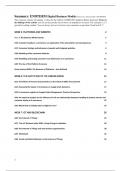
Summary: ENDTERM Digital Business Models University of Amsterdam: 6013B0504Y
This summary contains all readings + videos for the endterm of DBM 2023 taught by Balazs Szatsmari. Focus on
the findings of the articles (you do not necessarily need to know all hypotheses by heart). The summary is 1.5
spaced for reading comfort. You can always text me if you have any comments or questions! Good luck ☺ !!!
WEEK 5: PLATFORMS AND WEBSITES 2
V1 + 2: The Business Model Canvas 2
A16: Customer loyalty in e-commerce: an exploration of its antecedents and consequences. 4
A17: Consumer feelings and behaviours towards well designed websites. 6
A18: Modeling online consumer behavior 8
A19: Modelling and testing consumer trust dimensions in e-commerce. 11
A20: The rise of the Platform Economy 12
Guest Lecture 08/05: The Business of Platforms - Jens Heitland 14
WEEK 6: THE SUPPLY SIDE OF THE CANVAS MODEL 15
A21: The Effects of Process Characteristics on the Value of B2B E-Procurement 15
A22: Assessing the impact of e-business on supply chain dynamics. 17
A23: E-commerce Logistics in Supply Chain Management: Practice Perspective. 19
A24: An empirical analysis on the influence of risk on relationships between handling of product returns and
customer loyalty in E-commerce. 22
A25: Which kind of Collaboration is Right for You? 24
WEEK 7: IOT AND BLOCKCHAIN 26
A26: The Internet of Things 26
A27: The IoT Business Index 2020: a Step Change in Adoption 28
A28: The Internet of Things and new business opportunities 30
A29: Blockchain 32
A30: Social and Ethical Behavior in the Internet of Things 34
1
, Week 5: Platforms and Websites
V1 + 2: The Business Model Canvas
Osterwalder, A. (2012). https://www.youtube.com/watch?v=8GIbCg8NpBw
Blah blah blah Phenomenon = smart people using a lot of words, but not understanding each
other. → When it comes to business models: Words are not enough.
- We need a shared, visual language that allows us to sketch out business models.
An organization’s business model can be described with 9 basic building blocks → mapped
out in one pre-structured canvas to see how they all fit together → Business model Canvas:
tool that helps you map, discuss, design, and invent new business models.
On the left-hand side: On the right-hand side:
back stage that enables front stage related to
the front stage. the customer.
https://www.youtube.com/watch?v=2FumwkBMhLo&t=9s
DEMAND SIDE
1. Customer Segments – all the people / organizations for which you are creating value.
2. Value Proposition – the bundles of products and services which create value for your customers.
3. Channels – through which touchpoints you’re interacting with customers and delivering value.
4. Customer Relationships – outline the type of relationships you’re establishing with your customers.
5. Revenue Streams – make clear how and through which pricing mechanisms your business model
is capturing value.
2
,SUPPLY SIDE
6. Key Resources – the infrastructure to create, deliver, and capture value.
o Show which assets are indispensable in our business model.
7. Key Activities – show which things you really need to be able to perform well.
8. Key Partnerships – show who can help you leverage your business model.
o You will not own all key resources/perform all key activities yourself.
9. Cost Structure – describes the costs that business occurs through its operations.
Business Model Canvas – The Basics
- You never write on a canvas.
- For every building block: use a Post-It Note.
o Mobility: “you can put it up, you can discuss, you can put it down”
o E.g., taking away one post-It: what is the impact on the rest of the model?
Example: Nespresso gets consumers to pay 600 to 800% more for home coffee.
- In a commodities business. How?
o Nespresso almost failed in 1987 due to nonperforming business model.
▪ Same product/technology: but BM did not work.
o Nespresso changed the business model for espresso.
▪ First to invent single portion coffee – machines + aluminum pods.
▪ Recurring revenues: You can buy the machines everywhere, but you can only
buy the pods from them (patents are important key resource).
• Want to switch? Need to buy a new machine: high switching cost.
▪ Very high-end brand (expensive): cannot establish this only through the
internet. → Physical stores important as well.
o Results: one of the fastest growing businesses in the Nestlé group.
https://www.youtube.com/watch?v=o1RBSPEKqYU → Watch this if you would like to see
how Osterwalder fills in the BM Canvas for Nespresso.
3
, A16: Customer loyalty in e-commerce: an exploration of its antecedents and consequences.
Srinivasan, S. S., Anderson, R., & Ponnavolu, K. (2002). Journal of Retailing, 78(1), 41–50.
This paper investigates the antecedents and consequences of customer loyalty in an online business-to-consumer
(B2C) context. Eight factors (the 8Cs—customization, contact interactivity, care, community, convenience,
cultivation, choice, and character) potentially impact e-loyalty. Findings: all these factors, except convenience,
impact e-loyalty. E-loyalty has an impact on two customer-related outcomes: word-of- mouth promotion and
willingness to pay more.
Customer Loyalty: E-loyalty = a customer’s favorable attitude toward the e-retailer that
results in repeat buying behavior.
The Antecedents of E-Loyalty: 8 e-business factors that potentially positively impact e-loyalty.
1. Customization = the ability of an e-retailer to tailor products, services, and the
transactional environment to individual customers.
- Operational Definition: The extent to which an e-retailer’s web site can recognize a customer and
then tailor the choice of products, services, and shopping experience for that customer.
2. Contact Interactivity = the dynamic nature of the engagement that occurs between an e-
retailer and its customers through its website.
- OD: The availability and effectiveness of customer support tools on a website, and the degree to
which two-way communication with customers is facilitated.
3. Cultivation = the extent to which an e-retailer provides relevant information and
incentives to its customers to extend the breadth and depth of their purchases over time.
- OD: the frequency of desired information and cross-selling offers that an e-retailer provides to
customers.
4. Care = the attention that an e-retailer pays to all the pre- and post-purchase customer
interface activities designed to facilitate both immediate transactions and long-term
customer relationships.
- OD: the extent to which a customer is kept informed about the availability of preferred products
and the status of orders, and the level of efforts expended to minimize disruptions in providing
desired services.
5. Community = an online social entity comprised of existing and potential customers that is
organized and maintained by an e-retailer to facilitate the exchange of opinions and
information regarding offered products and services.
- OD: the extent to which customers are provided with the opportunity and ability to share opinions
among themselves through comment links, buying circles, and chat rooms sponsored by the e-
retailer.
4
This summary contains all readings + videos for the endterm of DBM 2023 taught by Balazs Szatsmari. Focus on
the findings of the articles (you do not necessarily need to know all hypotheses by heart). The summary is 1.5
spaced for reading comfort. You can always text me if you have any comments or questions! Good luck ☺ !!!
WEEK 5: PLATFORMS AND WEBSITES 2
V1 + 2: The Business Model Canvas 2
A16: Customer loyalty in e-commerce: an exploration of its antecedents and consequences. 4
A17: Consumer feelings and behaviours towards well designed websites. 6
A18: Modeling online consumer behavior 8
A19: Modelling and testing consumer trust dimensions in e-commerce. 11
A20: The rise of the Platform Economy 12
Guest Lecture 08/05: The Business of Platforms - Jens Heitland 14
WEEK 6: THE SUPPLY SIDE OF THE CANVAS MODEL 15
A21: The Effects of Process Characteristics on the Value of B2B E-Procurement 15
A22: Assessing the impact of e-business on supply chain dynamics. 17
A23: E-commerce Logistics in Supply Chain Management: Practice Perspective. 19
A24: An empirical analysis on the influence of risk on relationships between handling of product returns and
customer loyalty in E-commerce. 22
A25: Which kind of Collaboration is Right for You? 24
WEEK 7: IOT AND BLOCKCHAIN 26
A26: The Internet of Things 26
A27: The IoT Business Index 2020: a Step Change in Adoption 28
A28: The Internet of Things and new business opportunities 30
A29: Blockchain 32
A30: Social and Ethical Behavior in the Internet of Things 34
1
, Week 5: Platforms and Websites
V1 + 2: The Business Model Canvas
Osterwalder, A. (2012). https://www.youtube.com/watch?v=8GIbCg8NpBw
Blah blah blah Phenomenon = smart people using a lot of words, but not understanding each
other. → When it comes to business models: Words are not enough.
- We need a shared, visual language that allows us to sketch out business models.
An organization’s business model can be described with 9 basic building blocks → mapped
out in one pre-structured canvas to see how they all fit together → Business model Canvas:
tool that helps you map, discuss, design, and invent new business models.
On the left-hand side: On the right-hand side:
back stage that enables front stage related to
the front stage. the customer.
https://www.youtube.com/watch?v=2FumwkBMhLo&t=9s
DEMAND SIDE
1. Customer Segments – all the people / organizations for which you are creating value.
2. Value Proposition – the bundles of products and services which create value for your customers.
3. Channels – through which touchpoints you’re interacting with customers and delivering value.
4. Customer Relationships – outline the type of relationships you’re establishing with your customers.
5. Revenue Streams – make clear how and through which pricing mechanisms your business model
is capturing value.
2
,SUPPLY SIDE
6. Key Resources – the infrastructure to create, deliver, and capture value.
o Show which assets are indispensable in our business model.
7. Key Activities – show which things you really need to be able to perform well.
8. Key Partnerships – show who can help you leverage your business model.
o You will not own all key resources/perform all key activities yourself.
9. Cost Structure – describes the costs that business occurs through its operations.
Business Model Canvas – The Basics
- You never write on a canvas.
- For every building block: use a Post-It Note.
o Mobility: “you can put it up, you can discuss, you can put it down”
o E.g., taking away one post-It: what is the impact on the rest of the model?
Example: Nespresso gets consumers to pay 600 to 800% more for home coffee.
- In a commodities business. How?
o Nespresso almost failed in 1987 due to nonperforming business model.
▪ Same product/technology: but BM did not work.
o Nespresso changed the business model for espresso.
▪ First to invent single portion coffee – machines + aluminum pods.
▪ Recurring revenues: You can buy the machines everywhere, but you can only
buy the pods from them (patents are important key resource).
• Want to switch? Need to buy a new machine: high switching cost.
▪ Very high-end brand (expensive): cannot establish this only through the
internet. → Physical stores important as well.
o Results: one of the fastest growing businesses in the Nestlé group.
https://www.youtube.com/watch?v=o1RBSPEKqYU → Watch this if you would like to see
how Osterwalder fills in the BM Canvas for Nespresso.
3
, A16: Customer loyalty in e-commerce: an exploration of its antecedents and consequences.
Srinivasan, S. S., Anderson, R., & Ponnavolu, K. (2002). Journal of Retailing, 78(1), 41–50.
This paper investigates the antecedents and consequences of customer loyalty in an online business-to-consumer
(B2C) context. Eight factors (the 8Cs—customization, contact interactivity, care, community, convenience,
cultivation, choice, and character) potentially impact e-loyalty. Findings: all these factors, except convenience,
impact e-loyalty. E-loyalty has an impact on two customer-related outcomes: word-of- mouth promotion and
willingness to pay more.
Customer Loyalty: E-loyalty = a customer’s favorable attitude toward the e-retailer that
results in repeat buying behavior.
The Antecedents of E-Loyalty: 8 e-business factors that potentially positively impact e-loyalty.
1. Customization = the ability of an e-retailer to tailor products, services, and the
transactional environment to individual customers.
- Operational Definition: The extent to which an e-retailer’s web site can recognize a customer and
then tailor the choice of products, services, and shopping experience for that customer.
2. Contact Interactivity = the dynamic nature of the engagement that occurs between an e-
retailer and its customers through its website.
- OD: The availability and effectiveness of customer support tools on a website, and the degree to
which two-way communication with customers is facilitated.
3. Cultivation = the extent to which an e-retailer provides relevant information and
incentives to its customers to extend the breadth and depth of their purchases over time.
- OD: the frequency of desired information and cross-selling offers that an e-retailer provides to
customers.
4. Care = the attention that an e-retailer pays to all the pre- and post-purchase customer
interface activities designed to facilitate both immediate transactions and long-term
customer relationships.
- OD: the extent to which a customer is kept informed about the availability of preferred products
and the status of orders, and the level of efforts expended to minimize disruptions in providing
desired services.
5. Community = an online social entity comprised of existing and potential customers that is
organized and maintained by an e-retailer to facilitate the exchange of opinions and
information regarding offered products and services.
- OD: the extent to which customers are provided with the opportunity and ability to share opinions
among themselves through comment links, buying circles, and chat rooms sponsored by the e-
retailer.
4