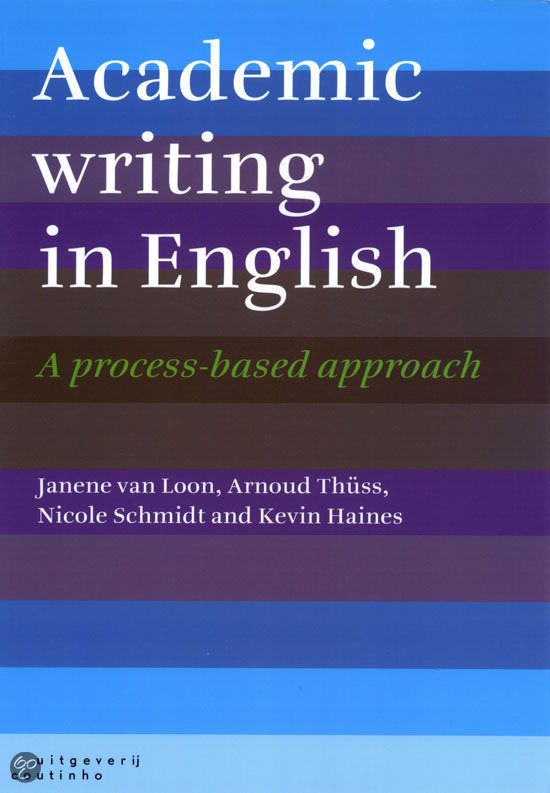
Academic writing in English: A process based approach
Ch1: Introduction to academic writing
Each paper needs to have an introduction, a main body and a conclusion. The main idea of an
academic article is contained in the last sentence of the introduction. This is the thesis
statement, problem statement, research question or hypothesis, depending on the type of
text one is writing. In the main body, the arguments are arranged in paragraphs in a logical
order. There are several types of academic paper: the expository essay, the argumentative
essay, the scientific article and the investigative business report.
What one should watch out for when writing an academic article is plagiarism. Plagiarism is
when the original ideas of authors are used without proper referencing. It can happen in four
cases:
Failure to cite source
Failure to mention the source with a quotation or paraphrase
Failure to correctly identify a quotation by using quotation marks
Failure to use your own words when paraphrasing
Ch2: Pre-writing and the rhetorical situation
The scope of a paper suggests the amount of detail that will be covered from beginning to
end. A topic sentence is the first word of each paragraph. It tells the reader what the
paragraph is about.
A written message can be conveyed in many ways. The factors which shape a text, such as
purpose, audience, genre register and style are known as rhetorical devices. A rhetorical
situation is created when these factors are combined to make the author’s message effective.
This situation can be described by answering the following questions:
1. Why has the text been written?
2. Who will read the text?
3. Which structure and format will the text include?
4. How will the message of the text be communicated?
Purpose is the reason for writing. Genre is the kind of text that should be produced based on
looking at the purpose and audience. The social context in which the text is used will
determine which register, or choice of language, is most appropriate. Some of the
characteristics of formal register are:
- Depersonalisation; passive, third person, without emotion or judgement.
- Avoiding sarcasm, irony, exaggeration or unsuitable humour.
- Using cautious, tentative language.
- Adopting a formal style of language.
Peer feedback of a paper might include directive feedback (a kind of commentary in which a
specific change is suggested), praise (a clear and positive description of part of a paper) and
summary comments (the review of the main points of a text without offering suggestions).
Ch1: Introduction to academic writing
Each paper needs to have an introduction, a main body and a conclusion. The main idea of an
academic article is contained in the last sentence of the introduction. This is the thesis
statement, problem statement, research question or hypothesis, depending on the type of
text one is writing. In the main body, the arguments are arranged in paragraphs in a logical
order. There are several types of academic paper: the expository essay, the argumentative
essay, the scientific article and the investigative business report.
What one should watch out for when writing an academic article is plagiarism. Plagiarism is
when the original ideas of authors are used without proper referencing. It can happen in four
cases:
Failure to cite source
Failure to mention the source with a quotation or paraphrase
Failure to correctly identify a quotation by using quotation marks
Failure to use your own words when paraphrasing
Ch2: Pre-writing and the rhetorical situation
The scope of a paper suggests the amount of detail that will be covered from beginning to
end. A topic sentence is the first word of each paragraph. It tells the reader what the
paragraph is about.
A written message can be conveyed in many ways. The factors which shape a text, such as
purpose, audience, genre register and style are known as rhetorical devices. A rhetorical
situation is created when these factors are combined to make the author’s message effective.
This situation can be described by answering the following questions:
1. Why has the text been written?
2. Who will read the text?
3. Which structure and format will the text include?
4. How will the message of the text be communicated?
Purpose is the reason for writing. Genre is the kind of text that should be produced based on
looking at the purpose and audience. The social context in which the text is used will
determine which register, or choice of language, is most appropriate. Some of the
characteristics of formal register are:
- Depersonalisation; passive, third person, without emotion or judgement.
- Avoiding sarcasm, irony, exaggeration or unsuitable humour.
- Using cautious, tentative language.
- Adopting a formal style of language.
Peer feedback of a paper might include directive feedback (a kind of commentary in which a
specific change is suggested), praise (a clear and positive description of part of a paper) and
summary comments (the review of the main points of a text without offering suggestions).