Alternative Perspectives in
Economics 2022/23
Week 2:
Lecture 1 – Schools of Economic Thought
Introduction
• No single way of doing economics
• Orthodox (or mainstream) view based on neoclassical economics
• Various schools of non-neoclassical thought critical of the neoclassical approach
• Alternatives to orthodoxy are often grouped together as heterodox economics
Progression of Economic Thought
• Orthodox view: Linear progression (Classical → Neoclassical → Mainstream)
Implication: Later schools of thought replace earlier ones (theoretical monism)
• Heterodox view: No unique linear progression
Implication: Schools of thought can coexist (theoretical pluralism)
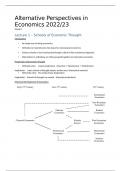
Historical Development of Economics
Early 19th Century Late 19th century 20 th century
Institutional
Economics
Neo-Ricardian
Economics
Marxian Radical
Economics Economics
Classical Economics Kalecki Post Keynesian
Keynes Economics
Neoclassical Mainstream
Economics Economics
Austrian
Economics
,Classical Economics
Prime focus of interest is economic growth and development, which depends on investment by
profit recipients and hence on the factor distribution of income between profit, rent and wages.
• e.g. Smith, Ricardo, J.S. Mill
• Prime focus of interest is economic growth and development
• Development depends on investment by profit recipients
• Profits depend on the factor distribution of income between profit, rent and wages.
• A permanent surplus is present (implying market power), ensuring regular profits and
investment
Neoclassical Economics
Main concern is with resource allocation, rather than economic growth or development. Theory
begins with rational economic agents, not economic classes, and relates agents to each other
through market clearing equilibria. Claims to have universal relevance.
• e.g. Jevons, Marshall, Walras
• Main concern is with resource allocation, rather than economic growth or development.
• Theory begins with rational economic agents, not economic classes, and relates agents to
each other through market clearing equilibria.
• Stress on micro rather than macro issues
• Claims to have universal relevance.
Mainstream Economics
Rests on neoclassical foundations (individualism, instrumental rationality, market clearing
equilibrium), but with many elaborations, often taking the form of market imperfections and
failures. Neoclassical core remains intact as the universal starting point and benchmark.
• e.g any orthodox textbook
• Rests on neoclassical foundations (individualism, instrumental rationality, market clearing
equilibrium)
• Adds various elaborations, often taking the form of market imperfections and failures.
• Neoclassical core remains intact as the universal starting point and benchmark.
Marxian Economics
Strong classical foundations, e.g. in importance of factor shares and reliance on a labour theory of
value. Adopts a historical and dialectical approach, founded on class conflicts. Growth and
development are emphasised, but subject to chronic instability and crises.
• e.g. Marx, Engels
• Strong classical foundations, e.g. in importance of factor shares and reliance on a labour
theory of value.
, • Adopts a historical and dialectical approach, founded on class conflicts.
• Anti-capitalist in attitude.
• Growth and development are emphasised, but subject to chronic instability and crises.
Radical Economics
Centred mainly on modern developments of Marxian economics, e.g. the monopoly capital
approach, regulation theory and the social structures of accumulation model. Other strands draw
from Post Keynesian and institutional economics.
• e.g. Gordon, Sherman, Weisskopf
• Centred mainly on modern developments of Marxian economics.
• Prominent examples are the monopoly capital approach, regulation theory and the social
structures of accumulation model.
• Other strands draw from Post Keynesian and institutional economics.
Post Keynesian Economics
• e.g. Robinson, Kaldor, Davidson
• Based largely on Keynes’s writings, especially his beliefs about uncertainty and money.
• Rejects mainstream interpretations of Keynes (e.g. the neoclassical synthesis and New
Keynesian economics).
• Another major source is the work of Kalecki, stressing factor shares and monopoly power
(sometimes classified separately as Kaleckian economics).
Sraffian (neo-Ricardian) Economics
Stemming from the work of Sraffa, it attempts to revive classical (Ricardian) economics as an
alternative to the neoclassical mainstream. Also critical of many Marxian doctrines, notably the
labour theory of value.
• e.g. Sraffa
• Stems from the work of Sraffa in formalising and adapting Ricardo’s ideas.
• Main objective is to revive classical (Ricardian) economics as an alternative to the
neoclassical mainstream.
• Also critical of many Marxian doctrines, notably the labour theory of value.
Institutional Economics
Developed in USA mainly as a reaction against neoclassical economics, and influenced by non-
economic disciplines. Key ideas are the importance of culture and institutions, the endogeneity of
preferences and the principle of cumulative causation. Suspicious of mathematical formalism in
economics.
• e.g. Veblen, Commons, Mitchell
Economics 2022/23
Week 2:
Lecture 1 – Schools of Economic Thought
Introduction
• No single way of doing economics
• Orthodox (or mainstream) view based on neoclassical economics
• Various schools of non-neoclassical thought critical of the neoclassical approach
• Alternatives to orthodoxy are often grouped together as heterodox economics
Progression of Economic Thought
• Orthodox view: Linear progression (Classical → Neoclassical → Mainstream)
Implication: Later schools of thought replace earlier ones (theoretical monism)
• Heterodox view: No unique linear progression
Implication: Schools of thought can coexist (theoretical pluralism)
Historical Development of Economics
Early 19th Century Late 19th century 20 th century
Institutional
Economics
Neo-Ricardian
Economics
Marxian Radical
Economics Economics
Classical Economics Kalecki Post Keynesian
Keynes Economics
Neoclassical Mainstream
Economics Economics
Austrian
Economics
,Classical Economics
Prime focus of interest is economic growth and development, which depends on investment by
profit recipients and hence on the factor distribution of income between profit, rent and wages.
• e.g. Smith, Ricardo, J.S. Mill
• Prime focus of interest is economic growth and development
• Development depends on investment by profit recipients
• Profits depend on the factor distribution of income between profit, rent and wages.
• A permanent surplus is present (implying market power), ensuring regular profits and
investment
Neoclassical Economics
Main concern is with resource allocation, rather than economic growth or development. Theory
begins with rational economic agents, not economic classes, and relates agents to each other
through market clearing equilibria. Claims to have universal relevance.
• e.g. Jevons, Marshall, Walras
• Main concern is with resource allocation, rather than economic growth or development.
• Theory begins with rational economic agents, not economic classes, and relates agents to
each other through market clearing equilibria.
• Stress on micro rather than macro issues
• Claims to have universal relevance.
Mainstream Economics
Rests on neoclassical foundations (individualism, instrumental rationality, market clearing
equilibrium), but with many elaborations, often taking the form of market imperfections and
failures. Neoclassical core remains intact as the universal starting point and benchmark.
• e.g any orthodox textbook
• Rests on neoclassical foundations (individualism, instrumental rationality, market clearing
equilibrium)
• Adds various elaborations, often taking the form of market imperfections and failures.
• Neoclassical core remains intact as the universal starting point and benchmark.
Marxian Economics
Strong classical foundations, e.g. in importance of factor shares and reliance on a labour theory of
value. Adopts a historical and dialectical approach, founded on class conflicts. Growth and
development are emphasised, but subject to chronic instability and crises.
• e.g. Marx, Engels
• Strong classical foundations, e.g. in importance of factor shares and reliance on a labour
theory of value.
, • Adopts a historical and dialectical approach, founded on class conflicts.
• Anti-capitalist in attitude.
• Growth and development are emphasised, but subject to chronic instability and crises.
Radical Economics
Centred mainly on modern developments of Marxian economics, e.g. the monopoly capital
approach, regulation theory and the social structures of accumulation model. Other strands draw
from Post Keynesian and institutional economics.
• e.g. Gordon, Sherman, Weisskopf
• Centred mainly on modern developments of Marxian economics.
• Prominent examples are the monopoly capital approach, regulation theory and the social
structures of accumulation model.
• Other strands draw from Post Keynesian and institutional economics.
Post Keynesian Economics
• e.g. Robinson, Kaldor, Davidson
• Based largely on Keynes’s writings, especially his beliefs about uncertainty and money.
• Rejects mainstream interpretations of Keynes (e.g. the neoclassical synthesis and New
Keynesian economics).
• Another major source is the work of Kalecki, stressing factor shares and monopoly power
(sometimes classified separately as Kaleckian economics).
Sraffian (neo-Ricardian) Economics
Stemming from the work of Sraffa, it attempts to revive classical (Ricardian) economics as an
alternative to the neoclassical mainstream. Also critical of many Marxian doctrines, notably the
labour theory of value.
• e.g. Sraffa
• Stems from the work of Sraffa in formalising and adapting Ricardo’s ideas.
• Main objective is to revive classical (Ricardian) economics as an alternative to the
neoclassical mainstream.
• Also critical of many Marxian doctrines, notably the labour theory of value.
Institutional Economics
Developed in USA mainly as a reaction against neoclassical economics, and influenced by non-
economic disciplines. Key ideas are the importance of culture and institutions, the endogeneity of
preferences and the principle of cumulative causation. Suspicious of mathematical formalism in
economics.
• e.g. Veblen, Commons, Mitchell