
Consumer behaviour
Week 1 – the psychological core
Knowledge clips + related articles week 1
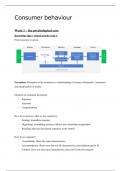
From exposure to action.
Perception: Perception is the awareness or understanding of sensory information. Awareness
and interpretation of reality.
Elements of consumer perception
- Exposure
- Attention
- Comprehension
How do we process what we are exposed to
- Sensing: immediate response
- Organizing: assembling sensory evidence into something recognizable
- Reacting: physical and mental responses to the stimuli
How do we organize?
- Assimilation: Share the same characteristics
- Accommodation: Share some but not all characteristics, need adjustment for fit
- Contrast: Does not share any characteristics, does not fit into the category
,Theories about perception:
The traditional dissociation paradigm suggest that consumers are influenced by stimuli
even when they are not aware of them
When do we detect the stimuli
- Objective threshold: stimuli is not detected by the senses
- Subjective threshold: stimuli enters conscious awareness (Supraliminal)
- Between: stimuli is detected by the senses but does not enter conscious awareness
(Subliminal)
Problem: how can we measure something that consumers are not aware of?
whenever an indirect measure if responding is more strongly influenced by stimulus
exposure than is a comparable direct measure of responding, perception without awareness
can be identified.
Mere exposure effect
unreinforced exposure is sufficient to enhance attitude toward the stimulus
Proven in different context:
- Advertising
- Social perceptions and behavior
- Prejudice
The mere exposure effects can be obtained by stimuli that are neither recalled nor recognized
by subject
Article 1- Bornstein (1989)
RQ: comparing the magnitude of the mere exposure effect produced by subliminal stimuli vs
supraliminal stimuli that are consciously perceived
Mere exposure effect: people tend to develop a preference for things merely because they are
familiar with them
,Experimental procedure
- Different stimuli (abstract, meaningful social stimuli)
- Different exposures (0,1,5,10,20 repetitions per stimuli)
- Half of the stimuli were exposed at a subliminal exposure duration (5ms), half of the
stimuli were exposed at a supraliminal exposure (500ms)
- After exposure subjects made affect (liking) and recognition judgements
Experiment 1
- 120 participants, stimuli: 25 polygons and 25 photographs of women
- Main effect exposure frequency on liking rating: frequently exposed stimuli received
more positive ratings than infrequently exposed stimuli
- Main effect of exposure duration on liking rating: 5ms receiving higher ratings than
500ms
- Interaction effect between exposure durations and exposure frequency: 5 ms stimuli
showed a more rapid increase in liking ratings with increasing exposure frequency
than did 500 ms stimuli.
- Mere exposure effect? Increase in liking with increasing exposure frequency in
the 5 ms condition, but not significant effect for the 500 ms condition
, Attention: Devoting cognitive resources to stimuli
Characteristics attention
- Limited:
- Selective
- Can be divided
Attention
- Voluntary: top-down, subjective voluntary focuses attention, goal-directed
- Involuntary: bottom-up, salient objects draw attention, stimulus-driven
Promote voluntary attention
- Make it personal
- Connect with needs
Promote involuntary attention
- Increase salience
- Increase vividness
What visual properties draw attention
Color, size, motion, pictures. Gestalt rules of visual processing
Gestalt: a set of rules describing visual perception
- Proximity
- Similarity
- Continuity
Proximity: elements that are close together tend to be viewed as part of the same object;
those farther apart tend to be viewed a part of different objects
Similarity: elements that physically resemble each other tend to be viewed as part of the
same object; those that are physically dissimilar tend to be viewed as different objects.
Continuity: incomplete or partially hidden objects tend to be viewed as whole or completed
patterns
Week 1 – the psychological core
Knowledge clips + related articles week 1
From exposure to action.
Perception: Perception is the awareness or understanding of sensory information. Awareness
and interpretation of reality.
Elements of consumer perception
- Exposure
- Attention
- Comprehension
How do we process what we are exposed to
- Sensing: immediate response
- Organizing: assembling sensory evidence into something recognizable
- Reacting: physical and mental responses to the stimuli
How do we organize?
- Assimilation: Share the same characteristics
- Accommodation: Share some but not all characteristics, need adjustment for fit
- Contrast: Does not share any characteristics, does not fit into the category
,Theories about perception:
The traditional dissociation paradigm suggest that consumers are influenced by stimuli
even when they are not aware of them
When do we detect the stimuli
- Objective threshold: stimuli is not detected by the senses
- Subjective threshold: stimuli enters conscious awareness (Supraliminal)
- Between: stimuli is detected by the senses but does not enter conscious awareness
(Subliminal)
Problem: how can we measure something that consumers are not aware of?
whenever an indirect measure if responding is more strongly influenced by stimulus
exposure than is a comparable direct measure of responding, perception without awareness
can be identified.
Mere exposure effect
unreinforced exposure is sufficient to enhance attitude toward the stimulus
Proven in different context:
- Advertising
- Social perceptions and behavior
- Prejudice
The mere exposure effects can be obtained by stimuli that are neither recalled nor recognized
by subject
Article 1- Bornstein (1989)
RQ: comparing the magnitude of the mere exposure effect produced by subliminal stimuli vs
supraliminal stimuli that are consciously perceived
Mere exposure effect: people tend to develop a preference for things merely because they are
familiar with them
,Experimental procedure
- Different stimuli (abstract, meaningful social stimuli)
- Different exposures (0,1,5,10,20 repetitions per stimuli)
- Half of the stimuli were exposed at a subliminal exposure duration (5ms), half of the
stimuli were exposed at a supraliminal exposure (500ms)
- After exposure subjects made affect (liking) and recognition judgements
Experiment 1
- 120 participants, stimuli: 25 polygons and 25 photographs of women
- Main effect exposure frequency on liking rating: frequently exposed stimuli received
more positive ratings than infrequently exposed stimuli
- Main effect of exposure duration on liking rating: 5ms receiving higher ratings than
500ms
- Interaction effect between exposure durations and exposure frequency: 5 ms stimuli
showed a more rapid increase in liking ratings with increasing exposure frequency
than did 500 ms stimuli.
- Mere exposure effect? Increase in liking with increasing exposure frequency in
the 5 ms condition, but not significant effect for the 500 ms condition
, Attention: Devoting cognitive resources to stimuli
Characteristics attention
- Limited:
- Selective
- Can be divided
Attention
- Voluntary: top-down, subjective voluntary focuses attention, goal-directed
- Involuntary: bottom-up, salient objects draw attention, stimulus-driven
Promote voluntary attention
- Make it personal
- Connect with needs
Promote involuntary attention
- Increase salience
- Increase vividness
What visual properties draw attention
Color, size, motion, pictures. Gestalt rules of visual processing
Gestalt: a set of rules describing visual perception
- Proximity
- Similarity
- Continuity
Proximity: elements that are close together tend to be viewed as part of the same object;
those farther apart tend to be viewed a part of different objects
Similarity: elements that physically resemble each other tend to be viewed as part of the
same object; those that are physically dissimilar tend to be viewed as different objects.
Continuity: incomplete or partially hidden objects tend to be viewed as whole or completed
patterns



