Disability discrimination
Saturday, 23 October 2021 11:08
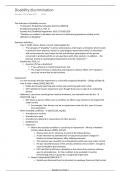
The definition of disability sources:
- 'Framework' Employment Equality Directive 2000/78
- EA 2010 (including Sch.1, Part 1)
- Equality Act (Disability) Regulations 2010, SI 2010/2128
- "Guidance on matters to be taken into account in determining questions relating to the
definition of disability"
Statutory definition:
- Case C-13/05 Chacon Navas v Eurest Colectividades SA
○ 'The concept of "disability" must be understood as referring to a limitation which results
in particular from physical, mental or psychological impairments which in interaction
with various barriers may hinder the full and effective participation of the person
concerned in professional life on an equal basis with other workers. In addition … the
physical, mental or psychological impairments must be "long term".'
- Equality Act 2010, s.6
○ A person (P) has a disability if
▪ P has a physical or mental impairment, and
▪ The impairment has a substantial and long-term adverse effect on P's ability to
carry out normal day-to-day activities
'Impairment'
- It is not necessary that the impairment is a clinically recognised disability - College of Ripon &
York St John v Hobbs [2002] IRLR 185
○ Hobbs had muscle twitching and cramps and could only walk with a stick
○ EAT held that he had an impairment even though there was no sign of an underlying
disease
- Addictions, save those resulting from medical treatment, are excluded from the Act - SI
2010/2128, reg.3
○ BUT where a person suffers such a condition, its effects may amount to an impairment
under the Act
▪ For example, liver disease can be an impairment under the Act, even if it arose
from alcoholism
- Other excluded conditions - SI 2010/2128, reg.4(1)
○ A tendency to set fires
○ A tendency to steal
○ A tendency to physical or sexual abuse of other persons
○ Exhibitionism
○ Voyeurism
▪ Where the excluded condition is caused by an impairment - Murray v Newham
Citizens Advice Bureau [2003] ICR 643
□ Murray went for an interview to work at the Advice Bureau
□ At the interview he admitted that he had previously been charged in
relation to violent behaviours after stabbing someone
□ The violence was caused by his schizophrenia which was now under control
□ He was rejected because of this previous tendency to be violent - brought a
claim of disability discrimination
□ EAT held that he did have a disability as the cause of his previous violence
was his schizophrenia - for the condition to be excluded it must be
freestanding and not caused by a recognised impairment
▪ Nuttall v Butterfield [2006] ICR 77
□ Nuttall was dismissed from his job when his employer found out that he had
two previous convictions for indecent exposure
Equality Law Page 1
, two previous convictions for indecent exposure
□ Nuttall brought a claim for disability discrimination
□ EAT said that the approach taken in Murray (freestanding) was not helpful
□ Because the cause of the dismissal was the convictions for indecent
exposure, not the depression that caused him to indecently expose himself,
he did not have a disability and therefore had no claim - the treatment was
not linked to a disability
'Ability to carry out normal day-to-day activities'
- Goodwin v The Patent Office [1999] ICR 302, 309 (Morison, J)
○ 'What is a day-to-day activity is best left unspecified: easily recognised, but defined with
difficulty.'
- The activities affected should be assessed as a whole, and not in isolation - Ekpe v
Commissioner of Police of the Metropolis [2001] ICR 1084
○ Ekpe had wasting muscles in her right hand - she could not carry heavy shopping, scrub
and peel vegetables etc
○ Court of first instance took each of her problems in isolation - held that the impairment
did not impact her ability to carry out day-to-day activities
○ EAT reversed
- Work as a day to day activity - specialised work activities seem to be excluded - Paterson v
Commissioner of Police for the Metropolis [2007] IRLR 763
○ Paterson suffered from mild dyslexia and struggled in promotion exams - it didn’t affect
him in every day life
○ Sued for extra time in his exams and he prevailed
○ EAT got around the issue by stating that the promotion exams were a usual yet irregular
occurrence
- Children - those under 6 years old with an impairment are treated as if that impairment has
the requisite effect, where normally it would have such an effect on the ability of an older
person to carry out normal day-to-day activities - SI 2010/2128, reg.6
- Children - Case C-303/06 Coleman v Attridge Law [2008] 3 CMLR 27
○ Worker discriminated and harassed due to the disability of her child
- Disfigurements
○ EA 2010, Sch 1 & 3
▪ A 'severe' disfigurement will 'be treated as having a substantial adverse effect on
the ability of the person concerned to carry out normal day-to-day activities.'
○ Does not include tattoos or other decorative or other (non-medical) piercings - SI
2010/2128, reg.5
○ May include scars, birthmarks, limb or postural deformation (including restricted bodily
development) or diseases of the skin
'Long term effects'
- EA 2010, Sch.1, para.2(1): An impairment has a long term effect if
○ It has lasted at least 12 months or
○ The period for which it lasts is likely to be at least 12 months or
○ It is likely to last for the rest of the life of the person affected
- Recurring or fluctuating effects
○ EA 2010, Sch.1, para.2(2): Where an impairment ceases to have a substantial adverse
effect … it is to be treated as continuing to have that effect if that effect is likely to recur
○ The likelihood of recurrence should be assessed at the time of the discriminatory act -
Richmond College v McDougall [2008] ICR 431
▪ McDougall had a history of mental illness
▪ Nov 2001 - Feb 2002 she was sectioned under the Mental Health Act 1983
▪ In April 2005 she applied for a job at Richmond College
▪ She was offered the job subject to a health check - when they saw the medical
records they withdrew the offer
▪ At that time, McDougall's effects were unlikely to recur
▪ In August 2005 she relapsed and was re-admitted to hospital in December
▪ Court decided that the time of the discriminatory act should be the time when
Equality Law Page 2
Saturday, 23 October 2021 11:08
The definition of disability sources:
- 'Framework' Employment Equality Directive 2000/78
- EA 2010 (including Sch.1, Part 1)
- Equality Act (Disability) Regulations 2010, SI 2010/2128
- "Guidance on matters to be taken into account in determining questions relating to the
definition of disability"
Statutory definition:
- Case C-13/05 Chacon Navas v Eurest Colectividades SA
○ 'The concept of "disability" must be understood as referring to a limitation which results
in particular from physical, mental or psychological impairments which in interaction
with various barriers may hinder the full and effective participation of the person
concerned in professional life on an equal basis with other workers. In addition … the
physical, mental or psychological impairments must be "long term".'
- Equality Act 2010, s.6
○ A person (P) has a disability if
▪ P has a physical or mental impairment, and
▪ The impairment has a substantial and long-term adverse effect on P's ability to
carry out normal day-to-day activities
'Impairment'
- It is not necessary that the impairment is a clinically recognised disability - College of Ripon &
York St John v Hobbs [2002] IRLR 185
○ Hobbs had muscle twitching and cramps and could only walk with a stick
○ EAT held that he had an impairment even though there was no sign of an underlying
disease
- Addictions, save those resulting from medical treatment, are excluded from the Act - SI
2010/2128, reg.3
○ BUT where a person suffers such a condition, its effects may amount to an impairment
under the Act
▪ For example, liver disease can be an impairment under the Act, even if it arose
from alcoholism
- Other excluded conditions - SI 2010/2128, reg.4(1)
○ A tendency to set fires
○ A tendency to steal
○ A tendency to physical or sexual abuse of other persons
○ Exhibitionism
○ Voyeurism
▪ Where the excluded condition is caused by an impairment - Murray v Newham
Citizens Advice Bureau [2003] ICR 643
□ Murray went for an interview to work at the Advice Bureau
□ At the interview he admitted that he had previously been charged in
relation to violent behaviours after stabbing someone
□ The violence was caused by his schizophrenia which was now under control
□ He was rejected because of this previous tendency to be violent - brought a
claim of disability discrimination
□ EAT held that he did have a disability as the cause of his previous violence
was his schizophrenia - for the condition to be excluded it must be
freestanding and not caused by a recognised impairment
▪ Nuttall v Butterfield [2006] ICR 77
□ Nuttall was dismissed from his job when his employer found out that he had
two previous convictions for indecent exposure
Equality Law Page 1
, two previous convictions for indecent exposure
□ Nuttall brought a claim for disability discrimination
□ EAT said that the approach taken in Murray (freestanding) was not helpful
□ Because the cause of the dismissal was the convictions for indecent
exposure, not the depression that caused him to indecently expose himself,
he did not have a disability and therefore had no claim - the treatment was
not linked to a disability
'Ability to carry out normal day-to-day activities'
- Goodwin v The Patent Office [1999] ICR 302, 309 (Morison, J)
○ 'What is a day-to-day activity is best left unspecified: easily recognised, but defined with
difficulty.'
- The activities affected should be assessed as a whole, and not in isolation - Ekpe v
Commissioner of Police of the Metropolis [2001] ICR 1084
○ Ekpe had wasting muscles in her right hand - she could not carry heavy shopping, scrub
and peel vegetables etc
○ Court of first instance took each of her problems in isolation - held that the impairment
did not impact her ability to carry out day-to-day activities
○ EAT reversed
- Work as a day to day activity - specialised work activities seem to be excluded - Paterson v
Commissioner of Police for the Metropolis [2007] IRLR 763
○ Paterson suffered from mild dyslexia and struggled in promotion exams - it didn’t affect
him in every day life
○ Sued for extra time in his exams and he prevailed
○ EAT got around the issue by stating that the promotion exams were a usual yet irregular
occurrence
- Children - those under 6 years old with an impairment are treated as if that impairment has
the requisite effect, where normally it would have such an effect on the ability of an older
person to carry out normal day-to-day activities - SI 2010/2128, reg.6
- Children - Case C-303/06 Coleman v Attridge Law [2008] 3 CMLR 27
○ Worker discriminated and harassed due to the disability of her child
- Disfigurements
○ EA 2010, Sch 1 & 3
▪ A 'severe' disfigurement will 'be treated as having a substantial adverse effect on
the ability of the person concerned to carry out normal day-to-day activities.'
○ Does not include tattoos or other decorative or other (non-medical) piercings - SI
2010/2128, reg.5
○ May include scars, birthmarks, limb or postural deformation (including restricted bodily
development) or diseases of the skin
'Long term effects'
- EA 2010, Sch.1, para.2(1): An impairment has a long term effect if
○ It has lasted at least 12 months or
○ The period for which it lasts is likely to be at least 12 months or
○ It is likely to last for the rest of the life of the person affected
- Recurring or fluctuating effects
○ EA 2010, Sch.1, para.2(2): Where an impairment ceases to have a substantial adverse
effect … it is to be treated as continuing to have that effect if that effect is likely to recur
○ The likelihood of recurrence should be assessed at the time of the discriminatory act -
Richmond College v McDougall [2008] ICR 431
▪ McDougall had a history of mental illness
▪ Nov 2001 - Feb 2002 she was sectioned under the Mental Health Act 1983
▪ In April 2005 she applied for a job at Richmond College
▪ She was offered the job subject to a health check - when they saw the medical
records they withdrew the offer
▪ At that time, McDougall's effects were unlikely to recur
▪ In August 2005 she relapsed and was re-admitted to hospital in December
▪ Court decided that the time of the discriminatory act should be the time when
Equality Law Page 2