8. Infringement Procedures
8. Infringement Procedure
Infringement procedure
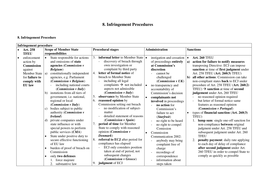
Art. 258 Scope of Member State Procedural stages Administration Sanctions
TFEU responsibilities
enforcement State responsible for actions 3. informal letter to Member State instigation and cessation Art. 260 TFEU
action by and omissions of state - discovery of breach through of proceedings entirely a) action for failure to notify measures
Commission agencies (Commission v own investigation or at Commission’s transposing Directive: ECJ can impose
against Belgium) complaint by third party discretion sanction at time of first judgment under
Member State a) constitutionally independent 4. letter of formal notice of - cannot be Art. 258 TFEU (Art. 260(3) TFEU)
for failure to agencies, e.g. Parliament breach to Member State challenged b) all other actions: Commission can take
comply with (Commission v Belgium) - including all legal (Commission v UK) non-compliant states back to ECJ under
EU law - including national courts complaints not included no transparency and procedure of Art. 258 TFEU (Art. 260(2)
(Commission v Italy) aspects not admissible accountability of TFEU) sanction at time of second
b) instutions from all tiers of (Commission v Italy) Commission’s decision judgement under Art. 260 TFEU
government, i.e. national, 5. observance by Member State complainants not - no reasoned opinion required
regional or local 6. reasoned opinion by involved in proceedings - but letter of formal notice same
(Commission v Italy) Commission setting out breach - no action for features as reasoned opinion
c) bodies subject to public - no modification of subject- Commission’s (Commission v Portugal)
authority (Commission v matter failure to act types of financial sanction (Art. 260(3)
Ireland) - detailed statement of reasons (Starfruit) TFEU)
d) private companies under (Commission v Spain) - no right to be heard 1. lump sum: single one-off sanction for
state influence or with 7. period of time for Member - no right to compel non-compliance between original
special powers to perform State to comply with reasoned Comission judgment under Art. 258 TFEU and
public services (CMA) opinion (Commission v Commission subsequent judgment under Art. 260
State under positive duty to Denmark) Communication 2002: TFEU
secure effective functioning 8. referral to ECJ after period for - anybody may bring 2. penalty payment: daily rate applying
of EU law compliance has elapsed complaint free of to each day of delay of compliance
burden of proof of breach on - ECJ only considers position charge after second judgment under Art.
Commission taken at end of period, not - recordings of 260 TFEU in order to compel State to
only two defenses subsequent changes correspondence comply as quickly as possible
1. force majeure (Commission v Greece) - information about
2. substantive law 9. judgment of ECJ steps taken
8. Infringement Procedure
Infringement procedure
Art. 258 Scope of Member State Procedural stages Administration Sanctions
TFEU responsibilities
enforcement State responsible for actions 3. informal letter to Member State instigation and cessation Art. 260 TFEU
action by and omissions of state - discovery of breach through of proceedings entirely a) action for failure to notify measures
Commission agencies (Commission v own investigation or at Commission’s transposing Directive: ECJ can impose
against Belgium) complaint by third party discretion sanction at time of first judgment under
Member State a) constitutionally independent 4. letter of formal notice of - cannot be Art. 258 TFEU (Art. 260(3) TFEU)
for failure to agencies, e.g. Parliament breach to Member State challenged b) all other actions: Commission can take
comply with (Commission v Belgium) - including all legal (Commission v UK) non-compliant states back to ECJ under
EU law - including national courts complaints not included no transparency and procedure of Art. 258 TFEU (Art. 260(2)
(Commission v Italy) aspects not admissible accountability of TFEU) sanction at time of second
b) instutions from all tiers of (Commission v Italy) Commission’s decision judgement under Art. 260 TFEU
government, i.e. national, 5. observance by Member State complainants not - no reasoned opinion required
regional or local 6. reasoned opinion by involved in proceedings - but letter of formal notice same
(Commission v Italy) Commission setting out breach - no action for features as reasoned opinion
c) bodies subject to public - no modification of subject- Commission’s (Commission v Portugal)
authority (Commission v matter failure to act types of financial sanction (Art. 260(3)
Ireland) - detailed statement of reasons (Starfruit) TFEU)
d) private companies under (Commission v Spain) - no right to be heard 1. lump sum: single one-off sanction for
state influence or with 7. period of time for Member - no right to compel non-compliance between original
special powers to perform State to comply with reasoned Comission judgment under Art. 258 TFEU and
public services (CMA) opinion (Commission v Commission subsequent judgment under Art. 260
State under positive duty to Denmark) Communication 2002: TFEU
secure effective functioning 8. referral to ECJ after period for - anybody may bring 2. penalty payment: daily rate applying
of EU law compliance has elapsed complaint free of to each day of delay of compliance
burden of proof of breach on - ECJ only considers position charge after second judgment under Art.
Commission taken at end of period, not - recordings of 260 TFEU in order to compel State to
only two defenses subsequent changes correspondence comply as quickly as possible
1. force majeure (Commission v Greece) - information about
2. substantive law 9. judgment of ECJ steps taken