4. EU Law-Making
4.1. EU legislation
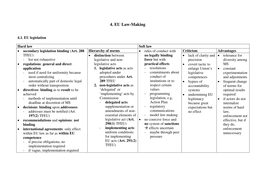
Hard law Soft law
secondary legislation binding (Art. 288 Hierarchy of norms rules of conduct with Criticism Advantages
TFEU) distinction between no legally binding lack of clarity and tolerance for
- list not exhaustive legislative and non- force but with precision diversity among
regulations: general and direct legislative acts practical effects covert tactic to MS
application 1. legislative acts as acts - resolutions enlarge Union’s constant
- used if need for uniformity because adopted under - commitments about legislative experimentation
most centralizing procedures under Art. conduct of competences and adjustments
- automatically part of domestic legal 289 TFEU institutions or to bypass of frequent change
order without transposition 2. non-legislative acts as respect certain accountability of norms for
directives: binding as to result to be ‘delegated‘ or values systems optimal results
achieved ‘implementing‘ acts by - programming undermining EU required
- methods of implementation until Commission legislation, e.g, legitimacy if actors do not
deadline at discretion of MS - delegated acts: Action Plan because great internalize
decisions: binding upon addressees supplementation or - regulatory expectations but norms of hard
- addressee must be notified (Art. amendments of non- communications no effect law,
197(2) TFEU) essential elements of - model law-making enforcement not
recommendations and opinions: not legislative act (Art. no coercive force and effective, but if
binding 290(1) TFEU) no system of sanctions they do,
international agreements: only effect - implementing acts: effects uncertain enforcement
within EU law as far as within EU uniform conditions - maybe through peer unnecessary
competence for implementing pressure
- if precise obligations, no EU acts (Art. 291(2)
implementation required TFEU)
- if vague, implementation required
4.1. EU legislation
Hard law Soft law
secondary legislation binding (Art. 288 Hierarchy of norms rules of conduct with Criticism Advantages
TFEU) distinction between no legally binding lack of clarity and tolerance for
- list not exhaustive legislative and non- force but with precision diversity among
regulations: general and direct legislative acts practical effects covert tactic to MS
application 1. legislative acts as acts - resolutions enlarge Union’s constant
- used if need for uniformity because adopted under - commitments about legislative experimentation
most centralizing procedures under Art. conduct of competences and adjustments
- automatically part of domestic legal 289 TFEU institutions or to bypass of frequent change
order without transposition 2. non-legislative acts as respect certain accountability of norms for
directives: binding as to result to be ‘delegated‘ or values systems optimal results
achieved ‘implementing‘ acts by - programming undermining EU required
- methods of implementation until Commission legislation, e.g, legitimacy if actors do not
deadline at discretion of MS - delegated acts: Action Plan because great internalize
decisions: binding upon addressees supplementation or - regulatory expectations but norms of hard
- addressee must be notified (Art. amendments of non- communications no effect law,
197(2) TFEU) essential elements of - model law-making enforcement not
recommendations and opinions: not legislative act (Art. no coercive force and effective, but if
binding 290(1) TFEU) no system of sanctions they do,
international agreements: only effect - implementing acts: effects uncertain enforcement
within EU law as far as within EU uniform conditions - maybe through peer unnecessary
competence for implementing pressure
- if precise obligations, no EU acts (Art. 291(2)
implementation required TFEU)
- if vague, implementation required