1. Lisbon Treaty
1. Lisbon Treaty
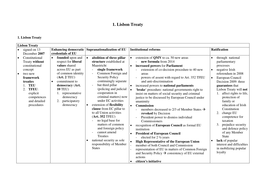
Lisbon Treaty
signed on 13 Enhancing democratic Supranationalization of EU Institutional reforms Ratification
December 2007 credentials of EU
Constitutional founded upon and abolition of three pillar extension of QMV to ca. 50 new areas through national
Treaty without respect for liberal structure established at - new formula from 2014 parliamentary
constitutional values shared Maastricht increased powers for Parliament processes
concept across EU as part - single framework - extension of co-decision procedure to 40 new negative Irish
two new of common identity - Common Foreign and areas referendum in 2008
framework (Art. 2 TEU) Security Policy - powers of assent with regard to Art. 352 TFEU European Council
treaties commitment to continuingly separate and anti-discrimination Decision 2009: three
1. TEU democracy (Art. - but third pillar increased powers to national parliaments guarantees that
2. TFEU: 10 TEU) (policing and judicial ‘brake‘ procedure: national governments right to Lisbon Treaty will not
explicit 1. representative cooperation in insist on matters of social security and criminal 1. affect rights to life,
competences democracy criminal matters) now justice to be discussed by European Council under protection of
and detailed 2. participatory under EC activities unanimity family or
procedures democracy extension of flexibility Commission education of Irish
clause from EC pillar to - members decreased to 2/3 of Member States Constitution
to all Union activities revoked by Decision 2. change EU
(Art. 352 TFEU) - President power to dismiss individual competence for
- no legal base for Commissioners taxation
matters of common recognition of European Council as formal EU 3. prejudice security
and foreeign policy institution and defence policy
- cannot amend President of European Council of any Member
Treaties - elected for 2 ½ years State
national security as sole High Representative of the European Union lack of popular
responsibility of Member - member of both Council and Commission interest and difficulties
States - representation of EU in matters of Common Foreign in mobilizing popular
and Security Policy consistency of EU external loyalty
actions
citizen’s initiative
1. Lisbon Treaty
Lisbon Treaty
signed on 13 Enhancing democratic Supranationalization of EU Institutional reforms Ratification
December 2007 credentials of EU
Constitutional founded upon and abolition of three pillar extension of QMV to ca. 50 new areas through national
Treaty without respect for liberal structure established at - new formula from 2014 parliamentary
constitutional values shared Maastricht increased powers for Parliament processes
concept across EU as part - single framework - extension of co-decision procedure to 40 new negative Irish
two new of common identity - Common Foreign and areas referendum in 2008
framework (Art. 2 TEU) Security Policy - powers of assent with regard to Art. 352 TFEU European Council
treaties commitment to continuingly separate and anti-discrimination Decision 2009: three
1. TEU democracy (Art. - but third pillar increased powers to national parliaments guarantees that
2. TFEU: 10 TEU) (policing and judicial ‘brake‘ procedure: national governments right to Lisbon Treaty will not
explicit 1. representative cooperation in insist on matters of social security and criminal 1. affect rights to life,
competences democracy criminal matters) now justice to be discussed by European Council under protection of
and detailed 2. participatory under EC activities unanimity family or
procedures democracy extension of flexibility Commission education of Irish
clause from EC pillar to - members decreased to 2/3 of Member States Constitution
to all Union activities revoked by Decision 2. change EU
(Art. 352 TFEU) - President power to dismiss individual competence for
- no legal base for Commissioners taxation
matters of common recognition of European Council as formal EU 3. prejudice security
and foreeign policy institution and defence policy
- cannot amend President of European Council of any Member
Treaties - elected for 2 ½ years State
national security as sole High Representative of the European Union lack of popular
responsibility of Member - member of both Council and Commission interest and difficulties
States - representation of EU in matters of Common Foreign in mobilizing popular
and Security Policy consistency of EU external loyalty
actions
citizen’s initiative