

Finance 1
Lecture 1: 3 November 2022
S&P 500: IX 25
Key decisions in finance
- What should I invest in?
- How do I get the money?
Chapter 1 – the corporation
Key questions:
1. What is a corporation?
2. What is the objective of a corporation?
3. Who owns/runs the corporation?
4. Does the corporation generate problems?
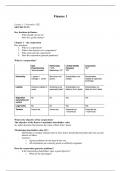
What is a corporation?
What is the objective of the corporation?
The objective of the firm is to maximize shareholder value
So, make decisions that increase the value of their firms’ shares
Maximizing shareholder value (SV)
- Shareholder is residual claimant (last in line), hence should (theoretically) take into account
interest of others
- Assumes:
o Agency problems do not stand in the way
o All externalities are correctly priced or suffiently regulated
Does the corporation generate problems?
- Is the maximizing shareholder value a good objective?
o What are the advantages?
, o What are the disadvantages?
- Do (people working within) firms maximize shareholder value?
Evaluating maximizing shareholder value
- Max shareholder value is a good start…
- Without frictions and externalities, maximizing shareholder value makes sense as an objective
- With frictions and externalities (like agency problems or pollution), this objective introduces
new problems
- Shareholder value versus stakeholder value
- Regulation of corporations is needed
Issues with maximizing SV due to externalities
- Rules and regulations often do not sufficiently protect interests of all stakeholders (e.g.
employees)
- SV does not take into account impact on future generations (e.g. CO2 emissions, depletion of
natural resources)
- Externalities are not sufficiently internalized when not or insufficiently priced
Firm objective: academic debate
- Paper Hart and Zingales (2017): propose maximizing shareholder welfare as alternative
objective:
o Investments often are intrinsically linked with “damage” and money-making decisions
cannot be separated from ethical considerations by shareholders
- Laws and rules should support this
o Voting mechanisms
Externalities and SV as objective
- Rules and regulation
- Ethical behavior management
Who runs/owns the corporation?
- Shareholders are called “owners”... but do not have full ownership rights only some economic
and voting rights
- CEO / managers run the firm (make day to day decisions)
- Corporation is owner of its assets
Do (people working within) firms maximize shareholder value?
- Firms have managers and shareholders who are often not the same people
- This leads to separation of ownership and control (shareholder = ‘owner’ and manager =
control)
- Introduces an agency problem
- Self-interested managers maximize their own utility, not shareholder value
How do firms minimize the agency problem?
Corporate Governance
- Board of directors overlooking CEO
- Tie management’s compensation to firm performance
- Competition on product markets
- Poor performance investor’s sell shares share price drops hostile takeovers (new
management team tries to fix the company)
Conclusion chapter 1
- Organizations can be organized in different ways (private, public, limited liability)
- We assume firms to try to maximize (shareholder) value although managers have their own
objectives (agency problems)
, - Maximizing shareholder value is not a perfect objective (think of externalities)
Chapter 2 financial statement analysis
- What financial information about the firm is available?
- What do the financial statements tell us about the firm?
- How is accounting information related to firm value?
Financial statement issues
- Market value vs book values
- Enterprise value
- Cash flows versus profits
- Leverage, valuation ratios
Enterprise value
- Consider the following balance sheet (market values!)
Lecture 1: 3 November 2022
S&P 500: IX 25
Key decisions in finance
- What should I invest in?
- How do I get the money?
Chapter 1 – the corporation
Key questions:
1. What is a corporation?
2. What is the objective of a corporation?
3. Who owns/runs the corporation?
4. Does the corporation generate problems?
What is a corporation?
What is the objective of the corporation?
The objective of the firm is to maximize shareholder value
So, make decisions that increase the value of their firms’ shares
Maximizing shareholder value (SV)
- Shareholder is residual claimant (last in line), hence should (theoretically) take into account
interest of others
- Assumes:
o Agency problems do not stand in the way
o All externalities are correctly priced or suffiently regulated
Does the corporation generate problems?
- Is the maximizing shareholder value a good objective?
o What are the advantages?
, o What are the disadvantages?
- Do (people working within) firms maximize shareholder value?
Evaluating maximizing shareholder value
- Max shareholder value is a good start…
- Without frictions and externalities, maximizing shareholder value makes sense as an objective
- With frictions and externalities (like agency problems or pollution), this objective introduces
new problems
- Shareholder value versus stakeholder value
- Regulation of corporations is needed
Issues with maximizing SV due to externalities
- Rules and regulations often do not sufficiently protect interests of all stakeholders (e.g.
employees)
- SV does not take into account impact on future generations (e.g. CO2 emissions, depletion of
natural resources)
- Externalities are not sufficiently internalized when not or insufficiently priced
Firm objective: academic debate
- Paper Hart and Zingales (2017): propose maximizing shareholder welfare as alternative
objective:
o Investments often are intrinsically linked with “damage” and money-making decisions
cannot be separated from ethical considerations by shareholders
- Laws and rules should support this
o Voting mechanisms
Externalities and SV as objective
- Rules and regulation
- Ethical behavior management
Who runs/owns the corporation?
- Shareholders are called “owners”... but do not have full ownership rights only some economic
and voting rights
- CEO / managers run the firm (make day to day decisions)
- Corporation is owner of its assets
Do (people working within) firms maximize shareholder value?
- Firms have managers and shareholders who are often not the same people
- This leads to separation of ownership and control (shareholder = ‘owner’ and manager =
control)
- Introduces an agency problem
- Self-interested managers maximize their own utility, not shareholder value
How do firms minimize the agency problem?
Corporate Governance
- Board of directors overlooking CEO
- Tie management’s compensation to firm performance
- Competition on product markets
- Poor performance investor’s sell shares share price drops hostile takeovers (new
management team tries to fix the company)
Conclusion chapter 1
- Organizations can be organized in different ways (private, public, limited liability)
- We assume firms to try to maximize (shareholder) value although managers have their own
objectives (agency problems)
, - Maximizing shareholder value is not a perfect objective (think of externalities)
Chapter 2 financial statement analysis
- What financial information about the firm is available?
- What do the financial statements tell us about the firm?
- How is accounting information related to firm value?
Financial statement issues
- Market value vs book values
- Enterprise value
- Cash flows versus profits
- Leverage, valuation ratios
Enterprise value
- Consider the following balance sheet (market values!)




