2610 Distribution Management-
2016 Exam Preparation Notes and Summary. By: Dubst3phs
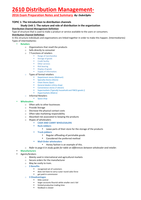
TOPIC 1: The Introduction to distribution channels
Study Unit 1: The nature and role of distribution in the organization
Distribution Channel Management Definition
Type of structure that is used to make a product or service available to the users or consumers.
Distribution Channel Definition
In this structure individuals and organizations are linked together in order to make this happen. (Intermediaries)
Types of intermediaries:
• Retailers
o Organizations that resell the products
o Sells directly to consumer
o 7 Functions of retailers
§ Range of merchandise
§ Storage of goods
§ Credit facility
§ Other services
§ Risk bearing
§ Display of goods
§ Supply of information.
o Types of formal retailers
§ Department stores (Walmart)
§ Specialty Stores (iStore)
§ Chain Stores (Spar)
§ General dealers (china shop)
§ Convenience stores (7-eleven)
§ Supermarkets (Typically household and FMCG goods ()
§ Hypermarkets (Makro)
o Informal Retailers
§ Spaza shop
• Wholesalers
o Often sells to other businesses
o Provide Storage
o Decrease the physical contact costs
o Often take marketing responsibility
o Absorbed risk associated to keeping the products
o 4types of wholesalers
§ CASH AND CARRY WHOLESALERS
§ Rack-Jobbers
• Lease parts of their store for the storage of the products
§ Truck-jobbers
• Regular offloading of perishable goods
• Considered the preferred method
§ Mail-Order wholesalers
• Honey fashion is an example of this.
o Refer to page 6 in study guide for table on differences between wholesaler and retailer.
• Manufacturers
• Agents/brokers
o Mainly used in international and agricultural markets
o Secure orders for the manufacturer
o May be costly to train.
o 3 Benefits
§ recognized set of customers
§ does not have to carry a year round sales force
§ get paid in commission
o 3 Disadvantages
§ little control
§ larger accounts flourish while smaller one’s fail
§ limited productive trading time
§ feedback is slower
2016 Exam Preparation Notes and Summary. By: Dubst3phs
TOPIC 1: The Introduction to distribution channels
Study Unit 1: The nature and role of distribution in the organization
Distribution Channel Management Definition
Type of structure that is used to make a product or service available to the users or consumers.
Distribution Channel Definition
In this structure individuals and organizations are linked together in order to make this happen. (Intermediaries)
Types of intermediaries:
• Retailers
o Organizations that resell the products
o Sells directly to consumer
o 7 Functions of retailers
§ Range of merchandise
§ Storage of goods
§ Credit facility
§ Other services
§ Risk bearing
§ Display of goods
§ Supply of information.
o Types of formal retailers
§ Department stores (Walmart)
§ Specialty Stores (iStore)
§ Chain Stores (Spar)
§ General dealers (china shop)
§ Convenience stores (7-eleven)
§ Supermarkets (Typically household and FMCG goods ()
§ Hypermarkets (Makro)
o Informal Retailers
§ Spaza shop
• Wholesalers
o Often sells to other businesses
o Provide Storage
o Decrease the physical contact costs
o Often take marketing responsibility
o Absorbed risk associated to keeping the products
o 4types of wholesalers
§ CASH AND CARRY WHOLESALERS
§ Rack-Jobbers
• Lease parts of their store for the storage of the products
§ Truck-jobbers
• Regular offloading of perishable goods
• Considered the preferred method
§ Mail-Order wholesalers
• Honey fashion is an example of this.
o Refer to page 6 in study guide for table on differences between wholesaler and retailer.
• Manufacturers
• Agents/brokers
o Mainly used in international and agricultural markets
o Secure orders for the manufacturer
o May be costly to train.
o 3 Benefits
§ recognized set of customers
§ does not have to carry a year round sales force
§ get paid in commission
o 3 Disadvantages
§ little control
§ larger accounts flourish while smaller one’s fail
§ limited productive trading time
§ feedback is slower