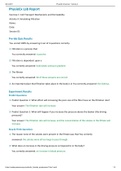
Week 1: Lab - Scientific Method Labster: Experimental Design (Kidney + Ex-P):
1) What is a hypothesis? Testable Explanation 2) Which cell line? Kidney Epithelial cells 3) What is the dependent variable? Number of dead cells 4) What is the independent variable? Compound Concentration 5) What variable is Exposure Time (48 hr in incubator w/ kidney epithelial plate with the 3 plasma compounds in Ex-P)? Controlled variable 6) After incubation, put in the microscope, what do cells look like? All cells look the same. 7) Fluorescent cell death assay → pink dye can penetrate the dead cell membranes 8) Why do we need experimental controls? To make sure dependent variable is b/c independent variable a) Can use Compound X (causes analgesic nephropathy) as a positive control b) Can use Buffer as baseline negative control 9) What result do you expect to see in negative control? No staining 10) What is expected of cells exposed to compound X? Cells die 11) What if negative control cells were red? Experimental set-up is flawed 12) What can you conclude from positive control cells? Experimental set-up can detect kidney injuries 13) Conclusions: It looks like Ex-P causes Kidney Injuries. Need to reproduce results to replicate. Then, analyze data and draw conclusions. Pre-lab/Post-lab Questions: 1)What is the conventional (most common) p-value used to signify statistical significance? 0.05 Week 2: Lab - Pipetting and Epidemiology Pre-lab/Post-lab Questions

Geschreven voor
- Instelling
- Dominican University Of California
- Vak
- LIFESCIENC 23L
Documentinformatie
- Geüpload op
- 29 april 2023
- Aantal pagina's
- 2
- Geschreven in
- 2022/2023
- Type
- Tentamen (uitwerkingen)
- Bevat
- Onbekend
Onderwerpen
-
lifescienc 23l
-
ls 23l final test prep