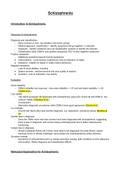
Schizophrenia
Introduction to Schizophrenia
Diagnosis of schizophrenia
Diagnosis and classification
- More common in men, city-dwellers and poorer groups.
- Medical approach, classification - identify symptoms that go together = a disorder.
- Diagnosis - identify symptoms and use classification systems to identify the disorder.
- Classification either DSM-5 (one positive symptoms) ICD-10 (two negative symptoms).
Positive symptoms
- Additional symptoms beyond normal experience:
● Hallucinations - usual sensory experiences may be distortion of reality.
● Delusions - beliefs not based in reality bizarre behaviour.
Negative symptoms
- Loss of usual abilities, including:
● Speech poverty - reduced amount and poor quality of speech.
● Avolution - loss of motivation, low activity.
Evaluation
Good reliability
- DSM-5 reliability has improved - inter-rater reliability = +.97 and test-retest reliability = +.92
(Osorio et al.).
Low validity
- 100 clients assessed, 68 diagnosed with schizophrenia using ICD-10 and 39 with DSM-IV, low
criterion validity (Cheniaux et al.).
Counterpoint
- Alternative diagnostic procedures within DSM-5 show good agreement (Osorio et al.).
Co-morbidity
- Around half clients also have another diagnosis, e.g. depression, substance abuse (Buckley et
al.).
Gender bias in diagnosis
- Since the 1980s more men than women have been diagnosed with schizophrenia, suggesting
there is bias in diagnosis, with women being underdiagnosed due to better interpersonal
functioning.
Culture bias in diagnosis
- African-Caribbean British are 9 times more likely to be diagnosed tha white British, maybe
because norms in African-Caribbean communities are misinterpreted by white clinicians.
Symptom overlap
- Symptoms of schizophrenia and e.g. bipolar disorders overlap, both conditions involve delusions
and avolition. Makes diagnosis and classification difficult.
Biological Explanation for Schizophrenia
Introduction to Schizophrenia
Diagnosis of schizophrenia
Diagnosis and classification
- More common in men, city-dwellers and poorer groups.
- Medical approach, classification - identify symptoms that go together = a disorder.
- Diagnosis - identify symptoms and use classification systems to identify the disorder.
- Classification either DSM-5 (one positive symptoms) ICD-10 (two negative symptoms).
Positive symptoms
- Additional symptoms beyond normal experience:
● Hallucinations - usual sensory experiences may be distortion of reality.
● Delusions - beliefs not based in reality bizarre behaviour.
Negative symptoms
- Loss of usual abilities, including:
● Speech poverty - reduced amount and poor quality of speech.
● Avolution - loss of motivation, low activity.
Evaluation
Good reliability
- DSM-5 reliability has improved - inter-rater reliability = +.97 and test-retest reliability = +.92
(Osorio et al.).
Low validity
- 100 clients assessed, 68 diagnosed with schizophrenia using ICD-10 and 39 with DSM-IV, low
criterion validity (Cheniaux et al.).
Counterpoint
- Alternative diagnostic procedures within DSM-5 show good agreement (Osorio et al.).
Co-morbidity
- Around half clients also have another diagnosis, e.g. depression, substance abuse (Buckley et
al.).
Gender bias in diagnosis
- Since the 1980s more men than women have been diagnosed with schizophrenia, suggesting
there is bias in diagnosis, with women being underdiagnosed due to better interpersonal
functioning.
Culture bias in diagnosis
- African-Caribbean British are 9 times more likely to be diagnosed tha white British, maybe
because norms in African-Caribbean communities are misinterpreted by white clinicians.
Symptom overlap
- Symptoms of schizophrenia and e.g. bipolar disorders overlap, both conditions involve delusions
and avolition. Makes diagnosis and classification difficult.
Biological Explanation for Schizophrenia