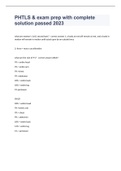
PHTLS & exam prep with complete solution passed 2023
PHTLS & exam prep with complete solution passed 2023what are newton's 1st & second laws? - correct answer 1: a body at rest will remain at rest, and a body in motion will remain in motion until acted upon by an outside force 2: force = mass x accelleration what are the rule of 9's? - correct answer ADULT 9% = entire head 9% = entire arm 9% =chest 9% =abdomen 18% = entire back 18% = entire leg 1% perineum CHILD 18% = entire head 9% =entire arm 9% = chest 9% = abdomen 18% = entire back 14% = entire leg 1% = perineum what are the signs/symptoms of spinal injury? - correct answer neurologic function above the injury is intact and function below the injury is absent or markedly diminished. Specific manifestations will depend on the exact level of injury. what are the (5) major areas of blood loss? - correct answer - external - chest - abdomen - pelvis - long bones what are the (3) types of blast injuries? - correct answer Primary injuries are caused by the effect of transmitted blast waves on gas-containing structures; secondary injuries, by the impact of airborne debris; tertiary injury, by the transposition of the entire body because of blast wind or structural collapse; and quaternary injuries, by all other forces what 3 collisions are involved with an MVA? - correct answer 1. vehicle collides with an object 2. unrestrained occupant collides with inside of car 3. internal organs collide with one another or with the wall of the cavity that contains them what is o'donohue's triad? - correct answer adult pedestrian vs car accident - adults tend to protect themselves by turning away 1 - bumper vs lower legs; tib/fib#, knee tear 2 - falls towards bonnet; intra-abdominal/thoracic injury, #femur/pelvis/thorax/spine. 3 - strikes ground; deceleration/compression forces, head injuries what is waddell's triad? - correct answer child vs car - children tend to face the oncoming vehicle 1 - bumper vs fermur/pelvis 2 - bonet vs thorax; head/neck flexes forward; head/face/neck may collide with bonnet. 3 - strikes ground/dragged under car. what is the munro-kellie doctrine? - correct answer 1. The total intracranial volume if fixed because of the inelastic nature of the skull 2. Inside the skull is the brain, blood & CSF 3. If ICP is increased (via haematoma, swelling or tumour) the skull cannot expand to accommodate this 4. As a result some other structure must be forced out 5. First the CSF & Blood are forced out 6. The only way out is through the foramen magnum 7. Once the ability to force out CSF & blood has been exhausted, the ICP rises rapidly & the next structure to be forced out of the vault is the brain 8. One of the first parts of the brain to be forced out is the medulla oblongata causing an alteration in respirations what is major trauma? - correct answer any trauma that requires p1 transport under what conditions should a patient with major trauma NOT be taken to the major trauma centre? - correct answer - diversion to nearest ED for stabilisation is required what considerations should be remembered in major trauma and burns? - correct answer Burns patients with burns should be taken to fiona stanley. Should major trauma be present, they should be taken to RPH. what are 4 signs to assist determination of death? - correct answer persons in cardiac arrest - obvious signs of death - rigor mortis, with or without decomposition/putrification - palliative care - advanced directive when should a patient be taken directly to the burns unit? - correct answer - 10%TBSA - airway burns - face, hands, perineum, feet, genitalia - circumferential burns? define shock - correct answer a life-threatening medical condition of low blood perfusion to tissues resulting in cellular injury and inadequate tissue function. what is the process involved in shock? - correct answer 1. hypoperfusion 2. cellular hypoxia 3. anaerobic metabolism 4. cell death 5. organ failure 6. patient death what processes are involved with anaerobic metabolism that contribute to shock? - correct answer - anaerobic metabolism is caused by ischemia to the tissues. - produces lactic acid - increases metabolic acidosis - excess hydrogen ions in the blood causes a shift of hydrogen ions into the cells to balance the gradient. causing potassium to move out. increasing hyperkalemia and hyponatremia causing cells to swell, increasing hypovolemia.

Geschreven voor
- Instelling
- PHTLS
- Vak
- PHTLS
Documentinformatie
- Geüpload op
- 26 april 2023
- Aantal pagina's
- 12
- Geschreven in
- 2022/2023
- Type
- Tentamen (uitwerkingen)
- Bevat
- Vragen en antwoorden
Onderwerpen
-
phtls amp exam prep with complete solution passed 2023
-
what are newtons 1st amp second laws 1 a body at rest will remain at rest
-
and a body in motion will remain in motion until acted upon

Ook beschikbaar in voordeelbundel