HENRY MINTZBERG: ORGANIZATION DESIGN: FASHION OR FIT?
A company should not change one element inside its organizational structure without considering the consequences
to all the other parts of the company.
The characteristics of organizations fall in natural clusters, or configurations. When characteristics are mismatched,
the organization does not function effectively.
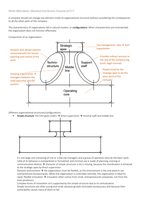
Components of an organization:
Top management: idea start
organization
Analysts who design systems
concerned with the formal
planning and control of the Provides indirect services to
work the rest of the company (eg.
lunch, legal counsel)
People hired by the
Growing organization strategic apex to do the
managers between the basic work of the
chief executive and the company
workers
Different organizational structures/configurations:
Simple structure: the CEO gives orders direct supervision minimal staff and middle line.
It’s one large unit consisting of one or a few top managers and a group of operators who do the basic work.
Little of its behavior is standardized or formalized, and minimal use is made of planning, training or
communication devices character of simple structure: a lot is missing, because the coordination is achieved
at the strategic apex by direct supervision.
Dynamic environment the organization must be flexible, as this environment is the only place it can
outmanoeuvre bureaucracies. When the organization is controlled centrally, the organization is ideal for
rapid, flexible innovation innovation often comes from small, entrepreneurial companies, not from the
mass producers.
Complex forms of innovation isn’t supported by the simple structure due to its centralization.
Simple structures are often young and small, because growth stimulates bureaucracy and because their
vulnerability causes many of them to fail.
A company should not change one element inside its organizational structure without considering the consequences
to all the other parts of the company.
The characteristics of organizations fall in natural clusters, or configurations. When characteristics are mismatched,
the organization does not function effectively.
Components of an organization:
Top management: idea start
organization
Analysts who design systems
concerned with the formal
planning and control of the Provides indirect services to
work the rest of the company (eg.
lunch, legal counsel)
People hired by the
Growing organization strategic apex to do the
managers between the basic work of the
chief executive and the company
workers
Different organizational structures/configurations:
Simple structure: the CEO gives orders direct supervision minimal staff and middle line.
It’s one large unit consisting of one or a few top managers and a group of operators who do the basic work.
Little of its behavior is standardized or formalized, and minimal use is made of planning, training or
communication devices character of simple structure: a lot is missing, because the coordination is achieved
at the strategic apex by direct supervision.
Dynamic environment the organization must be flexible, as this environment is the only place it can
outmanoeuvre bureaucracies. When the organization is controlled centrally, the organization is ideal for
rapid, flexible innovation innovation often comes from small, entrepreneurial companies, not from the
mass producers.
Complex forms of innovation isn’t supported by the simple structure due to its centralization.
Simple structures are often young and small, because growth stimulates bureaucracy and because their
vulnerability causes many of them to fail.