Barker & Jane Chapter 1: An Introduction To Cultural Studies
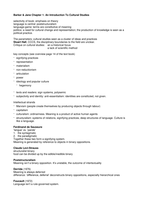
selectivity of book: emphasis on theory
language is central: poststructuralism
language-game: terms are constitutive of meaning
politics: a need for cultural change and representation; the production of knowledge is seen as a
political practice.
The parameters: cultural studies seen as a cluster of ideas and practices
Stuart Hall, CCCS, the disciplinary boundaries to the field are unclear.
Critique on cultural studies: an a-historical focus
a lack of scientific method
key concepts (see overview page 14 of the text book)
- signifying practices
- representation
- materialism
- non-reductionism
- articulation
- power
- ideology and popular culture
- hegemony
- texts and readers: sign systems, polysemic
- subjectivity and identity: anti-essentialism: identities are constituted, not given.
Intellectual strands
- Marxism (people create themselves by producing objects through labour)
- capitalism
- culturalism: ordinariness. Meaning is a product of active human agents
- structuralism: systems of relations, signifying practices, deep structures of language. Culture is
like a language.
Ferdinand de Saussure
‘langue’ vs. ‘parole’
1. the syntagmatic
2. the paradigmatic
Together these two form a signifying system.
Meaning is generated by reference to objects in binary oppositions.
Claude Levi-Strauss
structuralist binary
food can be divided up by the edible/inedible binary
Poststructuralism
Meaning isn’t a binary opposition. It’s unstable, the outcome of intertextuality
Derrida (1976)
Meaning is always deferred
differance: ‘difference, deferral’ deconstructs binary oppositions, especially hierarchical ones
Foucault (1972)
Language isn’t a rule-governed system.
selectivity of book: emphasis on theory
language is central: poststructuralism
language-game: terms are constitutive of meaning
politics: a need for cultural change and representation; the production of knowledge is seen as a
political practice.
The parameters: cultural studies seen as a cluster of ideas and practices
Stuart Hall, CCCS, the disciplinary boundaries to the field are unclear.
Critique on cultural studies: an a-historical focus
a lack of scientific method
key concepts (see overview page 14 of the text book)
- signifying practices
- representation
- materialism
- non-reductionism
- articulation
- power
- ideology and popular culture
- hegemony
- texts and readers: sign systems, polysemic
- subjectivity and identity: anti-essentialism: identities are constituted, not given.
Intellectual strands
- Marxism (people create themselves by producing objects through labour)
- capitalism
- culturalism: ordinariness. Meaning is a product of active human agents
- structuralism: systems of relations, signifying practices, deep structures of language. Culture is
like a language.
Ferdinand de Saussure
‘langue’ vs. ‘parole’
1. the syntagmatic
2. the paradigmatic
Together these two form a signifying system.
Meaning is generated by reference to objects in binary oppositions.
Claude Levi-Strauss
structuralist binary
food can be divided up by the edible/inedible binary
Poststructuralism
Meaning isn’t a binary opposition. It’s unstable, the outcome of intertextuality
Derrida (1976)
Meaning is always deferred
differance: ‘difference, deferral’ deconstructs binary oppositions, especially hierarchical ones
Foucault (1972)
Language isn’t a rule-governed system.