Chapter 7 – Mechanisms of perception
Following on from the visual system, we have gustation, olfaction, audition, attention, and
somatosensory systems.
Primary sensory cortex, secondary sensory cortex, and association cortex. From most informational
relay to higher processing.
Features of sensory system organisation:
- Hierarchical organisation: Thalamic nuclei pick up information, then the association cortices
allow higher level functioning utilising this information. From specificity to complex systems,
each system needs the other to carry out their respective functions. Damage to receptors
that perceive initial input causes disruptions to the system, but fundamental features remain
intact when the association cortex is mildly damaged, with specific damage done. Sensation
is a basic function, perception requires higher cognitive processing, which some people may
lack after associative damage.
- Functional segregation: Each level of the somatosensory pathway has its own specific
function. Nothing is homogenous, which is why each bit of the cortex is necessary.
- Parallel processing: Multiple pathways of information processed parallel to one another,
allowing us to have multiple things going on at once. This can be conscious or unconscious.
One signal can be processed at the same time by multiple pathways to create one whole.
- Information is not homogenous or serial. It is complex, segregated, and independent, with
all the information making sense in our brain to help create the whole. The binding problem
is the idea that the brain must be able to bring together all this information somehow, but if
they are independent and work on their own, then how does this happen? The claustrum is
rumoured to be involved in making sense of all information, but this is debated. The
claustrum is a thin sheet of neurons and glial cells, connecting to the frontal cortex and the
thalamus.
Auditory system
Humans hear sound from around 20-20,000 Hz. Sound is any vibrating air molecule that can
stimulate the auditory system.
Amplitude links to volume, frequency links to pitch, and complexity links to timbre (how a sound
sounds). Sound in real life is complex, not pure, or simple sin wave sounds. The complex sound is
made by the summation of a lot of simple sin waves that make up the whole complex sound. This is
called Fourier analysis, where complex is seen as the breakdown into simple.
Fundamental frequency: the lowest frequency picked up from a sound wave. It is the first harmonic.
This is usually the frequency needed for the sound to be heard, anything following on being a
multiple of the harmonic.
The ear
, The sound travels from the outer ear to the canal, causing the eardrum to vibrate (TYMPANIC
MEMBRANE). This sends vibrations to the ossicles (hammer, anvil, stirrup), which causes signals to
get sent to the cochlea by the oval window or the sound dissipates at the round window. The
cochlea is a snail shaped fluid area containing the organ of Corti. The organ of Corti has fine hairs on
it, along with the basilar membrane and tectorial membrane, which stimulates the auditory nerves
and sends axonal firing to be perceived by the brain via the cranial nerve auditory vestibular. The
auditory nerves synapse at the ipsilateral cochlear nuclei.
Different segments of the basilar membrane are stimulated to produce different frequencies. This
organisation is tonotopic. The mystery surrounding the auditory system is the fact that we can single
out a certain sound even when surrounded by noise at a club. We hear sounds that relate to us more
over the loudest sounds, making the system highly complex and specialised. The semi-circular canals
are also underrated. They help to localise sound and under the influence of gravity, it helps us retain
our balance (vestibular system).
Information gets to the primary auditory cortex via the
medial geniculate nuclei. The cochlea sends
information to the superior olives, after the auditory
nerves synapse. The superior olives project via the
lateral lemniscus to the inferior colliculi in the tectum
(mesencephalon), where they synapse on the neurons
that project to the medial geniculate nucleus in the
thalamus and then the primary auditory cortex.
Following on from the visual system, we have gustation, olfaction, audition, attention, and
somatosensory systems.
Primary sensory cortex, secondary sensory cortex, and association cortex. From most informational
relay to higher processing.
Features of sensory system organisation:
- Hierarchical organisation: Thalamic nuclei pick up information, then the association cortices
allow higher level functioning utilising this information. From specificity to complex systems,
each system needs the other to carry out their respective functions. Damage to receptors
that perceive initial input causes disruptions to the system, but fundamental features remain
intact when the association cortex is mildly damaged, with specific damage done. Sensation
is a basic function, perception requires higher cognitive processing, which some people may
lack after associative damage.
- Functional segregation: Each level of the somatosensory pathway has its own specific
function. Nothing is homogenous, which is why each bit of the cortex is necessary.
- Parallel processing: Multiple pathways of information processed parallel to one another,
allowing us to have multiple things going on at once. This can be conscious or unconscious.
One signal can be processed at the same time by multiple pathways to create one whole.
- Information is not homogenous or serial. It is complex, segregated, and independent, with
all the information making sense in our brain to help create the whole. The binding problem
is the idea that the brain must be able to bring together all this information somehow, but if
they are independent and work on their own, then how does this happen? The claustrum is
rumoured to be involved in making sense of all information, but this is debated. The
claustrum is a thin sheet of neurons and glial cells, connecting to the frontal cortex and the
thalamus.
Auditory system
Humans hear sound from around 20-20,000 Hz. Sound is any vibrating air molecule that can
stimulate the auditory system.
Amplitude links to volume, frequency links to pitch, and complexity links to timbre (how a sound
sounds). Sound in real life is complex, not pure, or simple sin wave sounds. The complex sound is
made by the summation of a lot of simple sin waves that make up the whole complex sound. This is
called Fourier analysis, where complex is seen as the breakdown into simple.
Fundamental frequency: the lowest frequency picked up from a sound wave. It is the first harmonic.
This is usually the frequency needed for the sound to be heard, anything following on being a
multiple of the harmonic.
The ear
, The sound travels from the outer ear to the canal, causing the eardrum to vibrate (TYMPANIC
MEMBRANE). This sends vibrations to the ossicles (hammer, anvil, stirrup), which causes signals to
get sent to the cochlea by the oval window or the sound dissipates at the round window. The
cochlea is a snail shaped fluid area containing the organ of Corti. The organ of Corti has fine hairs on
it, along with the basilar membrane and tectorial membrane, which stimulates the auditory nerves
and sends axonal firing to be perceived by the brain via the cranial nerve auditory vestibular. The
auditory nerves synapse at the ipsilateral cochlear nuclei.
Different segments of the basilar membrane are stimulated to produce different frequencies. This
organisation is tonotopic. The mystery surrounding the auditory system is the fact that we can single
out a certain sound even when surrounded by noise at a club. We hear sounds that relate to us more
over the loudest sounds, making the system highly complex and specialised. The semi-circular canals
are also underrated. They help to localise sound and under the influence of gravity, it helps us retain
our balance (vestibular system).
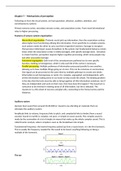
Information gets to the primary auditory cortex via the
medial geniculate nuclei. The cochlea sends
information to the superior olives, after the auditory
nerves synapse. The superior olives project via the
lateral lemniscus to the inferior colliculi in the tectum
(mesencephalon), where they synapse on the neurons
that project to the medial geniculate nucleus in the
thalamus and then the primary auditory cortex.