EXAMPLE BIOL 111 end of module test – for
Moodle web page.
1. Define the term ‘isotope’. (1 mark)
2. What type of covalent bond connects a hydrogen atom to an oxygen atom in a water molecule? (1
mark)
3. Define ‘specific heat’ of water. (1 mark)
4. Draw a detailed picture of one molecule of methane. (2 marks)
5. What is the pH of 0.01M NaOH? Show all working. (5 marks)
6. Write the sequence of the mRNA molecule synthesized from a DNA template strand with the
sequence 5’-ATCGTACCGTTA-3’ (3 marks)
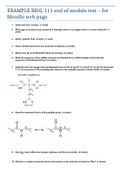
7. Determine the net charge of the predominant form of Glu at (a) pH 1.0, (b) pH 3.0, (c) pH 6.0 and (d) pH
11.0. The structure of Glu including pKa values for the ionisable groups is shown below. (4 marks)
8. Draw the resonance forms of the peptide group. (3 marks)
9. Give two major difference between globular and fibrous proteins. (2 marks)
10. Glycine is a highly conserved amino acid residue in the evolution of proteins. Why? (3 marks)
Moodle web page.
1. Define the term ‘isotope’. (1 mark)
2. What type of covalent bond connects a hydrogen atom to an oxygen atom in a water molecule? (1
mark)
3. Define ‘specific heat’ of water. (1 mark)
4. Draw a detailed picture of one molecule of methane. (2 marks)
5. What is the pH of 0.01M NaOH? Show all working. (5 marks)
6. Write the sequence of the mRNA molecule synthesized from a DNA template strand with the
sequence 5’-ATCGTACCGTTA-3’ (3 marks)
7. Determine the net charge of the predominant form of Glu at (a) pH 1.0, (b) pH 3.0, (c) pH 6.0 and (d) pH
11.0. The structure of Glu including pKa values for the ionisable groups is shown below. (4 marks)
8. Draw the resonance forms of the peptide group. (3 marks)
9. Give two major difference between globular and fibrous proteins. (2 marks)
10. Glycine is a highly conserved amino acid residue in the evolution of proteins. Why? (3 marks)