Statistical Methods for International Business Administration
Chapter 1: Introduction and basic concepts
A study in economics often uses measurements collected from a previously specified set of objects.
The set of objects under investigation is called the population. The objects themselves are the
(population) elements. The observations or measurements made is called the data. Data has to be
collected first after it can be summarized. Often the population is too large which makes it too
expensive/time consuming to obtain measurements for all population elements. That’s why there is
a sample which is an observed part of the population. This sample has to be a random sample
(sample with arbitrarily drawn elements from the population) to ensure that the whole population
can be checked. A characteristic (feature of interest for the population) can be measured by a
variable which each have their own value. Since many conclusions are essentially probabilistic
reflections, probability is very important for statistics.
Statistics can be divided into four sub-fields:
- Descriptive statistics colleting, summarizing and presenting data by tables, graphs and numbers.
- Probability studies the behaviour and the laws of chance and probability in experiments that
allow more than one outcome.
- Sampling theory studies methods of sampling and their properties
- Inferential statistics studies and applies methods to draw conclusions about distinctive numbers
of the whole population of interest by considering only a sample
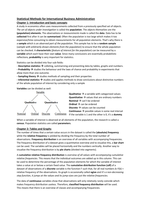
Variables can be divided as well:
Qualitative a variable with categorized values
Quantitative values that are ordinary numbers
Nominal can’t be ordered
Ordinal can be ordered
Discrete values can be counted
Continuous possible values is some real interval
If the variable is 1 and the other is 0, it’s a dummy.
When a variable of interest is observed at all elements of the population, the research is called a
census. Population statistics are called parameters.
Chapter 2: Tables and Graphs
The number of times that a certain value occurs in the dataset is called the (absolute) frequency
while the relative frequency is yielded by dividing the frequency by the total number of
observations. Frequency distribution is an overview of all variables with accompanying frequencies.
The frequency distribution of a dataset gives a quantitative overview and to visualize this, a bar chart
can be used. The variables will be placed horizontally and the numbers vertically. Another way to
visualize the frequency distribution is by pie charts (divided into segments).
A cumulative relative frequency distribution is overview of all values with accompanying cumulative
relative frequencies. This means that the individual outcomes are added up in this column. This can
be used to determine the percentage of the population elements for which the variable of interest
takes a value at or below a certain fixed value. The cumulative distribution function (cdf) of a
dataset of observations of a discrete variable is the function F such that, for all real numbers b: F(b) =
relative frequency of the observations. Its graph is occasionally called ogive and it’s a non-decreasing
step function, it jumps at the values and its jump-sizes are just the relative frequencies.
The data of continuous variables show that observations will only relatively rarely coincide which
makes frequency distribution useless. Therefore, classified frequency distribution will be used.
This means that there is an overview of classes and accompanying frequencies.
Chapter 1: Introduction and basic concepts
A study in economics often uses measurements collected from a previously specified set of objects.
The set of objects under investigation is called the population. The objects themselves are the
(population) elements. The observations or measurements made is called the data. Data has to be
collected first after it can be summarized. Often the population is too large which makes it too
expensive/time consuming to obtain measurements for all population elements. That’s why there is
a sample which is an observed part of the population. This sample has to be a random sample
(sample with arbitrarily drawn elements from the population) to ensure that the whole population
can be checked. A characteristic (feature of interest for the population) can be measured by a
variable which each have their own value. Since many conclusions are essentially probabilistic
reflections, probability is very important for statistics.
Statistics can be divided into four sub-fields:
- Descriptive statistics colleting, summarizing and presenting data by tables, graphs and numbers.
- Probability studies the behaviour and the laws of chance and probability in experiments that
allow more than one outcome.
- Sampling theory studies methods of sampling and their properties
- Inferential statistics studies and applies methods to draw conclusions about distinctive numbers
of the whole population of interest by considering only a sample
Variables can be divided as well:
Qualitative a variable with categorized values
Quantitative values that are ordinary numbers
Nominal can’t be ordered
Ordinal can be ordered
Discrete values can be counted
Continuous possible values is some real interval
If the variable is 1 and the other is 0, it’s a dummy.
When a variable of interest is observed at all elements of the population, the research is called a
census. Population statistics are called parameters.
Chapter 2: Tables and Graphs
The number of times that a certain value occurs in the dataset is called the (absolute) frequency
while the relative frequency is yielded by dividing the frequency by the total number of
observations. Frequency distribution is an overview of all variables with accompanying frequencies.
The frequency distribution of a dataset gives a quantitative overview and to visualize this, a bar chart
can be used. The variables will be placed horizontally and the numbers vertically. Another way to
visualize the frequency distribution is by pie charts (divided into segments).
A cumulative relative frequency distribution is overview of all values with accompanying cumulative
relative frequencies. This means that the individual outcomes are added up in this column. This can
be used to determine the percentage of the population elements for which the variable of interest
takes a value at or below a certain fixed value. The cumulative distribution function (cdf) of a
dataset of observations of a discrete variable is the function F such that, for all real numbers b: F(b) =
relative frequency of the observations. Its graph is occasionally called ogive and it’s a non-decreasing
step function, it jumps at the values and its jump-sizes are just the relative frequencies.
The data of continuous variables show that observations will only relatively rarely coincide which
makes frequency distribution useless. Therefore, classified frequency distribution will be used.
This means that there is an overview of classes and accompanying frequencies.