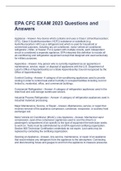
EPA CFC EXAM 2023 Questions and Answers
Appliance - Answer- Any device which contains and uses a Class I (chlorofluorocarbon; CFC), Class II (hydrofluorocarbon; HCFC) substance or substitute (e.g. Hydrofluorocarbon: HFC) as a refrigerant and which is used for household or commercial purposes, including any air conditioner, motor vehicle air conditioner, refrigerator, chiller, or freezer. For a system with multiple circuits, each independent circuit is considered a separate appliance. EPA interprets this definition to include all air-conditioning and refrigeration equipment except that designed and used exclusively for military purposes. Apprentice - Answer- Any person who is currently registered as an apprentice in maintenance, service, repair, or disposal of appliances with the U.S. Department of Labor's Office of Apprenticeship (or a State Apprenticeship Council recognized by the Office of Apprenticeship). Comfort Cooling - Answer- A category of air-conditioning appliances used to provide cooling in order to control heat and/or humidity in occupied facilities including, but not limited to, residential, office, and commercial buildings. Commercial Refrigeration - Answer- A category of refrigeration appliances used in the retail food and cold storage warehouse sectors. Industrial Process Refrigeration - Answer- A category of refrigeration appliances used in industrial materials processing. Major Maintenance, Service, or Repair - Answer- Maintenance, service, or repair that involves removal of the appliance compressor, condenser, evaporator, or auxiliary heat exchanger coil. Motor Vehicle Air Conditioner (MVAC)- Like Appliance - Answer- Mechanical vapor compression, open-drive compressor appliances used to cool the driver's or passenger's compartment of an specific to the type of equipment the technician seeks to work on. Tests must be administered by an EPA-approved certifying organization. Section 608 Technician Certification credentials do not expire. Lost cards may be replaced by contacting the certifying organization. Opening an Appliance - Answer- Any service, maintenance, or repair of an appliance that would release any refrigerant from the appliance to the atmosphere. Connecting and disconnecting hoses and gauges to and from the appliance to measure pressures within the appliance and to add refrigerant to or recover refrigerant from the appliance are not considered "opening." Reclaim - Answer- To reprocess recovered refrigerant to at least the purity specified in the Air-Conditioning, Heating, and Refrigeration Institute (AHRI) Standard 700 and to verify this purity using the analytical methodology prescribed in the standard. Reclamation requires specialized machinery not available at a particular job site or auto repair shop. The technician will recover the refrigerant and then send it either to a general reclaimer or back to the refrigerant manufacturer. Recover - Answer- To remove refrigerant in any condition from an appliance and store it in an external container without necessarily testing or processing it in any way. Recycle - Answer- When referring to a refrigerant, to recycle means to extract refrigerant from an appliance (except an MVAC) and clean it for reuse in equipment of the same owner without meeting all of the requirements for reclamation. In general, recycled refrigerant is refrigerant that is cleaned using oil separation and single or multiple passes through devices such as; replaceable core filter-driers; that reduce moisture, acidity and particulate matter. Under Section 609 of the Clean Air Act, refrigerant can be removed from one car's air conditioner, recycled onsite and then charged into a different car. Refrigerant Pressure Classifications - Answer- Shown below are examples of refrigerants that fall in the "very high", "high", and "low" pressure categories. Small Appliance - Answer- Any of the following products that is fully manufactured, charged, and hermetically sealed in a factory with five pounds or less of refrigerant: refrigerators and freezers designed for home use, room air conditioners (including window air conditioners and packaged terminal air conditioners), packaged terminal heat pumps, dehumidifiers, under-the-counter ice makers, vending machines, and drinking water coolers. Self-Contained (Active) - Answer- Uses its own means to draw refrigerant out of the refrigeration system. System-Dependent (Passive) - Answer- Relies upon the compressor in an appliance and/or the pressure of the refrigerant in the appliance to remove the refrigerant into an external container. Technician - Answer- Any person who, in the course of maintenance, service, or repair of an appliance (except MVACs), could be reasonably expected to violate the integrity of the refrigerant circuit and thereby release Class I or Class II refrigerants into the environment. This term also means any person who, in the course of disposal of an appliance (except small appliances, MVACs, and MVAC-like appliances), could be reasonably expected to violate the integrity of the refrigerant circuit and thereby release refrigerants from the appliance into the environment. Activities reasonably expected to violate the integrity of the refrigerant circuit include but are not limited to: attaching or detaching hoses and gauges to and from the appliance, adding or removing refrigerant, adding or removing components, and cutting the refrigerant line. Activities such as painting the appliance, rewiring an external electrical circuit, replacing insulation on a length of pipe, or tightening nuts and bolts are not reasonably expected to violate the integrity of the refrigerant circuit. Activities conducted on appliances that have been properly evacuated are not reasonably expected to release refrigerants unless the activity includes adding refrigerant to the appliance. Technicians could include, but are not limited to installers, contractor employees, in-house service personnel, and owners and/or operators of appliances. This term also means any person disposing of appliances, except for small appliances. Type I Certification - Answer- For technicians who maintain, service, or repair small (household) appliances. Must pass the Core exam and the Type I exam to receive a Type I certification. Type 2 Certification - Answer- For technicians who maintain, service, repair or dispose of high pressure or very-high-pressure appliances, except small appliances and Motor Vehicle Air Conditioners (MVACs). Must pass the Core exam and the Type II exam to receive a Type II certification. Type 3 Certification - Answer- For technicians who maintain, service, or repair low-pressure appliances or dispose of low-pressure appliances. Must pass the Core exam and the Type III exam to receive a Type III certification. Universal - Answer- For technicians who maintain, service, or repair low-pressure, high pressure and very high-pressure equipment. Passing the Core and Type I, Type II, and Type III exams qualifies a technician for a universal certification. Class I Substances - Answer- One of several groups of chemicals with an ozone-depletion potential (ODP) of 0.2 or higher, relative to R-11 being 1.0. This includes CFCs, halons, carbon tetrachloride, and methyl chloroform. See Text for a description of CFC phase out dates. Class II Substances - Answer- A chemical with an ozone-depletion potential (ODP) of less than 0.2, including all HCFCs. See Text for a description of HCFC phase out dates. What is a CFC? - Answer- Chlorofluorocarbon. What is a HCFC? - Answer- Hydrochlorofluorocarbon. What is a HFC? - Answer- Hydrofluorocarbon. The ozone layer protects the planet's surface from? - Answer- UV radiation. Ozone depletion in the stratosphere is a ______ problem - Answer- Global. One of the most serious results of damage to the ozone layer is ______. - Answer- Increases in human skin cancer. ______ is a gas that helps form a protective shield around the earth - Answer- Stratospheric ozone. When ______ is found in the upper stratosphere, it indicates that the ozone layer is being destroyed - Answer- Chlorine monoxide. ______ is the element in refrigerants that causes ozone depletion - Answer- Chlorine. Ozone in the stratosphere above the earth consists of ______ - Answer- Molecules containing three oxygen atoms. Ozone depletion potential or "ODP" is ______ - Answer- A measurement of a refrigerant's ability to destroy ozone. An increase in ultraviolet radiation could result in an increase in the number of ______ ? - Answer- Cataracts cases. Chlorofluorocarbons (CFCs) and hydrochlorofluorocarbons (HCFCs) are similar in that - Answer- Both must be recovered before opening or disposing of appliances. ______ have the highest ozone depletion potential (ODP) - Answer- CFC's. Of the following refrigerants, ______ has the lowest ODP - Answer- R-134a. The strongest evidence that CFCs are in the stratosphere is ______ . - Answer- Measurements of other man made compounds in air samples from the stratosphere. ______ is a chlorine free refrigerant - Answer- HFC-134a. Are fluorocarbon refrigerants that cause no harm to stratospheric ozone - Answer- HFC's. ______ is a CFC refrigerant - Answer- R-12. ______ is an HCFC refrigerant - Answer- R-22. ______ is an HFC refrigerant - Answer- R-134a. Refrigerant that can be used as a direct, "drop in" substitute for R-12 in a small appliance is ______ - Answer- None of the above (Which are R-134a, R-22 and R-141b). To stop damage to the stratospheric ozone layer, the U.S. is ______ - Answer- Eliminating the production and regulating the use of chlorofluorocarbons. 21) Compared to CFCs, HCFC refrigerants are ______ harmful to stratospheric ozone - Answer- Less. CFCs were not manufactured or imported into the U.S. after ______ - Answer- 1994. ______ is considered a class I substance - Answer- R-12. Equipment covered by EPA regulations includes ______ - Answer- All air conditioning and refrigeration equipment containing and using CFC and HCFC refrigerants. Ternary blend of refrigerants can be described as a(n) ______ mixture. - Answer- Three-part. ______and ______ refrigerants are mixed to create binary or ternary blends - Answer- None of the above (Which are R-11; r-12, R-12; r-134a and R-12; r-22). An azeotropic mixture is a mixture that ______ . - Answer- Combines two refrigerants that create a third refrigerant with its own individual characteristics. When a refrigerant blend has a range of boiling points or condensing points in the evaporator and condenser, Respectively, the term used to describe the range is ______ - Answer- Temperature glide. Blended refrigerants must be charged ______ . - Answer- By weight into the high-pressure side of the system as a liquid. Blended refrigerants leak from a system ______ . - Answer- In uneven amounts due to different vapor pressures. Refrigerant oil that is hygroscopic _______. - Answer- Has a high affinity for water. The oils that are used with most HFC-134a refrigerant applications are ______. - Answer- Polyol esters. The synthetic lubricants presently used with HCFC ternary blends are ______ lubricants. - Answer- Alkylbenzene. Ester base oils can be mixed with ______ . - Answer- No other oils. An oil sample should be taken when ______ . - Answer- A system has had a compressor burnout. When first inspecting a system with a hermetically sealed compressor when the system is known to be leaking, a technician should look for______. - Answer- Traces of refrigerant oil. Refrigerant will migrate to the crankcase of a compressor because of the difference in ______ between the oil and the refrigerant. - Answer- Density. Oil foaming usually occurs in the ______ area of a high- pressure refrigeration system. - Answer- Compressor. When removing oil from a low-pressure system, the compressor oil should be heated to 130°f because ______. - Answer- Less refrigerant will be contained in the oil at the higher temperature. The Montreal protocol is ______. - Answer- A treaty among nations that controls production of CFC's and HCFC's. The Montreal protocol controls ______. - Answer- Chlorofluorocarbons, hydrochlorofluorocarbons and halon. The clean air act ______. - Answer- Calls for the phase out of CFC/HCFC production, prohibits CFC/HCFC venting as of July 1, 1992 and requires the EPA to set standards for recovery of refrigerants prior to appliance disposal. Service technicians who violate clean air act provision

Geschreven voor
- Instelling
- EPA CFC
- Vak
- EPA CFC
Documentinformatie
- Geüpload op
- 10 april 2023
- Aantal pagina's
- 24
- Geschreven in
- 2022/2023
- Type
- Tentamen (uitwerkingen)
- Bevat
- Vragen en antwoorden
Onderwerpen
-
epa cfc
-
appliance
-
apprentice
-
comfort cooling
-
commercial refrigeration
-
major maintenance
-
service
-
or repair
-
epa cfc exam 2023 questions and answers
-
industrial process refrigeration

Ook beschikbaar in voordeelbundel