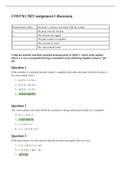
COS3761 2023 assignment 1 discussion
Propositional symbol Declarative sentence associated with the symbol
p My party wins the election
q The election was rigged
r The party leader is a populist
s The economy is weak
t The voter turnout is low
Using the symbols and their intended meaning given in Table 1, which of the options
below is a correct propositional logic translation of the following English sentence? Q1 -
Q4
Question 1
If the economy is weak and the party leader is a populist, then either my party wins the election or
the voter turnout is low.
1. (p ∨ t) → (s ∧ r)
2. (s ∨ r) → (p ∧ t)
3. (p ∧ t) → (s ∨ r)
4. (s ∧ r) → (p ∨ t)
Question 2
The voter turnout is low only if both the economy is strong and the party leader isn’t a populist.
1. (t → ¬ s) ∧ ¬ r
2. t → (¬ s ∧ ¬ r)
3. (¬ s ∧ r) → t
4. (¬ s → t) ∧ (r → t)
Question 3
If my party doesn’t win the election, then the election was rigged, and vice versa.
1. (¬ p → q) ∧ (¬ q → p)
2. (¬ p ∨ p) → (q ∨ ¬ q)
3. (p ↔ ¬q)
Propositional symbol Declarative sentence associated with the symbol
p My party wins the election
q The election was rigged
r The party leader is a populist
s The economy is weak
t The voter turnout is low
Using the symbols and their intended meaning given in Table 1, which of the options
below is a correct propositional logic translation of the following English sentence? Q1 -
Q4
Question 1
If the economy is weak and the party leader is a populist, then either my party wins the election or
the voter turnout is low.
1. (p ∨ t) → (s ∧ r)
2. (s ∨ r) → (p ∧ t)
3. (p ∧ t) → (s ∨ r)
4. (s ∧ r) → (p ∨ t)
Question 2
The voter turnout is low only if both the economy is strong and the party leader isn’t a populist.
1. (t → ¬ s) ∧ ¬ r
2. t → (¬ s ∧ ¬ r)
3. (¬ s ∧ r) → t
4. (¬ s → t) ∧ (r → t)
Question 3
If my party doesn’t win the election, then the election was rigged, and vice versa.
1. (¬ p → q) ∧ (¬ q → p)
2. (¬ p ∨ p) → (q ∨ ¬ q)
3. (p ↔ ¬q)