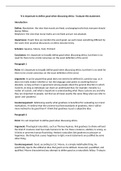
‘It is important to define good when discussing ethics.’ Evaluate this statement.
Introduction
Define: Absolutism- the view that morals are fixed, unchanging truths that everyone should
always follow.
Relativism- the view that moral truths are not fixed and are not absolute.
Importance: If each time we mention the word good, we each mean something different by
the word, then practical discussions on ethics become tricky.
Scholars: Aquinas, Moore, Foot, Prichard
Conclusion: It is important to broadly define good when discussing ethics, but there is no
need for there to be a total consensus on the exact definition of the word.
Paragraph 1
Point: It is important to broadly define good when discussing ethics, but there is no need for
there to be a total consensus on the exact definition of the word.
Argument: It can be argued that good does not need to be defined in a precise way, as it
does not really matter whether or not the language used points to anything fixed or
absolute, as long as there is agreement among people about the general direction in which
it points. As long as individuals can share an understand that, for example, morality is a
matter of custom, and what is important is understanding what those customs are and why
they are important to people, not that we all mean exactly the same thing when we refer to
‘good’ and ‘goodness’.
Counterargument: Addressing exactly what goodness is beneficial for evaluating our moral
motivations. If I believe that the universe has fixed standards of goodness, then I will be
more inclined to be good than if I think that goodness is just a subjective idea.
Paragraph 2
Point: It is not important to define good when discussing ethics.
Argument: Theological naturalists, such as Thomas Aquinas, link goodness to divine will and
the kind of creatures God has made humans to be. For these creatures, adultery is wrong, as
it limits or prevents human flourishing. Hedonic naturalists link goodness to pleasure or
happiness: the thing that causes happiness is right; moral statements are justified by some
other thing.
Counterargument: Good, according to G.E. Moore, is a simple indefinable thing. He
specifically rejects the utilitarian idea that good can be defined, measured, quantified, and
qualified. Moore characterised any attempt to define good as a naturalistic fallacy. Trying to
, say good is something that makes us happy breaks the word good down into something
else, which is not possible as good is a simple thing that can’t be broken down into parts.
According to G.E. Moore, the mistake that Aquinas makes is that he is looking into the world
for some physical thing to define or substitute in place of good. This turns the moral
judgement into a judgement about the physical world, and that is wrong.
Moore wrote, ‘everything is what it is and not another thing’ (Principia Ethica, 1903).
Paragraph 3
Point: It is important to broadly define good when discussing ethics, but there is no need for
there to be a total consensus on the exact definition of the word.
Argument: Instead of looking for the most precise definition of good, perhaps we should
find other ways to discuss morality. Perhaps we can talk about good in terms of virtue, habit
or practice, as Foot suggests, rather than a definition of ‘good’. Maybe we should focus on
how to flourish as human beings rather than on what is wrong or right to do, and think
about other features of moral decision-making like human motivation or conscience.
Prichard offers other words like ‘duty’, ‘obligation’ and ‘right’ to use alongside ‘good’.
Counterargument: Using precise language in moral questions and debates is significant as
matters of morality inform law and policy. Moral debates are often linked to questions
about people’s suffering and questions about justice and rights, so knowing the exact
definitions of terms used is imperative for productive debates.
Introduction
Define: Absolutism- the view that morals are fixed, unchanging truths that everyone should
always follow.
Relativism- the view that moral truths are not fixed and are not absolute.
Importance: If each time we mention the word good, we each mean something different by
the word, then practical discussions on ethics become tricky.
Scholars: Aquinas, Moore, Foot, Prichard
Conclusion: It is important to broadly define good when discussing ethics, but there is no
need for there to be a total consensus on the exact definition of the word.
Paragraph 1
Point: It is important to broadly define good when discussing ethics, but there is no need for
there to be a total consensus on the exact definition of the word.
Argument: It can be argued that good does not need to be defined in a precise way, as it
does not really matter whether or not the language used points to anything fixed or
absolute, as long as there is agreement among people about the general direction in which
it points. As long as individuals can share an understand that, for example, morality is a
matter of custom, and what is important is understanding what those customs are and why
they are important to people, not that we all mean exactly the same thing when we refer to
‘good’ and ‘goodness’.
Counterargument: Addressing exactly what goodness is beneficial for evaluating our moral
motivations. If I believe that the universe has fixed standards of goodness, then I will be
more inclined to be good than if I think that goodness is just a subjective idea.
Paragraph 2
Point: It is not important to define good when discussing ethics.
Argument: Theological naturalists, such as Thomas Aquinas, link goodness to divine will and
the kind of creatures God has made humans to be. For these creatures, adultery is wrong, as
it limits or prevents human flourishing. Hedonic naturalists link goodness to pleasure or
happiness: the thing that causes happiness is right; moral statements are justified by some
other thing.
Counterargument: Good, according to G.E. Moore, is a simple indefinable thing. He
specifically rejects the utilitarian idea that good can be defined, measured, quantified, and
qualified. Moore characterised any attempt to define good as a naturalistic fallacy. Trying to
, say good is something that makes us happy breaks the word good down into something
else, which is not possible as good is a simple thing that can’t be broken down into parts.
According to G.E. Moore, the mistake that Aquinas makes is that he is looking into the world
for some physical thing to define or substitute in place of good. This turns the moral
judgement into a judgement about the physical world, and that is wrong.
Moore wrote, ‘everything is what it is and not another thing’ (Principia Ethica, 1903).
Paragraph 3
Point: It is important to broadly define good when discussing ethics, but there is no need for
there to be a total consensus on the exact definition of the word.
Argument: Instead of looking for the most precise definition of good, perhaps we should
find other ways to discuss morality. Perhaps we can talk about good in terms of virtue, habit
or practice, as Foot suggests, rather than a definition of ‘good’. Maybe we should focus on
how to flourish as human beings rather than on what is wrong or right to do, and think
about other features of moral decision-making like human motivation or conscience.
Prichard offers other words like ‘duty’, ‘obligation’ and ‘right’ to use alongside ‘good’.
Counterargument: Using precise language in moral questions and debates is significant as
matters of morality inform law and policy. Moral debates are often linked to questions
about people’s suffering and questions about justice and rights, so knowing the exact
definitions of terms used is imperative for productive debates.