1
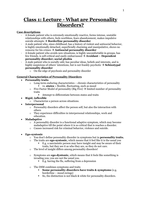
Class 1: Lecture - What are Personality
Disorders?
Case descriptions
- A female patient who is extremely emotionally reactive, forms intense, unstable
relationships with others, feels worthless, fears abandonment, makes impulsive
suicide attempts Borderline personality disorder
- A male patient who, since childhood, has a history of violent and antisocial behavior,
is highly emotionally detached, superficially charming and manipulative, shows no
remorse for his crimes Antisocial personality disorder
- A female patient who avoids new situations, is highly uncomfortable in groups, has
few friends, is self-critical and easily embarrassed Avoidant – Dependent
personality disorder; social phobia
- A male patient who is socially odd, has peculiar ideas, beliefs and interests, and is
highly suspicious of others’ intentions, but is not frankly psychotic Schizotypal
personality disorder
o On the edge of psychosis and personality disorder
General Characteristics of Personality Disorders
Personality traits
o Long-term enduring characteristics – chronic characteristics of personality
vs. states = flexible, fluctuating, such as mood
o Five Factor Model of personality (Big Five) limited number of personality
traits
Attempt to differentiate between states and traits
Rigid, inflexible
o Characterize a person across situations.
Interpersonal
o Personality disorders affect the person self, but also the interaction with
others
o They experience difficulties in interpersonal relationships, work and
education.
Maladaptive
o A personality disorder is a functional adaptive symptom, which may become
maladaptive till the point where it is so critical that is reaches a disorder.
o Causes increased risk for criminal behavior, violence and suicide.
Ego-syntonic
o You don't define personality disorder in symptoms but in personality traits.
o The traits are ego-syntonic, which means that it feel like it is the usual you
E.g. a narcissistic person may have insight and may be aware of their
traits, but they see it as who they are, so they do not care.
o The level of insight differs among personality disorders!
o Symptoms are ego-dyntonic, which means that it feels like something is
invading you; you are not the usual you.
E.g. having the flu, suffering from a depression
o The DSM combines symptoms and traits
Some personality disorders have traits & symptoms (e.g.
borderline – mood swings)
So, the distinction is not black & white for personality disorders.
Class 1: Lecture - What are Personality
Disorders?
Case descriptions
- A female patient who is extremely emotionally reactive, forms intense, unstable
relationships with others, feels worthless, fears abandonment, makes impulsive
suicide attempts Borderline personality disorder
- A male patient who, since childhood, has a history of violent and antisocial behavior,
is highly emotionally detached, superficially charming and manipulative, shows no
remorse for his crimes Antisocial personality disorder
- A female patient who avoids new situations, is highly uncomfortable in groups, has
few friends, is self-critical and easily embarrassed Avoidant – Dependent
personality disorder; social phobia
- A male patient who is socially odd, has peculiar ideas, beliefs and interests, and is
highly suspicious of others’ intentions, but is not frankly psychotic Schizotypal
personality disorder
o On the edge of psychosis and personality disorder
General Characteristics of Personality Disorders
Personality traits
o Long-term enduring characteristics – chronic characteristics of personality
vs. states = flexible, fluctuating, such as mood
o Five Factor Model of personality (Big Five) limited number of personality
traits
Attempt to differentiate between states and traits
Rigid, inflexible
o Characterize a person across situations.
Interpersonal
o Personality disorders affect the person self, but also the interaction with
others
o They experience difficulties in interpersonal relationships, work and
education.
Maladaptive
o A personality disorder is a functional adaptive symptom, which may become
maladaptive till the point where it is so critical that is reaches a disorder.
o Causes increased risk for criminal behavior, violence and suicide.
Ego-syntonic
o You don't define personality disorder in symptoms but in personality traits.
o The traits are ego-syntonic, which means that it feel like it is the usual you
E.g. a narcissistic person may have insight and may be aware of their
traits, but they see it as who they are, so they do not care.
o The level of insight differs among personality disorders!
o Symptoms are ego-dyntonic, which means that it feels like something is
invading you; you are not the usual you.
E.g. having the flu, suffering from a depression
o The DSM combines symptoms and traits
Some personality disorders have traits & symptoms (e.g.
borderline – mood swings)
So, the distinction is not black & white for personality disorders.