1
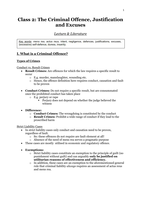
Class 2: The Criminal Offence, Justification
and Excuses
Lecture & Literature
I. What is a Criminal Offence?
Types of Crimes
Conduct vs. Result Crimes
Result Crimes: Are offences for which the law requires a specific result to
occur
o E.g. murder, manslaughter, wounding etc.
o Hence, the offence definition here requires conduct, causation and fault
to be proven
Conduct Crimes: Do not require a specific result, but are consummated
once the prohibited conduct has taken place
o E.g. perjury or rape
Perjury does not depend on whether the judge believed the
witness
Difference:
o Conduct Crimes: The wrongdoing is constituted by the conduct
o Result Crimes: Prohibit a wide range of conduct if they lead to the
proscribed harm
Strict Liability Cases
In strict liability cases only conduct and causation need to be proven,
regardless of fault.
o So: these offences do not require are fault element at all!
o Absence of the need of mens rea serves a pragmatic purpose
These cases are mostly utilised in economic and regulatory offence.
Exemptions:
o Strict liability cases constitute an exemption to the principle of guilt (no
punishment without guilt) and can arguably only be justified on
utilitarian reasons of effectiveness and efficiency.
o In addition, these cases are an exemption to the aforementioned general
rule that criminal liability always requires an assessment of actus reus
and mens rea.
Class 2: The Criminal Offence, Justification
and Excuses
Lecture & Literature
I. What is a Criminal Offence?
Types of Crimes
Conduct vs. Result Crimes
Result Crimes: Are offences for which the law requires a specific result to
occur
o E.g. murder, manslaughter, wounding etc.
o Hence, the offence definition here requires conduct, causation and fault
to be proven
Conduct Crimes: Do not require a specific result, but are consummated
once the prohibited conduct has taken place
o E.g. perjury or rape
Perjury does not depend on whether the judge believed the
witness
Difference:
o Conduct Crimes: The wrongdoing is constituted by the conduct
o Result Crimes: Prohibit a wide range of conduct if they lead to the
proscribed harm
Strict Liability Cases
In strict liability cases only conduct and causation need to be proven,
regardless of fault.
o So: these offences do not require are fault element at all!
o Absence of the need of mens rea serves a pragmatic purpose
These cases are mostly utilised in economic and regulatory offence.
Exemptions:
o Strict liability cases constitute an exemption to the principle of guilt (no
punishment without guilt) and can arguably only be justified on
utilitarian reasons of effectiveness and efficiency.
o In addition, these cases are an exemption to the aforementioned general
rule that criminal liability always requires an assessment of actus reus
and mens rea.