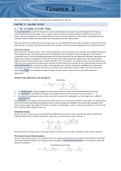
Finance 2
Berk, J. B., & DeMarzo, P. (2019). Corporate Finance, Global Edition. Pearson.
CHAPTER 9: VALUING STOCKS
9.1 THE DIVIDEND-DISCOUNT MODEL
The Law of One Price implies that the price of a security should equal the present value of the expected cash flows an
investor will receive from owning it. Thus, to value a stock, we need to know the expected cash flows an investor will
receive and the appropriate cost of capital with which to discount those cash flows. In this chapter we develop two stock
valuation models: dividend-discount model and the discounted free cash flows model.
The Law of One Price implies that to value any security, we must determine the expected cash flows an investor will receive
from owning it. If investors have the same beliefs, their valuation of the stock will not depend on their investment horizon.
A One-Year Investor
We first look at a one-year investor. There are two potential sources of cash flows from owning a stock: dividends and cash
from selling the stock. The total amount received in dividends and from selling the stock will depend on the investor’s
investment horizon. The future dividend payment and the future stock price are not known with certainty: these values are
based on the investor’s expectations at the time the stock is purchased. Given these expectations, the investor will be
willing to buy the stock at today’s price as long as the NPV of the transaction is not negative. Because these cash flows are
risky, we cannot compute their present value using the risk-free interest rate. Instead, we must discount them based on the
equity cost of capital, 𝑟𝐸 , for the stock, which is the expected return of other investments available in the market with
equivalent risk to the firm’s shares. Because for every buyer of the stock there must be a seller, the stock price should
𝐷𝑖𝑣1 +𝑃1
satisfy: 𝑃0 = . In a competitive market, buying or selling a share of stock must be a zero-NPV investment
1+𝑟𝐸
opportunity.
Dividend Yield, Capital Gains, and Total Returns
• The dividend yield is the percentage return the investor expects to earn from the dividend paid by the stock.
• The capital gain is the difference between the expected sale price and purchase price for the stock, 𝑃1 − 𝑃0.
• We divide the capital gain by the current stock price to express the capital gain as a percentage return, called the
capital gain rate.
The total return is the expected return that the investor will earn for a one-year investment in the stock. The expected total
return of the stock should equal the expected return of other investments available in the market with equivalent risk (=
equity cost of capital). This implies that the firm must pay its shareholders a return commensurate with the return they can
earn elsewhere while taking the same risk.
A Multiyear Investor
While a one-year investor does not care about the dividend and stock price in year 2 directly, she will care about them
indirectly because they will affect the price for which she can sell the stock at the end of year 1.
The formula for the stock price for a two-year investor is the same as the one for a sequence of two one-year investors.
The Dividend-Discount Model Equations
We can continue this process for any number of years by replacing the final stock price with the value that the next holder
of the stock would be willing to pay. Doing so leads to the general dividend-discount model for the stock price, where the
horizon N is arbitrary:
1
Berk, J. B., & DeMarzo, P. (2019). Corporate Finance, Global Edition. Pearson.
CHAPTER 9: VALUING STOCKS
9.1 THE DIVIDEND-DISCOUNT MODEL
The Law of One Price implies that the price of a security should equal the present value of the expected cash flows an
investor will receive from owning it. Thus, to value a stock, we need to know the expected cash flows an investor will
receive and the appropriate cost of capital with which to discount those cash flows. In this chapter we develop two stock
valuation models: dividend-discount model and the discounted free cash flows model.
The Law of One Price implies that to value any security, we must determine the expected cash flows an investor will receive
from owning it. If investors have the same beliefs, their valuation of the stock will not depend on their investment horizon.
A One-Year Investor
We first look at a one-year investor. There are two potential sources of cash flows from owning a stock: dividends and cash
from selling the stock. The total amount received in dividends and from selling the stock will depend on the investor’s
investment horizon. The future dividend payment and the future stock price are not known with certainty: these values are
based on the investor’s expectations at the time the stock is purchased. Given these expectations, the investor will be
willing to buy the stock at today’s price as long as the NPV of the transaction is not negative. Because these cash flows are
risky, we cannot compute their present value using the risk-free interest rate. Instead, we must discount them based on the
equity cost of capital, 𝑟𝐸 , for the stock, which is the expected return of other investments available in the market with
equivalent risk to the firm’s shares. Because for every buyer of the stock there must be a seller, the stock price should
𝐷𝑖𝑣1 +𝑃1
satisfy: 𝑃0 = . In a competitive market, buying or selling a share of stock must be a zero-NPV investment
1+𝑟𝐸
opportunity.
Dividend Yield, Capital Gains, and Total Returns
• The dividend yield is the percentage return the investor expects to earn from the dividend paid by the stock.
• The capital gain is the difference between the expected sale price and purchase price for the stock, 𝑃1 − 𝑃0.
• We divide the capital gain by the current stock price to express the capital gain as a percentage return, called the
capital gain rate.
The total return is the expected return that the investor will earn for a one-year investment in the stock. The expected total
return of the stock should equal the expected return of other investments available in the market with equivalent risk (=
equity cost of capital). This implies that the firm must pay its shareholders a return commensurate with the return they can
earn elsewhere while taking the same risk.
A Multiyear Investor
While a one-year investor does not care about the dividend and stock price in year 2 directly, she will care about them
indirectly because they will affect the price for which she can sell the stock at the end of year 1.
The formula for the stock price for a two-year investor is the same as the one for a sequence of two one-year investors.
The Dividend-Discount Model Equations
We can continue this process for any number of years by replacing the final stock price with the value that the next holder
of the stock would be willing to pay. Doing so leads to the general dividend-discount model for the stock price, where the
horizon N is arbitrary:
1