Judgement & Decision Making
Week 1 – Introduction to Normative Decision Making
Judgement and Decision Making in Accounting
- The production, certification and use of accounting information (still) requires human
judgement and decision making
- Professionals engaging in these activities need to understand something about the
psychology of judgement and decision making
Judgement and Decision making in Accounting
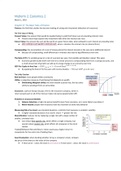
These yellow blocks happen in the real world,
need to capture these changes
Accounting information is provided to users,
inside the firm and outside the firms
Before that, it will be certified by external party
3 processes of accounting information
Judgements and Decisions
Judgement
- Attaching a (quantitative or qualitive) value to something
o Not necessarily quantitative value, can also be qualitative (higher, better etc)
o Giving an estimate of something, a valuation of something, opinion
- Decision
o Choosing between activities, between alternatives
Judgements and decisions are closely related
The production of accounting information
Examples:
- Depreciation method for a class of assets
o Residual value, need to determine their value, where should I put it, how should I
classify it?
- Residual value and lifetime of an asset
o Decisions about how accounting information is produced
- Classification of an asset or liability
- Reporting requirements for organizational units
- Layout of performance reports
o How simple little things in what reports look like (or internal reports) how they affect
the decisions people make based on that color, what it looks likes things that
should not have an effect
The certification of accounting information
Examples:
- Materiality
- Risk of material misstatement
- Analytical procedures
- Complex estimates
o Made by managers, how do we go about here, what is the specific process we used,
whether it is acceptable or not
, - Going concern
The use of accounting information
Examples:
- Owners and investors
o Estimate future cash flows
o Decide to sell or buy shares
- Financial Analysts
o Estimate future cash flows etc.
o Make Buy/Hold/Sell recommendation
- Creditors
o Estimate default risk
o Decide about loans, interest rates etc.
- Managers and other employees
o Evaluate the performance of units, teams and individuals
o Estimate the likely consequences of alternative courses of action
o Make business decisions
- Government
o Examples: Tax, regulation, licenses, permissions, integrity of financial reports, macro-
economic planning, etc.
- Suppliers and Customers
o Judge liquidity, solvency, etc.
o Contracting decisions (with supplier or customer, whether they are able to perform
their side of the deal)
Normative, descriptive and prescriptive models
- Normative
o How people should be making judgements and decisions
o What a rational person would do
o Typically what you are dealing with, what is rational, how should you calculate future
NPV and make a decision
- Descriptive
o How people actually make judgements and decisions
o Can be very different from how they should be
o This is what we are going to do in this course (psychology theories and help us
understand how people make decisions, apply these models to accounting settings)
o Prospect theory – Psychological theory on how people actually make decisions, not
on how they should make it higher level of abstraction
- Prescriptive
o Not so much an academic model
o Consultants develop these models based on what they know about what should be
done and what people most of the time do
o Practical suggestions on designing judgement and decision-making processes based
on normative and descriptive models
Normative decision making
- A rational process
- If you want to make best possible decision in the situation you are in, use all available
information, use it in an optimal way to maximize the expected net outcome of a decision
o The most accurate judgment possible
o The best choice possible
o People don’t behave like this
, - A rational process
- Use all available information in an optimal way to maximize the expected net outcome
- Rooted in:
o Philosophy
o Mathematics
o Classic economics
- Tell you what the best thing is you could to in a specific setting
Normative decision making
Bazerman & Moore:
1) Define the problem
2) Identify the criteria
3) Weigh the criteria
4) Generate alternatives
5) Rate each alternative on each criterion
6) Compute the optimal decision
How every decision in a firm should be made
Normative decision making
- Do people really make decisions like that? NO!
- On average, decisions improve if you follow these normative models more closely make
sure / stimulate / facilitate more rational decision processes by managers
- However, we tend to be ‘predictably irrational’ (Ariely)
o We can predict the shortcomings, biases in our decision making What we are
going to do in this course: those little mistakes that we all tend to make, where do
they come from? How do they affect the process? How are we able to prevent these
things from happening?
- We deviate from the normative framework in systematic, not just random, ways.
Descriptive models of decision making
- Explain how people actually do make decisions
- Insights from
o Cognitive psychology
o Social psychology
o Neuroscience
o Biology
o Sociology
o Anthropology
o Behavioral economics
Descriptive models of decision making
- Humans have evolved over millions of years
- For 99,99% of that time our ancestors faced a similar set of relatively straightforward
decisions
- We are well prepared to make fast and simple decisions in a stable, predictable environment
with relatively few homogeneous actors and to spend no more energy than strictly necessary
Graph: human species existed about 1,5 billion years ago
We are just not well prepared to make complex decisions in highly complex environments never
had to do that in history these things have completely changed
Descriptive models of decision making
, - We are not well prepared to make complex economic decisions, in a dynamic, unpredictable
environment with many heterogeneous actors
- When we face such decisions, we cannot simply ignore our human nature and follow a
rational process
- However, we can try…
o Try to find out these mistakes
System 1 and System 2 thinking
- Thinking of decision making can be explained as
consisting of two different systems working
together in your brain schematic way of
describing what goes on in our head
- Dual process theory
- System 1 is our intuitive, fast, automatic,
emotional, effortless, system of decision
making
o It is what you do without even thinking about it, without providing effort if you
talk / walk, you don’t think about what you do right foot before left foot, or left
foot before right foot
o It is employed when we interpret verbal language, process visual information, walk,
talk etc.
o System 1 thinking is quite sufficient as it would be impractical to logically reason
through every choice we make while shopping for groceries.
o System 1 generates impressions of the attributes of objects of perception and
thought. The label “intuitive” is applied to judgments that directly reflect
impressions, they are not modified by System 2.
- System 2 is slow, effortful, conscious, and explicit
o Active thinking
o You are aware of your own thinking; you are deliberately making a decision.
o Involved in all judgments, whether they originate in impressions or in deliberate
reasoning.
- We tend to rely a lot on system 1
- Both systems are always on, System 2 typically in a comfortable low-effort mode
- System 1 continuously provides system 2 with impressions, intuitions, feelings etc
(everything you see, hear, smell)
- Only when system 1 gets into trouble (doesn’t find a quick simple solution that is good
enough system 2)
o System 2 is only mobilized when system 1 runs into difficulties
- The division of labor is highly efficient only need system 2 when you can’t make a decision
with system 1 we are not automatically making smart decisions in a professional
environment
- System 1 is not designed for complex decision making, and it tends to make decisions that
are suboptimal
- System 2 will often do a better job, BUT
o System 2 relies on System 1 for input
o System 1 cannot be switched off
o System 2 may not be employed frequently enough
- In sum, even if we try to be rational, we are unlikely to succeed
- Our judgements and decisions will deviate from normative benchmarks
Week 1 – Introduction to Normative Decision Making
Judgement and Decision Making in Accounting
- The production, certification and use of accounting information (still) requires human
judgement and decision making
- Professionals engaging in these activities need to understand something about the
psychology of judgement and decision making
Judgement and Decision making in Accounting
These yellow blocks happen in the real world,
need to capture these changes
Accounting information is provided to users,
inside the firm and outside the firms
Before that, it will be certified by external party
3 processes of accounting information
Judgements and Decisions
Judgement
- Attaching a (quantitative or qualitive) value to something
o Not necessarily quantitative value, can also be qualitative (higher, better etc)
o Giving an estimate of something, a valuation of something, opinion
- Decision
o Choosing between activities, between alternatives
Judgements and decisions are closely related
The production of accounting information
Examples:
- Depreciation method for a class of assets
o Residual value, need to determine their value, where should I put it, how should I
classify it?
- Residual value and lifetime of an asset
o Decisions about how accounting information is produced
- Classification of an asset or liability
- Reporting requirements for organizational units
- Layout of performance reports
o How simple little things in what reports look like (or internal reports) how they affect
the decisions people make based on that color, what it looks likes things that
should not have an effect
The certification of accounting information
Examples:
- Materiality
- Risk of material misstatement
- Analytical procedures
- Complex estimates
o Made by managers, how do we go about here, what is the specific process we used,
whether it is acceptable or not
, - Going concern
The use of accounting information
Examples:
- Owners and investors
o Estimate future cash flows
o Decide to sell or buy shares
- Financial Analysts
o Estimate future cash flows etc.
o Make Buy/Hold/Sell recommendation
- Creditors
o Estimate default risk
o Decide about loans, interest rates etc.
- Managers and other employees
o Evaluate the performance of units, teams and individuals
o Estimate the likely consequences of alternative courses of action
o Make business decisions
- Government
o Examples: Tax, regulation, licenses, permissions, integrity of financial reports, macro-
economic planning, etc.
- Suppliers and Customers
o Judge liquidity, solvency, etc.
o Contracting decisions (with supplier or customer, whether they are able to perform
their side of the deal)
Normative, descriptive and prescriptive models
- Normative
o How people should be making judgements and decisions
o What a rational person would do
o Typically what you are dealing with, what is rational, how should you calculate future
NPV and make a decision
- Descriptive
o How people actually make judgements and decisions
o Can be very different from how they should be
o This is what we are going to do in this course (psychology theories and help us
understand how people make decisions, apply these models to accounting settings)
o Prospect theory – Psychological theory on how people actually make decisions, not
on how they should make it higher level of abstraction
- Prescriptive
o Not so much an academic model
o Consultants develop these models based on what they know about what should be
done and what people most of the time do
o Practical suggestions on designing judgement and decision-making processes based
on normative and descriptive models
Normative decision making
- A rational process
- If you want to make best possible decision in the situation you are in, use all available
information, use it in an optimal way to maximize the expected net outcome of a decision
o The most accurate judgment possible
o The best choice possible
o People don’t behave like this
, - A rational process
- Use all available information in an optimal way to maximize the expected net outcome
- Rooted in:
o Philosophy
o Mathematics
o Classic economics
- Tell you what the best thing is you could to in a specific setting
Normative decision making
Bazerman & Moore:
1) Define the problem
2) Identify the criteria
3) Weigh the criteria
4) Generate alternatives
5) Rate each alternative on each criterion
6) Compute the optimal decision
How every decision in a firm should be made
Normative decision making
- Do people really make decisions like that? NO!
- On average, decisions improve if you follow these normative models more closely make
sure / stimulate / facilitate more rational decision processes by managers
- However, we tend to be ‘predictably irrational’ (Ariely)
o We can predict the shortcomings, biases in our decision making What we are
going to do in this course: those little mistakes that we all tend to make, where do
they come from? How do they affect the process? How are we able to prevent these
things from happening?
- We deviate from the normative framework in systematic, not just random, ways.
Descriptive models of decision making
- Explain how people actually do make decisions
- Insights from
o Cognitive psychology
o Social psychology
o Neuroscience
o Biology
o Sociology
o Anthropology
o Behavioral economics
Descriptive models of decision making
- Humans have evolved over millions of years
- For 99,99% of that time our ancestors faced a similar set of relatively straightforward
decisions
- We are well prepared to make fast and simple decisions in a stable, predictable environment
with relatively few homogeneous actors and to spend no more energy than strictly necessary
Graph: human species existed about 1,5 billion years ago
We are just not well prepared to make complex decisions in highly complex environments never
had to do that in history these things have completely changed
Descriptive models of decision making
, - We are not well prepared to make complex economic decisions, in a dynamic, unpredictable
environment with many heterogeneous actors
- When we face such decisions, we cannot simply ignore our human nature and follow a
rational process
- However, we can try…
o Try to find out these mistakes
System 1 and System 2 thinking
- Thinking of decision making can be explained as
consisting of two different systems working
together in your brain schematic way of
describing what goes on in our head
- Dual process theory
- System 1 is our intuitive, fast, automatic,
emotional, effortless, system of decision
making
o It is what you do without even thinking about it, without providing effort if you
talk / walk, you don’t think about what you do right foot before left foot, or left
foot before right foot
o It is employed when we interpret verbal language, process visual information, walk,
talk etc.
o System 1 thinking is quite sufficient as it would be impractical to logically reason
through every choice we make while shopping for groceries.
o System 1 generates impressions of the attributes of objects of perception and
thought. The label “intuitive” is applied to judgments that directly reflect
impressions, they are not modified by System 2.
- System 2 is slow, effortful, conscious, and explicit
o Active thinking
o You are aware of your own thinking; you are deliberately making a decision.
o Involved in all judgments, whether they originate in impressions or in deliberate
reasoning.
- We tend to rely a lot on system 1
- Both systems are always on, System 2 typically in a comfortable low-effort mode
- System 1 continuously provides system 2 with impressions, intuitions, feelings etc
(everything you see, hear, smell)
- Only when system 1 gets into trouble (doesn’t find a quick simple solution that is good
enough system 2)
o System 2 is only mobilized when system 1 runs into difficulties
- The division of labor is highly efficient only need system 2 when you can’t make a decision
with system 1 we are not automatically making smart decisions in a professional
environment
- System 1 is not designed for complex decision making, and it tends to make decisions that
are suboptimal
- System 2 will often do a better job, BUT
o System 2 relies on System 1 for input
o System 1 cannot be switched off
o System 2 may not be employed frequently enough
- In sum, even if we try to be rational, we are unlikely to succeed
- Our judgements and decisions will deviate from normative benchmarks