
Summary week 1 Emerging Economies and Global Labour CH2203
Lecture 1
Globalization, what it brought. Heckscher-Ohlin and other Theories on World Trade
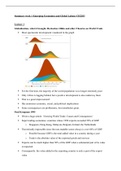
Most spectacular development visualized in the graph
For the first time, the majority of the world population is no longer extremely poor
Only Africa is lagging behind, but a positive development is also underway there
That is a great improvement!
Has enormous economic, social, and political implications
Some consequences are problematic, but nonetheless great.
Paul Krugman 1995
Wrote a huge article: ‘Growing World Trade: Causes and Consequences’
Super trading economies: countries whose 1990 exports exceeded 50% of GDP
o Singapore, Hong Kong, Malaysia, Belgium, Ireland, the Netherlands
Theoretically impossible since the non-tradable sector always is over 60% of GDP
o Possible because GDP is the total added value in a country during a year
o Trade is the absolute value of the exported goods and services
Exports can be much higher than 50% of the GDP when a substantial part of its value
is imported
Consequently: the value added in the exporting country is only a part of the export
value
, Krugman thought it a new phenomenon
Caused by cutting up production chains
o Nowadays: International Value Chains
o Causes: for every step in the production chain again a decision is made as to
where it will be produced
Super-trading economies
Term never used anymore, but nowadays many more countries in that category
National economy is, apart from the non-tradable sectors, nothing but a series of
mutually unrelated links in international value chains
o A country does not so much produce this or that
o A country has some functions in international productions chains
Production more and more internationalized
The question is why?
Not completely new
Since 1863, the Netherlands already had an export of over 60% of its GDP!
Reason exactly the same
The Dutch supplied the emerging German industry just across the border with
imported, slightly improved raw materials
Limited added value in the Netherlands
Export enormous
Transport costs low: rhine barging
Why did trade increase so much?
Essential: much lower transport costs
Jan Tinbergen: gravity model of international trade
Tij = A (YixYj / Dij)
o Predict bilateral trade between two countries
o Indicators: GDP and distance
o I and J: countries
o T: trade flow
o A: given constant
o Y: size of the economy (GDP) of each country (multiplied)
o D: the distance between the countries
The multiplication of the national incomes is divided by distance
, Distance, has a decreasing effect on trade, the formula says
In fact, not distance but trading cost do
We actually need new statistics
International trade in absolute value results in strange impressions
Netherlands 5th-7th exporting country in the owlrd
Value-added of exports much smaller
o Over 60% of the export value is imported
o Is the case for more and more countries
Emerging economies: often started with automotive or electronics assembly lines
o Enormous export value: the exported products are valuable
o However, these countries imported almost all parts of these products
o Added value in these countries is much smaller than the export value
Cost of transnational trade
Breaks down into a number of costs categories:
o Costs arising from political and institutional regulations
o Protectionism
o Governmental regulation on safety, health etc.
o Transport costs
o Costs due to cultural differences
These costs have fallen significantly since the 1970s
Costs of cultural differences difficult to measure
Cuts in protectionism
W. Max Corden (1927) came in 1971 with the concept of the effective rate of
protection
Proven that effective protection is often much higher than the nominal rates
o In many tariffs system materials or semi-finished products have a low tariff
and final products a higher tariff
Example: tariff on cars 10% of the value, raising the price from
€10.000 to €11.000
Tariff on car parts in zero
Auto parts are 80% of the car’s value
The value of assemblage therefore rises from €2000 to €3000
o Effective protection is not 10% but: (3000-2000)/2000 = 50%
Lecture 1
Globalization, what it brought. Heckscher-Ohlin and other Theories on World Trade
Most spectacular development visualized in the graph
For the first time, the majority of the world population is no longer extremely poor
Only Africa is lagging behind, but a positive development is also underway there
That is a great improvement!
Has enormous economic, social, and political implications
Some consequences are problematic, but nonetheless great.
Paul Krugman 1995
Wrote a huge article: ‘Growing World Trade: Causes and Consequences’
Super trading economies: countries whose 1990 exports exceeded 50% of GDP
o Singapore, Hong Kong, Malaysia, Belgium, Ireland, the Netherlands
Theoretically impossible since the non-tradable sector always is over 60% of GDP
o Possible because GDP is the total added value in a country during a year
o Trade is the absolute value of the exported goods and services
Exports can be much higher than 50% of the GDP when a substantial part of its value
is imported
Consequently: the value added in the exporting country is only a part of the export
value
, Krugman thought it a new phenomenon
Caused by cutting up production chains
o Nowadays: International Value Chains
o Causes: for every step in the production chain again a decision is made as to
where it will be produced
Super-trading economies
Term never used anymore, but nowadays many more countries in that category
National economy is, apart from the non-tradable sectors, nothing but a series of
mutually unrelated links in international value chains
o A country does not so much produce this or that
o A country has some functions in international productions chains
Production more and more internationalized
The question is why?
Not completely new
Since 1863, the Netherlands already had an export of over 60% of its GDP!
Reason exactly the same
The Dutch supplied the emerging German industry just across the border with
imported, slightly improved raw materials
Limited added value in the Netherlands
Export enormous
Transport costs low: rhine barging
Why did trade increase so much?
Essential: much lower transport costs
Jan Tinbergen: gravity model of international trade
Tij = A (YixYj / Dij)
o Predict bilateral trade between two countries
o Indicators: GDP and distance
o I and J: countries
o T: trade flow
o A: given constant
o Y: size of the economy (GDP) of each country (multiplied)
o D: the distance between the countries
The multiplication of the national incomes is divided by distance
, Distance, has a decreasing effect on trade, the formula says
In fact, not distance but trading cost do
We actually need new statistics
International trade in absolute value results in strange impressions
Netherlands 5th-7th exporting country in the owlrd
Value-added of exports much smaller
o Over 60% of the export value is imported
o Is the case for more and more countries
Emerging economies: often started with automotive or electronics assembly lines
o Enormous export value: the exported products are valuable
o However, these countries imported almost all parts of these products
o Added value in these countries is much smaller than the export value
Cost of transnational trade
Breaks down into a number of costs categories:
o Costs arising from political and institutional regulations
o Protectionism
o Governmental regulation on safety, health etc.
o Transport costs
o Costs due to cultural differences
These costs have fallen significantly since the 1970s
Costs of cultural differences difficult to measure
Cuts in protectionism
W. Max Corden (1927) came in 1971 with the concept of the effective rate of
protection
Proven that effective protection is often much higher than the nominal rates
o In many tariffs system materials or semi-finished products have a low tariff
and final products a higher tariff
Example: tariff on cars 10% of the value, raising the price from
€10.000 to €11.000
Tariff on car parts in zero
Auto parts are 80% of the car’s value
The value of assemblage therefore rises from €2000 to €3000
o Effective protection is not 10% but: (3000-2000)/2000 = 50%



