Chapter 4 : From Cells to Organ systems
Tissues = Groups of specialized cells with a common function
4Types of tissue : EPITHELIAL // CONNECTIVE /// MUSCLE // NERVOUS
EPITHELIAL tissues cover body surfaces and cavities
Two basic purposes :
Line body cavities and cover surfaces, protecting underlying tissues
‘Glandular epithelia’ (klieren - glands = epithelial tissues specialized to synthesize & secrete a product) :
Exocrine glands : Secrete products in hollow organs/ducts (secreting salivia, sweat, acid in stomach..)
Endocrine glands : Secrete hormones into blood stream with chemic messages( thyroid gland – schildklier)
Classified according to CELL SHAPE
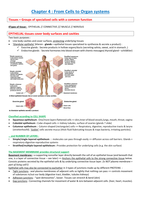
Squamous epitheleum : One/more layers flattened cells => skin,Inner of blood vessels,lungs, mouth, throat, vagina
Cuboidal epitheleum : Cube-shaped cells => kidney tubules, surface of ovaries (glands ? slide)
Columnar epitheleum : Column-shaped (rectangular) cells => Respiratory, digestive, reproductive tracts & larynx
(strottenhoofd). ‘Goblet’ cells secrete mucus (thick fluid llubricating tissues & traps bacteria, irritating particles).
… and NUMBER OF LAYERS :
• Simple/single-layered epitheleum : molecules can pass through easily => diffusion across cell barriers. Glands +
respiratory-digestive-reproductive systems
• Stratified/multiple-layered epitheleum : Provides protection for underlying cells (e.g. the skin surface)
The BASEMENT MEMBRANE provides structural support
Basement membrane = a supporting noncellar layer directly beneath the cell of an epithelial tissue (and beneath that
one, is a layer of connective tissue – see later) => Anchors the epithelial cells to the strong connective tissue below.
Consists proteins secreted by the epithelial cells & by underlying connective tissue layer. (is NOT plasma membrane =
part of living cell!!)
Epithelial cells may also be connected to eachother in 3 types of junctions made up by different PROTEINS :
Tight junctions : seal plasma membranes of adjecent cells so tightly that nothing can pass => controls movement
of substances in/out our body (digestive tract, bladder, tubules kidneys)
Adhesion junctions : “spot demosomes”, looser. Tissues can strectch & bend (skin)
Gap junctions : Connecting channels for movement of water & ions between adjacent cells. (liver, heart, muscles).
Tissues = Groups of specialized cells with a common function
4Types of tissue : EPITHELIAL // CONNECTIVE /// MUSCLE // NERVOUS
EPITHELIAL tissues cover body surfaces and cavities
Two basic purposes :
Line body cavities and cover surfaces, protecting underlying tissues
‘Glandular epithelia’ (klieren - glands = epithelial tissues specialized to synthesize & secrete a product) :
Exocrine glands : Secrete products in hollow organs/ducts (secreting salivia, sweat, acid in stomach..)
Endocrine glands : Secrete hormones into blood stream with chemic messages( thyroid gland – schildklier)
Classified according to CELL SHAPE
Squamous epitheleum : One/more layers flattened cells => skin,Inner of blood vessels,lungs, mouth, throat, vagina
Cuboidal epitheleum : Cube-shaped cells => kidney tubules, surface of ovaries (glands ? slide)
Columnar epitheleum : Column-shaped (rectangular) cells => Respiratory, digestive, reproductive tracts & larynx
(strottenhoofd). ‘Goblet’ cells secrete mucus (thick fluid llubricating tissues & traps bacteria, irritating particles).
… and NUMBER OF LAYERS :
• Simple/single-layered epitheleum : molecules can pass through easily => diffusion across cell barriers. Glands +
respiratory-digestive-reproductive systems
• Stratified/multiple-layered epitheleum : Provides protection for underlying cells (e.g. the skin surface)
The BASEMENT MEMBRANE provides structural support
Basement membrane = a supporting noncellar layer directly beneath the cell of an epithelial tissue (and beneath that
one, is a layer of connective tissue – see later) => Anchors the epithelial cells to the strong connective tissue below.
Consists proteins secreted by the epithelial cells & by underlying connective tissue layer. (is NOT plasma membrane =
part of living cell!!)
Epithelial cells may also be connected to eachother in 3 types of junctions made up by different PROTEINS :
Tight junctions : seal plasma membranes of adjecent cells so tightly that nothing can pass => controls movement
of substances in/out our body (digestive tract, bladder, tubules kidneys)
Adhesion junctions : “spot demosomes”, looser. Tissues can strectch & bend (skin)
Gap junctions : Connecting channels for movement of water & ions between adjacent cells. (liver, heart, muscles).