American Yawp, Chapter 1 with 100% complete solutions
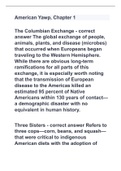
The Columbian Exchange The global exchange of people, animals, plants, and disease (microbes) that occurred when Europeans began traveling to the Western Hemisphere. While there are obvious long-term ramifications for all parts of this exchange, it is especially worth noting that the transmission of European disease to the Americas killed an estimated 95 percent of Native Americans within 130 years of contact—a demographic disaster with no equivalent in human history. Three Sisters Refers to three cops—corn, beans, and squash—that were critical to indigenous American diets with the adoption of permanent, intensive agriculture. These crops were symbiotic (meaning they could be sustainably farmed) and nutritionally rich, meaning that they allowed for the growth of stable and prosperous communities in North America. Matrilineal Form of social organization that recognizes familial and clan identity according to the female line (through mothers rather than through fathers). This often meant that women in many Native American societies wielded more influence (especially since they frequently also controlled agricultural production) than their counterparts in European societies. Cahokia Mississippian city whose population was an estimated 10,000-30,000 at its peak in the 13th century. Known for its elaborate earthworks, Cahokia was the center of a hierarchical civilization politically organized around clan-based chiefdoms. It collapsed around 1300, likely because of ecological devastation of the region along with warfare and internal political disputes. Native American slavery Unlike the form of race-based chattel slavery that Europeans would develop in later years, this form of slavery (usually the result of captivity during war) was not a permanent condition and could be overcome by establishing kinship bonds—through adoption or marriage—in the community. The trade of slaves and use of slave labor was significant economically and politically for many Native communities. Crusades A series of religiously-motivated wars instigated and supported by the Latin Church during the medieval period. Significant for linking Europe with the riches, technology, and advanced learning of Asia. These developments would help spur the Renaissance and create motivations for European expansion. Reconquista Refers to a series of military campaigns that resulted in the expulsion of Muslim Moors and Iberian Jews from the Iberian peninsula (Spain/Portugal), a process completed in 1492. Led to the death, forced immigration, or coerced conversion of large numbers of non-Christians in the region and helped give rise to a series of powerful Christian rulers—including Ferdinand and Isabella—who would move their military exploits across the Atlantic in following years. Encomienda System used by Spain in their American conquests to reward conquistadores with huge landed estates, accompanied by the right to the coerced labor of the indigenous populations bound to the estate. Bartolomé de Las Casas Spanish missionary who traveled to Hispaniola in 1502 and recorded the dehumanizing, violent exploitation of Native peoples at the hands of the Spanish. European murder, enslavement, and disease would essentially wipe out the population of the island from a million or more to less than 32,000 within a generation. Sistema de Castas An elaborate racial hierarchy that organized people into particular racial categories based on their lineage. This system, which promoted Spanish racial "purity" determined status -including the opportunity to advance socially, politically, and economically—in Spanish colonial society.

Geschreven voor
- Instelling
- Yawp
- Vak
- Yawp
Documentinformatie
- Geüpload op
- 27 februari 2023
- Aantal pagina's
- 6
- Geschreven in
- 2022/2023
- Type
- Tentamen (uitwerkingen)
- Bevat
- Vragen en antwoorden
Onderwerpen
-
american yawp
-
chapter 1 with 100 complete solutions

Ook beschikbaar in voordeelbundel