NACE CIP 2 Study Guides latest updated
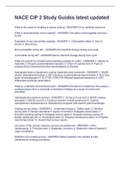
What is the cause of chalking in epoxy coating - ANSWER-UV or radiation exposure What is polymerization cured coating? - ANSWER-Two parts mixed together just prior to use Examples of non-convertible coatings - ANSWER-1. Chlorinated rubber 2. Vinyl 3. Acrylic 4. Bituminous Non-convertible curing def. - ANSWER-No chemical change during cure cycle Convertible curing def. - ANSWER-Some chemical change during cure cycle What info should be included when sending samples to a lab? - ANSWER-1. Identity of materials 2. Properly packed/labeled samples 3. Chain of custody form 4. Type of analysis that is expected and the concentrations of interest Specialized tests or equipment coating inspectors may encounter - ANSWER-1. AA/AE Atomic Absorption/Emission 2. ISP Induction coupled plasma Spectrometer 3. GLC Gas liquid chromatographs 4. IR, FTIR, FTIR-ATR INfrared spectrophotometers 5. DSC Differential scanning calorimeters What is a cathodic dis-bondment test? - ANSWER-Procedure to determine how easily a coating loosens from a substrate or develops holidays as a result of normal soil potentials Individuals who perform surveys - ANSWER-1. O-Cat or S-cat tech 2. NACE coating specialist 3. NACE Level III 4. Coating Inspector w/field experience 5. Coating manufacturer representative 6. Maintenence engineer with specific plant knowledge. Coating survey steps - ANSWER-1. Understand scope 2. Gather team 3. Develop survey plan 4. Review standards 5. Agree on format 6. Delegate various tasks 7. Eveluate existing coating 8. Delegate various tasks 9. Evaluate existing coating 10. Gather additional info 11. Summarize data 12. Prepare maintenance plans 13. Prepare reports/input data 14. Submit final survey reports. List some of the primary reasons surveys are performed - ANSWER-1. Plan maintenance. 2. Prioritize work 3. Budgetary concerns 4. Determine value of assets 5. Legal compliance Definition of a coating survey - ANSWER-Gather baseline info needed to plan maintenance coating procedures What are faying surfaces and why not galvanize them? - ANSWER-Surfaces that depend on friction to hold galvanizing it may/will reduce friction if they are galvanized Common problems seen during the usual inspections of HD galvanized items - ANSWER-1. Cracking 2. Peeling 3. Bare spots 4. Lumps 5. Blisters 6. Flux inclusions 7. Ash inclusions 8. Dross inclusions Post galvanizing treatments and why - ANSWER-To Remove Thickness: Roll, Wipe, Centrifuge/Air Blast To change properties/To alloy: Annealing Temperature range for galvanizing kettle - ANSWER-820-850 F Purpose of pickling - ANSWER-Hydrochloric or sulfuric acid bath to remove oxides and mill scale Purpose of caustic cleaning - ANSWER-Acid bath or caustic to remove dirt, oil and grease Stages of hot dip process - ANSWER-1. Surface prep. 2. Galvanizing 3. Post treatment 4. Inspection Hot dip galvanizing safety - ANSWER-1. Can stay for some time 2. Molten metal splash 3. Nascent hydrogen above kettle Usual layers of galvanized coating consists of: - ANSWER-1. ETA=100% Zn 2. ZETA= 94% Zn 6%Fe 3. DELTA= 90% Zn 10 Fe 4. GAMMA= 75% Zn 25% Fe What is hot dip galvanizing? - ANSWER-Coating iron or steel with zinc at temperatures of 820-860 F If a maintenance coating to be applied is incompatible with the existing coating system__________may occur - ANSWER-Curling ______________ is performed at the work area by working the edges of the repaired area back to achieve a fairly smooth transition from the repair area to sound coating. - ANSWER-Feathering With regards to maint. coating all parties should agree on___________? - ANSWER-1. Spot repair requirements 2. Feathering 3. Appearance of repaired areas Maint. coating selection process should take the following into consideration: - ANSWER-1. Compatability with existing system 2. Surface prep. 3. If abrasi ve blast is permitted and feasible When determining coating system life cycle the following should be considered: - ANSWER-1. Maint. costs 2. Length of coating life 3. Initial and maint. material costs 4. Intial and maint. labor costs Life cycle of a coating system can be affected by: - ANSWER-1. Service environment 2. Maint. intervals 3. Coating system chosen 4. Surface condition Maint. coating operations are defined as: - ANSWER-Applying coating over a substrate that has been installed in its final environment and placed in service Some service situations where permeation may occur include: - ANSWER-1. Sour crude storage tanks 2. Cooling towers 3. Fertilizer plants Special substrated that have tightly adherent oxide films include: - ANSWER-1. Stainless steel 2. Tin 3. Nickel 4. Cadmium Non-Ferrous substrates include: - ANSWER-1. Stainless steel 2. Nickel 3. Copper/Nickel alloys 4. Aluminum 5. Aluminum bronzes 6. Copper 7. Bronzes 8. Brass 9. Tin 10. Cadmium 11. Lead 12. Magnesium Common reasons wood is coated - ANSWER-1. Decoration 2. Protection 3. Sealing 4. Stabilization 5. Preservation 6. Flame retardence The following materials can be used to repair fusion bonded epoxy: - ANSWER-1. Epoxy FBE melt sticks 2. LIquid epoxy 3. Repair patches Destructive tests for heat shrink sleeves include_____________ - ANSWER-Peel test Non destructive tests for heat shrink sleeves include - ANSWER-1. UT 2. Physical inspection 3. Holiday inspection Pipeline coating field joints include - ANSWER-1. Heat shrink sleeves 2. Insulation 1/2 shells 3. Liquid epoxies 4. Cold applied tape 5. Hot applied tape 6. Fusion bonded epoxy 7. Wax tape Concrete coating characteristics include: - ANSWER-1. Good for wetlands 2. Can be applied in may thicknesses General application for CTE includes - ANSWER-1. Prime pipe 2. Apply CTE dope 3. Wrap w/glass fiber mat 4. Apply 2nd coat of CTE dope 5. Apply 2nd layer of glass met 6. Apply outer wrap of CTE impregnated glass fiber felt. 7. Cool Disadvantages of CTE coatings include: - ANSWER-1. Environmental concerns 2. Subject to corrosion and damage from soil stress Advantages of CTE pipeline coatings - ANSWER-1. Ease of application 2. Long life FBE process includes: - ANSWER-1. Preheat 2. Grit/shot blast to NACE #2 SSPC-SP10 3. Heat pipe 4. Apply coating 5. Cure coating 6. Quench 7. Stencil Common characteristics of FBE include: - ANSWER-1. Typically green or red 2. Single or two layer 3. DFT from 10-20 mils Typical plant applied coatings include - ANSWER-1. Two layer poly 2. 3 layer poly 3. FBE 4. Coal tar enamel 4. Asphalt 5. Concrete 6. Asphalt The majority of the pipes coated at a facilty or plant and shipped to site are called: - ANSWER-Plant applied Construction materials may include: - ANSWER-1. Steel 2. Aluminum 3. Stainless steel 4. Plastic Proper safe accurate operating procedure for low voltage holiday detector - ANSWER-Ground equipment and set for coating thickness VS voltage. Keep probe in contact with work, move slowly across surface. Don't oversaturate sponge Standards used for dry film measurement of coatings over concrete - ANSWER-ASTM-D6132-97 and SSPC-PA9 DFT of coating on concrete can be measured by: - ANSWER-UT thickness guage Which organization produces comparator plates for various prepared concrete surfaces? - ANSWER-International concrete repair institute Disadvantages of plural component airless spray over single piston: - ANSWER-1. Higher costs 2. Education for mechanic is higher 3. Heaters require HV electric 4. Applicators job is more difficult Advantages of plural component airless over single piston: - ANSWER-1. Automatic, accurate material mixing 2. Ability to spray thick materials w/o thinning 3. Ability to spray materials 2/short pot lives. 4 stages powder goes thru when heat is applied? - ANSWER-1. Flow 2. Wetting 3. Gel 4. Curing Two curing categories of powder coating - ANSWER-1. Thermoplastic: Softens when heated 2. Thermo-setting: Hardens when heated Characteristics of flouropolymer coatings? - ANSWER-1. Non-stick 2. High temperature resistance Two main types of fireproofing coatings - ANSWER-1. Passive 2. Intumescent Three main types of anti-fouling coatings - ANSWER-1. Ablative 2. Self smoothing 3. Foul release What are anti fouling materials and how do they work? - ANSWER-They are materials that make ships hulls distasteful, or too slick for bio-fouling material to attach Surface prep for lining installation - ANSWER-White metal blast SA3/NACE1/SSPC 5 Describe wicking - ANSWER-1. Liquid travels along fibers path and can cause substrate to corrode, blister or delaminate What does re-enforcing add to a resin? - ANSWER-Strength Some resins used in re-enforced linings: - ANSWER-1. Polyester 2. Epoxy 3. Vinyl ester Lining Definition - ANSWER-A coating normally in immersion service Thermal spray safety practices - ANSWER-1. HP rated hoses 2. Never use compressed air to clean work area or clothing 3. Don't use plant air for breathing air Common hazards associated with specialized applications - ANSWER-1. Fume/dust inhalation 2. Electrical shock 3. Burns 4. Falling objects Disadvantages of water jetting - ANSWER-1. Expensive equipment 2. Water injection danger 3. Surface needs anchor profile 4. Collection/Disposal of water Water jet advantages: - ANSWER-1. Less dangerous 2. Better air quality 3. Less stringent respiratory requirements 4. Less environmental damage 5. Less clean up Water jetting safety items include: - ANSWER-1. Barricade work area 2. Protect electrical equipment 3. Electrical connections dry 4. Make sure hoses and fittings are not worn excessively and are rated for use Two condsiderations w/regards to back thrust - ANSWER-1. Operator body weight 2. Alternating operators (fatigue etc.) Water jetting is effective for removing: - ANSWER-1. Surface oil or grease 2. Rust 3. Concrete spatter 4. Existing coatings Typical water jetting team - ANSWER-1. Nozzle operator 2. Pump operator 3. Additional operators or workers Requirements for NACE 5/SSPC-SP12 - ANSWER-1. Visual contaminants 2. Non-visual contaminants

Geschreven voor
- Instelling
- NACE
- Vak
- NACE
Documentinformatie
- Geüpload op
- 25 februari 2023
- Aantal pagina's
- 9
- Geschreven in
- 2022/2023
- Type
- Tentamen (uitwerkingen)
- Bevat
- Vragen en antwoorden
Onderwerpen
-
nace
-
conver
-
nace cip 2 study guides latest updated
-
what is the cause of chalking in epoxy coating
-
what is polymerization cured coating
-
examples of non convertible coatings
-
non convertible curing def

Ook beschikbaar in voordeelbundel