NURS 5220 Exam 2 Module 4, 7, 17, 18, 19, 20 QUESTIONS AND ANSWERS ALL CORRECT
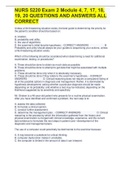
NURS 5220 Exam 2 Module 4, 7, 17, 18, 19, 20 QUESTIONS AND ANSWERS ALL CORRECT Unless a life-threatening situation exists, the best guide to determining the priority for the patient's condition should be based on: A. intuition. B. probability and utility. C. the use of algorithms. D. the examiner's initial favorite hypothesis. - CORRECT ANSWERS B Probability and utility should always be your guides to sequencing your actions, unless a life-threatening situation exists. Which of the following should be considered when determining a need for additional examination, testing, or procedures? A. These should be done to obtain as much data as possible. B. These should be done to attempt to get data that might be associated with multiple problems. C. These should be done only when it is absolutely necessary. D. These should be done if they relate to the examiner's hypothesis. - CORRECT ANSWERS D: Clinical reasoning does not require a compulsive listing of all of the possible options in diagnosis and management. Rather, it is dominated by hypothesis development; asking whether a particular diagnosis should be made depending on its probability; and whether a test may be indicated, depending on the likelihood suggested by its sensitivity and specificity Mr. Shaken is a 46-year-old patient who presents for a routine physical examination. After you have identified and confirmed a problem, the next step is to: A. assess the data collected. B. formulate a clinical opinion. C. conduct further assessment. D. determine the management plan. - CORRECT ANSWERS D: Clinical reasoning is the process by which the information gathered from the history and physical examination is merged with clinical knowledge, experience, and the current best evidence to formulate the next steps in patient care—development of the diagnostic and management plans. The use of a computer could potentially be detrimental to the examiner because: A. It may become a substitute for critical thinking. B. computer dysfunction makes it unreliable. C. the computer is limited in the amount of data it can interpret. D. the level of skill needed to run a diagnostic computer program is beyond the computer skills of most examiners. - CORRECT ANSWERS A: There is an unacceptable temptation at times to substitute electronic support for critical thinking and judgment. It is your responsibility to artfully merge subjective and objective data with best evidence and your knowledge and experience to make a clinical judgment. The ethical principle of utilitarianism is involved: A. when the duties of health care providers are established by tradition and cultural context. B. when health care providers "do no harm." C. when decisions regarding health care include appropriate use of resources for the good of the community. Correct D. when the interview is conducted appropriately. - CORRECT ANSWERS C: Utilitarianism means you should consider appropriate use of resources with concern for the greater good of the larger community. Which is a guideline to sound decision making? A. The underlying problem is always related to the chief complaint. B Rare problems tend to have unusual presentations. C. Common problems occur commonly, whereas rare ones do not. D. A diagnosis should be made quickly to enhance patient confidence. - CORRECT ANSWERS C: Remember that common problems occur commonly, and rare ones do not. Common problems can have unusual presentations and rare ones may have a seemingly common complaint. Laboratory tests should be used to: A. confirm a presumed diagnosis. B. develop a list of potential problems. C. rule out all possible causes of symptoms and clinical findings. D. assist the examiner only when the data do not point to a specific problem. - CORRECT ANSWERS A: After a match between the data (both subjective and objective) and a presumed diagnosis is made, consider the appropriate laboratory or radiologic studies to confirm the diagnosis. A problem is best identified as: A. something that bothers the patient. B. something that is out of the ordinary. C. something that is unexplainable. D. something that will need further evaluation and/or attention. - CORRECT ANSWERS D: A problem may be defined as anything that will need further evaluation and/or attention. Once a close match between the data and diagnosis is made, the next step in the process is to: A. return to the physical examination and repeat certain parts to validate the presence of specific signs. B. consider laboratory tests/consultations necessary for further evaluation. C. confirm the presumptive diagnosis with patient. D. reanalyze history data to determine where more information is needed. - CORRECT ANSWERS B: After a match between the data (both subjective and objective) and a presumed diagnosis is made, consider the appropriate laboratory or radiologic studies to confirm the diagnosis. Mechanistic thinking is governed by the premise that: A. knowledge is relevant and influenced by our thoughts, values, and ideas. B. knowledge is patterned in a way that truth will eventually evolve and facilitate our success. C. knowledge must be certain and not subject to any beliefs, values, and attitudes of the examiner and/or patient. D. knowledge must be experienced by those who are responsible for its dissemination and use. - CORRECT ANSWERS C: Mechanistic (deterministic) thinking is governed by a sense that knowledge must be certain and not subject to attributes of the observer. Probabilism recognizes that truth is difficult to achieve because: A. individuals are incapable of always telling the truth. B. cause and effect are not always directly related to each other. C. science is incapable of completely uncovering the truth. D. truth is in the eye of the beholder. - CORRECT ANSWERS B: Our decision making must have a balance between mechanism and probabilism (certainty in knowledge is impossible). Causes, effects, and our interpretations of them change probabilistically with time. Mrs. Bowers is a 38-year-old patient who presents to your office for a routine examination. The ability of an observation to identify correctly those who have a disease is the definition of: A. specificity. B. sensitivity. C. certainty. D. positive predictive value. - CORRECT ANSWERS B: Sensitivity is the ability of an observation to identify correctly those who have a disease. If an individual is suspected of having a specific condition, the condition is in fact present, and a laboratory test confirms its presence, then the outcome of the laboratory test is identified as a(n): A. true positive. B. absolute positive. C. false positive. D. sensitive positive. - CORRECT ANSWERS A:A true positive is an expected observation that is found when the disease characterized by that observation is present.

Geschreven voor
- Instelling
- NURS 5220
- Vak
- NURS 5220
Documentinformatie
- Geüpload op
- 22 februari 2023
- Aantal pagina's
- 49
- Geschreven in
- 2022/2023
- Type
- Tentamen (uitwerkingen)
- Bevat
- Vragen en antwoorden
Onderwerpen
-
nurs 5220
-
nurs 5220 exam 2 module 4
-
17
-
18
-
19
-
20
-
nurs 5220 exam 2 module 4
-
17
-
18
-
19
-
the best guide to dete
-
7
-
7
-
20 questions and answers all correct
-
unless a life threatening situation exists

Ook beschikbaar in voordeelbundel