100% tevredenheidsgarantie Direct beschikbaar na je betaling Lees online óf als PDF Geen vaste maandelijkse kosten 4,6 TrustPilot
logo-home
Tentamen (uitwerkingen)

Helwig NCE & CPCE Prep (HGrD). Top Exam Questions and answers, 100% Accurate, graded A+

Beoordeling
-
Verkocht
-
Pagina's
15
Cijfer
A+
Geüpload op
17-02-2023
Geschreven in
2022/2023

Helwig NCE & CPCE Prep (HGrD). Top Exam Questions and answers, 100% Accurate, graded A+ What is the definition of development? (HGrD) Systematic changes and continuities in the individual that occurs between conception and death. What are the three broad areas of systematic change in development? (HGrD) Three broad areas such as physical development, cognitive development, and psychosocial development. The theories which can explain how humans grow and develop fall into these following broad categories. (HGrD) There are the learning theories including behavioral theories, cognitive theories, psychoanalytic including the Neo-Freudian, and humanistic psychology included with self theories. Human growth and development changes can be viewed from these comparative concepts. (HGrD) Qualitative or quantitative, continuous or discontinuous, and mechanistic or organismic. What is a qualitative view of change in human growth and development? (HGrD) Qualitative change principle is that change occurs in structure or organization (for example, sexual development). What is quantitative view of change in human growth and development? (HGrD) Quantitative view of change is in number, degree or frequency (content changes, for example, intellectual development) What is considered as the continuous view of change when it comes to human growth and development? (HGrD) A continuous model states that change is sequential and cannot be separated easily (for example, personality development) What is considered in the discontinuous view of change in human growth and development? (HGrD) The discontinuous view attributes growth and development as certain changes in abilities or behaviors that can be separated from others which delineates stages of development (for example, language development). What is the mechanistic view of change in human growth and development? (HGrD) Mechanistic model states development and growth as those changes that are the reduction of all behavior to common elements (for example, instinctual or reflexive behavior) What is the organismic model of change in human growth and development? (HGrD) Organismic model states that because of new stages, there is change or discontinuity; development and growth is more than just stimulus-response. The organism is involved including the use of cognition An example of this model comes from theories on moral or ethical development. What is the definition of self-concept? (HGrD) Self-concept may be defined as your perception of your qualities, attributes, and traits. What is the theoretical self-concept at birth? (HGrD) At birth, infants have no sense of self. In early months this quickly changes. By 24 months, what is the theoretical self-concept for most infants? (HGrD) Most infants, by 24 months, show signs of self recognition; they are able to identify social categories they are in i.e. age and gender, “who is like me and who is not like me“; they exhibit various temperaments. At what stage of development does most children shows signs of concrete and physical self-concept? And at what age can be described inner qualities? (HGrD) It is the pre-school child’s self-concept that is very concrete and physical. By 8 years old or so, they can describe inner qualities. At what stage of development does a child start to develop a more abstract and psychological self-concept? (HGrD) It is by adolescents does self-concepts (self descriptions) become more abstract and psychological. Does the stabilization of self-concept attributes, in adolescents; continue, stop or maintain itself? (HGrD) The stabilization of self-concept attributes continues for adolescents. (HGrD) What influences the development of attributes and some traits for adolescents? (HGrD) It is cultural and family factors that influence the development of attributes and some traits. Explain nature versus nurture. (HGrD) Nature includes genetic and hereditary factors. While nurture includes learning and environmental factors. Explain genotype and phenotype. (HGrD) Genotype is the genetic (inherited) makeup of the individual. While phenotype is the way an individual’s genotype is expressed through physical and behavioral characteristics. What is the Tabula Rasa theory? (HGrD) John Locke's theory that children begin as a 'blank slate' acquiring their characteristics through experience. What does the statement “lifespan development has plasticity” mean? (HGrD) For most individuals lifespan development is plastic representing an easy and smooth transition from one stage to the next. Explain the concept of resiliency? (HGrD) Resiliency is the ability to adapt effectively despite the experience of adverse circumstances. For example, some children, despite experiencing potentially damaging conditions and circumstances, seem to suffer few consequences. What is neuroscience sometimes referred to in mental health professions? (HGrD) Neuroscience is usually sometimes referred to as the missing link in mental health professions. According to Ivey, D'Andrea and Ivey, what are the levels for which the mind is a product of activity occurring in the brain? (HGrD) The mind is a product of the activity occurring at the molecular, cellular, and anatomical levels. According to Ivey, D’Andrea and Ivey, what impacts the mind, as it is product of activities in the brain? (HGrD) The mind is impacted by a person’s interpersonal, relationships, cultural context, and societal experience. Counselor use of theories, skills and interventions help promote the release of what, which promotes related brain changes? (HGrD) When counselors promote the use of theories, skills and interventions, they help release various neurotransmitters which promotes related brain changes. What do Neurotransmitters affect? (HGrD) Neurotransmitters affect various cognitive, emotional, psychological and behavioral reactions that people have to their life experience. What are the four principle neurotransmitters important to counselors? (HGrD) The four principle neurotransmitters are acetylcholine, serotonin, dopamine, and GABA (gamma amino butyric acid). What is acetylcholine important for? (HGrD) The neurotransmitter, Acetylcholine is important for memory, optimal cognitive functioning, emotional balance and control. What does serotonin affects, critical for, and vital to? (HGrD) Serotonin tends to affect feelings, behaving, and thinking. Critical for emotional and cognitive processes. Vital to sleep and anxiety control. How is dopamine important to the human brain? (HGrD) Dopamine is important for emotional wellness, motivation, and pleasurable feelings. what role does GABA (gamma amino butyric acid) fulfill? (HGrD) GABA (gamma amino butyric acid) helps reduce anxiety and promotes relaxation and sleep. What did Abraham Maslow contribute to the field of psychology and what school of psychology is he affiliated? (HGrD) Maslow developed the “hierarchy of needs” and was considered to be an important humanistic psychologist. Explain the concept of Maslow’s Hierarchy of Needs. (HGrD) Maslow states that people are always motivated to higher-order needs and we go from filling our needs from the physiological level to the social level to the cognitive level. List the hierarchy of needs in the appropriate order? (HGrD) Maslow ranks people’s needs to higher-order from food/water to; security/safety to; belonging/love to; self-esteem/prestige/status to; self-actualization. What is Robert Havighurst known for? (HGrD) Havighurst is know to identify stages of growth for which each requires completion of the last one for success and happiness. From where does developmental tasks arise? (HGrD) Developmental tasks arise from physical maturation, influences from culture and society, and desires and values of the person. In other words an individual has to acquire it through physical maturation, social learning, and personal effort. What are outlined developmental tasks? (HGrD) Developmental tasks are the skills, knowledge, behaviors, and attitudes that an individual has to acquire overtime and through growth. What two individuals are credited in Behaviorism? (HGrD) Both John Watson and B.F. Skinner are attributed to Behaviorism. Identify the approach of Behaviorism, and outline the belief that it holds. (HGrD) Behaviorism is a learning approach. It is the belief that the environment manipulates biological and psychological drives and needs resulting in development. How do Behaviorist believe learning occurs and behaviors change? (HGrD) Learning and behavior changes are the result of rewards and punishments. We grow, develop, and learn through the nature of experience - the rewards and punishments we receive. What is a reward according to behaviorist? (HGrD) A reward is a positive-reinforcing stimulus which maintains or increase a behavior. What is punishment according to behaviorist? (HGrD) Punishment is when a behavior results in the termination of a positive-reinforcing stimulus or inspires the beginning of a negative stimulus such a behavior should weaken or drop out. Who formulated the law of effect? (HGrD) Edward L. Thorndike What does Thorndike's Law of Effect state? (HGrD) Thorndike’s law of effect states that when a stimulus-response connection is followed by a reward (reinforcement), that connection is strengthened. In other words, a behavior’s consequences determine the probability of its being repeated. There are nine principles of conditioning, define the classical conditioning. (HGrD) When the unconditioned stimulus -food- that is related to the unconditioned response -salivation- is substituted with conditioned stimulus -bell- that results in the conditioned response -salivation. Define operant conditioning. (HGrD) Pick up toys - get a hug or a cookie Explain reinforcement schedule. (HGrD) Reinforcement schedule is a schedule that can be continuous or variable. Behaviors established through variable or intermittent reinforcement or tougher to extinguish. Explain a fixed ratio reinforcement schedule. (HGrD) A fixed ratio reinforcement schedule states that reinforcement comes after a fixed number of responses. Explain variable ratio reinforcement schedule. (HGrD) Variable ratio reinforcement schedule is when reinforcement occurs on average after every nth (e.g. 5th) response. Elaborate on how a fixed interval reinforcement schedule is identified? (HGrD) Behavior is reinforced after a fixed period of time. How can we identify a variable interval reinforcement schedule? (HGrD) Variable interval is reinforcement, on the average, after every nth (e.g. 3rd) minute. Explain spontaneous recovery. (HGrD) Spontaneous recovery is when, after a rest period, the conditioned response reappears when the condition stimulus is again presented. Explain stimulus generalization. (HGrD) Stimulus generalization is when a conditioned response is elicited from stimuli that are similar to the conditioned stimulus. According to conditioning principles, how can we shape behaviors? (HGrD) Behaviors can be shaped through successive approximations. Explain successive approximations. (HGrD) Successive approximation; a method of shaping operant behavior by reinforcing responses similar to the desired behavior. Initially, responses roughly approximating desired behavior are reinforced. Later, only responses closely approximating the desired behavior are reinforced. It is a process of gradual leading to the desired behavior. Identify Freud’s five stages of development. (HGrD) Oral stage (birth to 18 mths), anal stage (2-3 yrs), phallic stage (3 - 5 yrs), latency stage (6-12 yrs.), and genital stage (12 - 19 yrs; others have said it never ends). During the Phallic Stage a boy might develop what kind of complex? (HGrD) Oedipus complex; the son has an attraction to his mother and feels threatened by his father. These are conflictual times for the son. During the Phallic stage a girl might develop what kind of complex. (HGrD) Electra complex; the daughter has an attraction to her father and feels threatened by her mother. These are conflictual times for the child. What is libido or libidinal energy? (HGrD) The basic energy or force of life. It consists of life instincts and death instincts. Explain the psychoanalytic concept of fixation. (HGrD) Incomplete or inhibited development at one of the five stages. Explain castration anxiety. (HGrD) The theory is that a child has a fear of damage being done to their genitalia by the parent of the same sex as punishment for sexual feelings toward the parent of the opposite sex. The parallel reaction of a boy’s realization that women do not have a penis. Explain penis envy. (HGrD) Stage theorized by Sigmund Freud regarding female psychosexual development, in which young girls experience anxiety upon realization that they do not have a penis. Explain the pleasure principle. (HGrD) Freudian psychoanalysis posits that this principle is the instinctive seeking of pleasure and avoiding of pain to satisfy biological and psychological needs. Specifically, the pleasure principle is the driving force guiding the id. Explain the reality principle. (HGrD) In Freudian psychology and psychoanalysis, reality principle is the ability of the mind to assess the reality of the external world, and act upon it accordingly, as opposed to acting on the pleasure principle. Delayed instant gratification. Reason over passion. Rational over emotional mind. Slow development from “pleasure-ego” into a “reality-ego.” What are considered to the Erogenous zones? (HGrD) The areas of bodily excitation such as the common ares of the mouth, genitals, and anus. Explain the idea of Defense Mechanisms. (HGrD) These are unconscious protective processes that help us control or abate primitive emotions and anxiety. Explain the defense mechanism of “repression.” (HGrD) Repression is the ejection from conscious thoughts as well as denying or forgetting the impulse or idea that provokes anxiety. Explain the defense mechanism of “projection.” (HGrD) Projection is when an individual avoids the conflict within oneself by ascribing the idea or motives to someone else external from the issue. Explain the defense mechanism of “reaction formation.” (HGrD) Reaction formation is the way of expressing a motive or impulse in a way that is directly opposite what was originally intended. Explain the defense mechanism of “rationalization”. (HGrD) When someone provides a reason for a behavior and thereby concealing the true motive or reason for the behavior. Explain the defense mechanism of “displacement.” (HGrD) With displacement, someone substitutes a different object or goal for the impulse or motive that is being expressed. Explain the defense mechanism of “introjection.” (HGrD) Introjection is the identifying through fantasy the expression of some impulse or motive. Explain the defense mechanism of “Regression.” (HGrD) Regression is the act of retreating to earlier or more primitive (childlike) forms of behavior. Explain the defense mechanism of “Denial”. (HGrD) The use of denial is posited with the refusal to se something that is a fact or true in reality. Explain the defense mechanism of “Sublimation”. (HGrD) Deemed as a positive defense mechanism, Sublimation is wherein anxiety or sexual tension or energy is channeled into socially acceptable activities such as work or exercise or other creative channels. Erik Erikson () developed how many stages of psychosocial development? (HGrD) There are eight identified stages wherein a psychosocial crisis or task is to be mastered. The theory involves stages, corresponding ages and resulting ego virtue. What is the 1st (first) stage of Erik Erikson’s psychosocial development? (HGrD) Erikson’s first stage takes place from birth to 18 months and titled Trust vs Mistrust. The resulting ego virtue is hope where the infant develops trust if basic needs are met. What is the 2nd (second) stage of Erik Erikson’s psychosocial development? (HGrD) Autonomy vs Shame and doubt is Erikson’s second stage which encapsulates 18 months to 3, and potentially results in ego virtue of Will (a sense of self). The infant asserts self; develops independence if allowed. The 3rd (third) stage of Erik Erikson’s psychosocial development is? (HGrD) From the age of 3 to 6, the ego virtue of purpose (goal setting) could develop from the psychosocial crisis or task of Initiative vs Guilt. Children meet challenges; assumes responsibility; identify rights of others. The 4th (fourth) stage of Erik Erikson’s psychosocial development? (HGrD) Between the ages of 6 to 11, Erikson states that children seek to master social and academic skills or start to feel inferior this is represented by the stage psychosocial crisis of Industry vs Inferiority. If successful the ego virtue of competence is developed. The 5th (fifth) stage of Erik Erikson’s psychosocial development? (HGrD) The fifth stage is titled Identity vs Role confusion//Diffusion. This psychosocial crisis occurs during adolescence (12-18) and at this stage the adolescent establishes social and vocational roles and identities or is confused about adult roles. Ego virtue: Fidelity (ability to commit).

Meer zien Lees minder
Instelling
Vak


Oeps! We kunnen je document nu niet laden. Probeer het nog eens of neem contact op met support.

Geschreven voor

Vak

Documentinformatie

Geüpload op
17 februari 2023
Aantal pagina's
15
Geschreven in
2022/2023
Type
Tentamen (uitwerkingen)
Bevat
Vragen en antwoorden

Onderwerpen

Voorbeeld van de inhoud

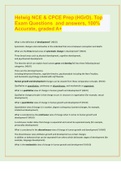
Helwig NCE & CPCE Prep (HGrD). Top
Exam Questions and answers, 100%
Accurate, graded A+

What is the definition of development? (HGrD)

Systematic changes and continuities in the individual that occurs between conception and death.

What are the three broad areas of systematic change in development? (HGrD)

Three broad areas such as physical development, cognitive development,
and psychosocial development.

The theories which can explain how humans grow and develop fall into these following broad
categories. (HGrD)

There are the learning theories
including behavioral theories, cognitive theories, psychoanalytic including the Neo-Freudian,
and humanistic psychology included with self theories.

Human growth and development changes can be viewed from these comparative concepts. (HGrD)

Qualitative or quantitative, continuous or discontinuous, and mechanistic or organismic.

What is a qualitative view of change in human growth and development? (HGrD)

Qualitative change principle is that change occurs in structure or organization (for example, sexual
development).

What is quantitative view of change in human growth and development? (HGrD)

Quantitative view of change is in number, degree or frequency (content changes, for example,
intellectual development)

What is considered as the continuous view of change when it comes to human growth and
development? (HGrD)

A continuous model states that change is sequential and cannot be separated easily (for example,
personality development)

What is considered in the discontinuous view of change in human growth and development? (HGrD)

The discontinuous view attributes growth and development as certain changes
in abilities or behaviors that can be separated from others which delineates stages of development (for
example, language development).

What is the mechanistic view of change in human growth and development? (HGrD)

, Mechanistic model states development and growth as those changes that are the reduction of all
behavior to common elements (for example, instinctual or reflexive behavior)

What is the organismic model of change in human growth and development? (HGrD)

Organismic model states that because of new stages, there is change or discontinuity; development and
growth is more than just stimulus-response. The organism is involved including the use of cognition An
example of this model comes from theories on moral or ethical development.

What is the definition of self-concept? (HGrD)

Self-concept may be defined as your perception of your qualities, attributes, and traits.

What is the theoretical self-concept at birth? (HGrD)

At birth, infants have no sense of self. In early months this quickly changes.

By 24 months, what is the theoretical self-concept for most infants? (HGrD)

Most infants, by 24 months, show signs of self recognition; they are able to identify social
categories they are in i.e. age and gender, “who is like me and who is not like me“; they exhibit
various temperaments.

At what stage of development does most children shows signs of concrete and physical self-concept?
And at what age can be described inner qualities? (HGrD)

It is the pre-school child’s self-concept that is very concrete and physical. By 8 years old or so, they can
describe inner qualities.

At what stage of development does a child start to develop a more abstract and psychological self-
concept? (HGrD)

It is by adolescents does self-concepts (self descriptions) become more abstract and psychological.

Does the stabilization of self-concept attributes, in adolescents; continue, stop or maintain itself?
(HGrD)

The stabilization of self-concept attributes continues for adolescents. (HGrD)

What influences the development of attributes and some traits for adolescents? (HGrD)

It is cultural and family factors that influence the development of attributes and some traits.

Explain nature versus nurture. (HGrD)

Nature includes genetic and hereditary factors.
While nurture includes learning and environmental factors.

Explain genotype and phenotype. (HGrD)

Genotype is the genetic (inherited) makeup of the individual. While phenotype is the way an
individual’s genotype is expressed through physical and behavioral characteristics.

What is the Tabula Rasa theory? (HGrD)
€10,42
Krijg toegang tot het volledige document:

100% tevredenheidsgarantie
Direct beschikbaar na je betaling
Lees online óf als PDF
Geen vaste maandelijkse kosten


Ook beschikbaar in voordeelbundel

Maak kennis met de verkoper

Seller avatar
De reputatie van een verkoper is gebaseerd op het aantal documenten dat iemand tegen betaling verkocht heeft en de beoordelingen die voor die items ontvangen zijn. Er zijn drie niveau’s te onderscheiden: brons, zilver en goud. Hoe beter de reputatie, hoe meer de kwaliteit van zijn of haar werk te vertrouwen is.
QuickPass Chamberlain College Of Nursing
Volgen Je moet ingelogd zijn om studenten of vakken te kunnen volgen
Verkocht
414
Lid sinds
3 jaar
Aantal volgers
304
Documenten
6372
Laatst verkocht
1 week geleden
Get all Documents you need at discount.

All nursing docs available: question banks, summaries, study guide and test banks

3,8

97 beoordelingen

5
52
4
11
3
10
2
10
1
14

Recent door jou bekeken

Waarom studenten kiezen voor Stuvia

Gemaakt door medestudenten, geverifieerd door reviews

Kwaliteit die je kunt vertrouwen: geschreven door studenten die slaagden en beoordeeld door anderen die dit document gebruikten.

Niet tevreden? Kies een ander document

Geen zorgen! Je kunt voor hetzelfde geld direct een ander document kiezen dat beter past bij wat je zoekt.

Betaal zoals je wilt, start meteen met leren

Geen abonnement, geen verplichtingen. Betaal zoals je gewend bent via iDeal of creditcard en download je PDF-document meteen.

Student with book image

“Gekocht, gedownload en geslaagd. Zo makkelijk kan het dus zijn.”

Alisha Student

Veelgestelde vragen