IGCSE PHYSICS – TOPIC 6
MAGNETISM AND ELECTROMAGNETISM
a) MAGNETISM
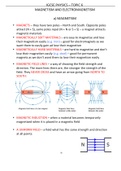
• MAGNETS – they have two poles – North and South. Opposite poles
attract (N + S), same poles repel (N + N or S + S) – a magnet attracts
magnetic materials
• MAGNETICALLY SOFT MATERIALS – are easy to magnetise and lose
their magnetism easily (e.g. iron) – good for electromagnets as we
want them to easily gain ad lose their magnetism
• MAGNETICALLY HARD MATERIALS – are hard to magnetise and don’t
lose their magnetism easily (e.g. steel) – good for permanent
magnets as we don’t want them to lose their magnetism easily
• MAGNETIC FIELD LINES – a way of showing the field strength and
direction. The more lines there are, the stronger the strength of the
field. They NEVER CROSS and have an arrow going from NORTH TO
SOUTH:
• MAGNETIC INDUCTION – when a material becomes temporarily
magnetized when it is placed in a magnetic field
• A UNIFORM FIELD – a field what has the same strength and direction
at all points:
36
, PRACTICAL TO INVESTIGATE: the magnetic field line pattern for a permanent bar magnet
and between two bar magnets
Method:
• Place a plotting compass at the corner of the magnet
• Mark the direction that the compass needle points with a SHARP PENCIL
• Put the edge of the compass on the dot and repeat step 2
• Join all the dots and add an arrow from North to South
b) ELECTROMAGNETISM
• When a CURRENT passes through a wire, a MAGNETIC FIELD is
created around the wire
• THE RIGHT HAND RULE – using the right hand rule we can figure out
the direction of the field lines
o THUMB – direction of the current
o FINGERS – direction of the field lines
• An ELECTROMAGNET can be formed by wrapping a COIL OF WIRE
around a SOFT IRON CORE – increase the number of coils to increase
field strength:
• When a wire is looped into a coil and a solenoid (a long coil)
37
MAGNETISM AND ELECTROMAGNETISM
a) MAGNETISM
• MAGNETS – they have two poles – North and South. Opposite poles
attract (N + S), same poles repel (N + N or S + S) – a magnet attracts
magnetic materials
• MAGNETICALLY SOFT MATERIALS – are easy to magnetise and lose
their magnetism easily (e.g. iron) – good for electromagnets as we
want them to easily gain ad lose their magnetism
• MAGNETICALLY HARD MATERIALS – are hard to magnetise and don’t
lose their magnetism easily (e.g. steel) – good for permanent
magnets as we don’t want them to lose their magnetism easily
• MAGNETIC FIELD LINES – a way of showing the field strength and
direction. The more lines there are, the stronger the strength of the
field. They NEVER CROSS and have an arrow going from NORTH TO
SOUTH:
• MAGNETIC INDUCTION – when a material becomes temporarily
magnetized when it is placed in a magnetic field
• A UNIFORM FIELD – a field what has the same strength and direction
at all points:
36
, PRACTICAL TO INVESTIGATE: the magnetic field line pattern for a permanent bar magnet
and between two bar magnets
Method:
• Place a plotting compass at the corner of the magnet
• Mark the direction that the compass needle points with a SHARP PENCIL
• Put the edge of the compass on the dot and repeat step 2
• Join all the dots and add an arrow from North to South
b) ELECTROMAGNETISM
• When a CURRENT passes through a wire, a MAGNETIC FIELD is
created around the wire
• THE RIGHT HAND RULE – using the right hand rule we can figure out
the direction of the field lines
o THUMB – direction of the current
o FINGERS – direction of the field lines
• An ELECTROMAGNET can be formed by wrapping a COIL OF WIRE
around a SOFT IRON CORE – increase the number of coils to increase
field strength:
• When a wire is looped into a coil and a solenoid (a long coil)
37