Unit 6
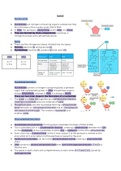
Nucleic acids
● Nucleotides are nitrogen-containing organic substances that
form the basis of the nucleic acids DNA & RNA
● In DNA, the pentose is deoxyribose and in RNA, it is ribose
● They are formed by three components: a pentose, a
nitrogenous base and a phosphate group
Bases
● There are five nitrogenous bases, divided into two types:
● Purines: adenine (A) and guanine (G)
● Pyrimidines: thymine (T), cytosine (C) and uracil (U)
DNA RNA
A=T A=U
C≡G C≡G
Nucleotide formation
Nucleotides contain a nitrogen-containing base, a pentose
sugar and a phosphate group. In DNA, the pentose sugar is
always deoxyribose, whereas in RNA, it is always a ribose.
There are two main steps in the formation of a nucleotide:
1. The sugar and base join together by a condensation reaction,
creating a nucleoside and one molecule of water
2. Phosphoric acid joins the nucleoside forming a phosphoester
bond between an -OH group on the acid and an -OH group on
the carbon 5 of the sugar. This creates a nucleotide and
another water
Polynucleotide formation
● Nucleotides can polymerise, forming polynucleotides; the basis of DNA & RNA
● Two nucleotides join in a condensation reaction , creating a diester bond between the -OH
on the phosphate of one nucleotide, and the -OH on carbon 3 on the other (dinucleotide)
● Each chain has a 5’ and a 3’ end. At the 5’ end, carbon 5 of the pentose is nearest to the
end, whilst at 3’ end, carbon 3 of the pentose is nearest to the end
● Additional nucleotides join by further phosphodiester bonds creating a polynucleotide
chain
● DNA contains a second, antiparallel chain that runs in the opposite direction (3’ to 5’) to
the first one
● The bases in both chains are complementary to each other: A = T and C ≡ G, joined by
hydrogen bonds
, ATP
● Adenosine triphosphate is an energy-carrying nucleotide that provides the energy to carry
out many essential processes inside cells
● It is a phosphorylated nucleotide, as it has more phosphate groups
● Adenosine can be combined with 1, 2 or 3 phosphate groups: adenosine
monophosphate (AMP), adenosine diphosphate (ADP) or adenosine triphosphate (ATP)
● ATP is dephosphorylated and turned into ADP when combined with two phosphate
groups, releasing energy
Structure of DNA
● Throughout the years, it has been discovered that DNA has a
double-stranded structure, that it has a helical structure, and
that the ratio between purine:pyrimidine bases is 1:1
● The structure of DNA consists of a double-helix made up of two
antiparallel chains of nucleotides joined by hydrogen bonds
between the complementary bases A = T & C ≡ G
● The phosphodiester bonds link the 5-carbon of one deoxyribose
sugar molecule to the phosphate group from the same
nucleotide, which is itself linked by another phosphodiester
bond to the 3-carbon of the deoxyribose sugar molecule of the
next nucleotide in the strand
● Each DNA polynucleotide strand is said to have a 3’ end and a 5’
end (these numbers relate to which carbon on the pentose
sugar could be bonded with another nucleotide)
● As the strands run in opposite directions (they are antiparallel),
one is known as the 5’ to 3’ strand and the other is known as the
3’ to 5’ strand
DNA packaging
● In eukaryotic cells, DNA is packaged in the nucleus as chromosomes. This DNA is
associated with histones, forming chromatin
● There are various steps of DNA packaging:
● DNA double helix: the length of the DNA molecule in an average human chromosome is
about 4.8cm long
● Nucleosome fibre: the DNA is wrapped around histone proteins, forming chromatin.
Histones associate in octamers to form “beads-on-a-string” structures called nucleosomes.
These are the basic unit of chromosomes
● Solenoide fibre: more histones help the nucleosome fibre form a tightly-coiled structure
called a solenoid fibre
● Folded/coiled solenoid fibre: the solenoid fibre is thought to wrap and coil around
scaffolding proteins, but the exact mechanism of this is not known
● Supercoiling: to reduce the stress on the molecule, the solenoid fibre twists and writhes,
like a curly telephone cable. The sum of this twisting and writhing is supercoiling
● Chromosome: the DNA molecule is packed so much that the average human
chromosome is just 6μm long. Here, the chromosome has replicated so it contains two
DNA molecules
Nucleic acids
● Nucleotides are nitrogen-containing organic substances that
form the basis of the nucleic acids DNA & RNA
● In DNA, the pentose is deoxyribose and in RNA, it is ribose
● They are formed by three components: a pentose, a
nitrogenous base and a phosphate group
Bases
● There are five nitrogenous bases, divided into two types:
● Purines: adenine (A) and guanine (G)
● Pyrimidines: thymine (T), cytosine (C) and uracil (U)
DNA RNA
A=T A=U
C≡G C≡G
Nucleotide formation
Nucleotides contain a nitrogen-containing base, a pentose
sugar and a phosphate group. In DNA, the pentose sugar is
always deoxyribose, whereas in RNA, it is always a ribose.
There are two main steps in the formation of a nucleotide:
1. The sugar and base join together by a condensation reaction,
creating a nucleoside and one molecule of water
2. Phosphoric acid joins the nucleoside forming a phosphoester
bond between an -OH group on the acid and an -OH group on
the carbon 5 of the sugar. This creates a nucleotide and
another water
Polynucleotide formation
● Nucleotides can polymerise, forming polynucleotides; the basis of DNA & RNA
● Two nucleotides join in a condensation reaction , creating a diester bond between the -OH
on the phosphate of one nucleotide, and the -OH on carbon 3 on the other (dinucleotide)
● Each chain has a 5’ and a 3’ end. At the 5’ end, carbon 5 of the pentose is nearest to the
end, whilst at 3’ end, carbon 3 of the pentose is nearest to the end
● Additional nucleotides join by further phosphodiester bonds creating a polynucleotide
chain
● DNA contains a second, antiparallel chain that runs in the opposite direction (3’ to 5’) to
the first one
● The bases in both chains are complementary to each other: A = T and C ≡ G, joined by
hydrogen bonds
, ATP
● Adenosine triphosphate is an energy-carrying nucleotide that provides the energy to carry
out many essential processes inside cells
● It is a phosphorylated nucleotide, as it has more phosphate groups
● Adenosine can be combined with 1, 2 or 3 phosphate groups: adenosine
monophosphate (AMP), adenosine diphosphate (ADP) or adenosine triphosphate (ATP)
● ATP is dephosphorylated and turned into ADP when combined with two phosphate
groups, releasing energy
Structure of DNA
● Throughout the years, it has been discovered that DNA has a
double-stranded structure, that it has a helical structure, and
that the ratio between purine:pyrimidine bases is 1:1
● The structure of DNA consists of a double-helix made up of two
antiparallel chains of nucleotides joined by hydrogen bonds
between the complementary bases A = T & C ≡ G
● The phosphodiester bonds link the 5-carbon of one deoxyribose
sugar molecule to the phosphate group from the same
nucleotide, which is itself linked by another phosphodiester
bond to the 3-carbon of the deoxyribose sugar molecule of the
next nucleotide in the strand
● Each DNA polynucleotide strand is said to have a 3’ end and a 5’
end (these numbers relate to which carbon on the pentose
sugar could be bonded with another nucleotide)
● As the strands run in opposite directions (they are antiparallel),
one is known as the 5’ to 3’ strand and the other is known as the
3’ to 5’ strand
DNA packaging
● In eukaryotic cells, DNA is packaged in the nucleus as chromosomes. This DNA is
associated with histones, forming chromatin
● There are various steps of DNA packaging:
● DNA double helix: the length of the DNA molecule in an average human chromosome is
about 4.8cm long
● Nucleosome fibre: the DNA is wrapped around histone proteins, forming chromatin.
Histones associate in octamers to form “beads-on-a-string” structures called nucleosomes.
These are the basic unit of chromosomes
● Solenoide fibre: more histones help the nucleosome fibre form a tightly-coiled structure
called a solenoid fibre
● Folded/coiled solenoid fibre: the solenoid fibre is thought to wrap and coil around
scaffolding proteins, but the exact mechanism of this is not known
● Supercoiling: to reduce the stress on the molecule, the solenoid fibre twists and writhes,
like a curly telephone cable. The sum of this twisting and writhing is supercoiling
● Chromosome: the DNA molecule is packed so much that the average human
chromosome is just 6μm long. Here, the chromosome has replicated so it contains two
DNA molecules