Senior Bookkeeping – Financial Statements
Module 1
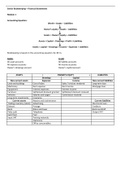
Accounting Equation:
Worth = Assets – Liabilities
Owner’s equity = Assets – Liabilities
Assets = Owner’s equity + Liabilities
Assets = Capital – Drawings + Profit + Liabilities
Assets = capital – Drawings + Income – Expenses + Liabilities
Bookkeeping is based on the accounting equation: A = O + L
Debits Credit
All asset accounts All liability accounts
All expense accounts All income accounts
Owner’s drawings account Owner’s capital account
ASSETS = OWNER’S EQUITY + LIABILITIES
Drawings Capital
Non-current assets Expenses Income Non-current liabilities
Land and buildings Cost of sales Sales / services rendered Long-term loan
Machinery Rent expense Rent income Mortgage loan
Equipment Interest expenses Interest income
Furniture Settlement discount granted Settlement discount received
Vehicles Salaries and wages Commission received
Long-term investments Insurance
Current assets Repairs and maintenance Current liabilities
Trading inventory (stock) Advertising Short-term loan
Debtors Postage Creditors
Bank Rates and taxes Bank overdraft
Petty cash Telephone Output VAT
Cash float Fuel
Input VAT Packing materials
Stationery
Office consumables
, Name of journal Abbr. Type of transaction Source document used Examples
Cashbook receipts CBR Transactions causing the bank Duplicate cash slip (cash Capital contribution
account to increase. register roll) Receiving money
Duplicate cash invoice Receiving rent money
Duplicate receipt Receiving interest
Duplicate bank deposit slip Debtor account
payment
Cashbook payments CBP Transactions causing the bank Cheque counterfoil Owner withdrawal
account to decrease. EFT confirmation slip Purchasing assets
Original invoice Paying expenses
Cash slip Creditor account
Receipt from supplier payment
Petty cash journal PCJ Purchases from petty cash box Petty cash voucher
causing the bank to decrease. Original invoice
Cash slip
Receipt from supplier
Creditors journal CJ Credit purchases of any product Original credit invoice (a Credit purchases of:
or services. tax invoice with payment Inventory
terms). Non-current assets
Consumables
Expenses on credit
Creditors allowances CAJ Returns/rebates with regard to Original credit note. Returns of/ rebates
journal transactions previously entered on:
into the CJ. Damaged inventory
Consumables
Non-current assets
Expenses on credit
Debtors journal DJ Credit sales of trading inventory Duplicate credit invoice (a Debtors journal
only. tax invoice with payment
terms).
Debtors allowances DAJ Returns/rebates with regard to Duplicate credit note.
journal transactions previously entered
into the DJ.
General journal GJ Sundry transactions that cannot Journal voucher
be recorded in other journals.
Module 2
Non-current assets are resources controlled by the entity (for longer than one year). Almost all non-current assets
fluctuate in the value over their lifespan. Whereas some of the assets might appreciate in value (real estate), many
lose their value over time (value depreciation).
Depreciation
Accounting cycle is a yearly cycle. Depreciation is the adjustment at the end of a financial year, where the
accountant attempts to adjust the value of the non-current assets to a value which is generally referred to as the net
realisable value. This is the realistic trade value of the asset as at the accounting date.
The original cos of the asset is adjusted with the depreciation calculated. The adjusted value of the asset is known as
the carrying value (book value).
Depreciation is classified as an expense account. If the asset is used for only a part of the financial period, the
depreciation is calculated based on the number of months for which the asset was used.
, Methods of depreciation
Two of the most common methods used are the straight-line (fixed instalment) method and the diminishing
(reducing) balance method.
Straight-line method
Depreciation is calculated on the cost price of the asset using a pre-determined rate of depreciation. If a non-current
asset was bought for R200 000 and its depreciation rate was given as 25% p.a. the annual depreciation would be 25%
of R200 000, which is R50 000.
The applicable depreciation rate can also be determined by estimating the useful life of the asset. Assume that the
asset was bought for R380 000, has a residual of R20 000 and it was expected to have an economic life of 6 years,
the annual depreciation would be R60 000 {(R380 000 – R20 000) / 6}. Note that the residual value must be deducted
to determine the depreciable value. A residual value is the expected scrapping or trade-in value at the end of the
asset’s useful life.
Diminishing balance method
According to this method, the annual depreciation is calculated as a percentage of the carrying value of the asset.
The carrying value is obtained by deducting the accumulated depreciation on the asset from the original cost of the
asset. The depreciation rate is the applied to the carrying value to calculate the depreciation amount for the year.
Accounting entries for depreciation
General ledger accounts are used to record the depreciation:
• The depreciation account (an expense account which is closed off against the profit and loss account at the
end of the financial year). This account will be debited when recording the depreciation adjustment.
• The accumulated depreciation account (provision for depreciation). This account holds all the depreciation
written off a particular asset until the asset is completely written off, sold or scrapped. Income and liability
accounts have credit balances. Since the accumulated depreciation account represents the credit side of the
asset account, it must also have a credit balance. It obviously cannot be an income or a liability account. This
account is therefore sometimes referred as a negative asset. When crediting the negative asset account, one
is actually crediting the asset account to which it serves as the negative asset. Thus one is increasing the
negative asset to decrease the carrying value of the asset.
The annual depreciation is shown as an expense in the income statement whilst the non-current asset is shown in
the statement of financial position at its carrying value.
NB: remember that every double-entry must be recorded in a subsidiary journal. The depreciation adjustment will
always be recorded in the general journal.
The four steps to asset disposal
Step 1: take the initial cost price out of the books. Debit asset disposal and credit he asset account.
Step 2: take the accumulated depreciation out of the books. Credit asset disposal and debit the accumulated
depreciation account.
Step 3: record the selling price. Debit bank (cash sale). Debtors’ control (credit sake) or creditors’ control/HP Loan
(trade-in) and credit the asset disposal account.
Step 4: calculate the profit/ (loss) with disposal. Debit/ (credit) the asset disposal and credit/ (debit) the profit/ (loss)
on disposal account.
Module 1
Accounting Equation:
Worth = Assets – Liabilities
Owner’s equity = Assets – Liabilities
Assets = Owner’s equity + Liabilities
Assets = Capital – Drawings + Profit + Liabilities
Assets = capital – Drawings + Income – Expenses + Liabilities
Bookkeeping is based on the accounting equation: A = O + L
Debits Credit
All asset accounts All liability accounts
All expense accounts All income accounts
Owner’s drawings account Owner’s capital account
ASSETS = OWNER’S EQUITY + LIABILITIES
Drawings Capital
Non-current assets Expenses Income Non-current liabilities
Land and buildings Cost of sales Sales / services rendered Long-term loan
Machinery Rent expense Rent income Mortgage loan
Equipment Interest expenses Interest income
Furniture Settlement discount granted Settlement discount received
Vehicles Salaries and wages Commission received
Long-term investments Insurance
Current assets Repairs and maintenance Current liabilities
Trading inventory (stock) Advertising Short-term loan
Debtors Postage Creditors
Bank Rates and taxes Bank overdraft
Petty cash Telephone Output VAT
Cash float Fuel
Input VAT Packing materials
Stationery
Office consumables
, Name of journal Abbr. Type of transaction Source document used Examples
Cashbook receipts CBR Transactions causing the bank Duplicate cash slip (cash Capital contribution
account to increase. register roll) Receiving money
Duplicate cash invoice Receiving rent money
Duplicate receipt Receiving interest
Duplicate bank deposit slip Debtor account
payment
Cashbook payments CBP Transactions causing the bank Cheque counterfoil Owner withdrawal
account to decrease. EFT confirmation slip Purchasing assets
Original invoice Paying expenses
Cash slip Creditor account
Receipt from supplier payment
Petty cash journal PCJ Purchases from petty cash box Petty cash voucher
causing the bank to decrease. Original invoice
Cash slip
Receipt from supplier
Creditors journal CJ Credit purchases of any product Original credit invoice (a Credit purchases of:
or services. tax invoice with payment Inventory
terms). Non-current assets
Consumables
Expenses on credit
Creditors allowances CAJ Returns/rebates with regard to Original credit note. Returns of/ rebates
journal transactions previously entered on:
into the CJ. Damaged inventory
Consumables
Non-current assets
Expenses on credit
Debtors journal DJ Credit sales of trading inventory Duplicate credit invoice (a Debtors journal
only. tax invoice with payment
terms).
Debtors allowances DAJ Returns/rebates with regard to Duplicate credit note.
journal transactions previously entered
into the DJ.
General journal GJ Sundry transactions that cannot Journal voucher
be recorded in other journals.
Module 2
Non-current assets are resources controlled by the entity (for longer than one year). Almost all non-current assets
fluctuate in the value over their lifespan. Whereas some of the assets might appreciate in value (real estate), many
lose their value over time (value depreciation).
Depreciation
Accounting cycle is a yearly cycle. Depreciation is the adjustment at the end of a financial year, where the
accountant attempts to adjust the value of the non-current assets to a value which is generally referred to as the net
realisable value. This is the realistic trade value of the asset as at the accounting date.
The original cos of the asset is adjusted with the depreciation calculated. The adjusted value of the asset is known as
the carrying value (book value).
Depreciation is classified as an expense account. If the asset is used for only a part of the financial period, the
depreciation is calculated based on the number of months for which the asset was used.
, Methods of depreciation
Two of the most common methods used are the straight-line (fixed instalment) method and the diminishing
(reducing) balance method.
Straight-line method
Depreciation is calculated on the cost price of the asset using a pre-determined rate of depreciation. If a non-current
asset was bought for R200 000 and its depreciation rate was given as 25% p.a. the annual depreciation would be 25%
of R200 000, which is R50 000.
The applicable depreciation rate can also be determined by estimating the useful life of the asset. Assume that the
asset was bought for R380 000, has a residual of R20 000 and it was expected to have an economic life of 6 years,
the annual depreciation would be R60 000 {(R380 000 – R20 000) / 6}. Note that the residual value must be deducted
to determine the depreciable value. A residual value is the expected scrapping or trade-in value at the end of the
asset’s useful life.
Diminishing balance method
According to this method, the annual depreciation is calculated as a percentage of the carrying value of the asset.
The carrying value is obtained by deducting the accumulated depreciation on the asset from the original cost of the
asset. The depreciation rate is the applied to the carrying value to calculate the depreciation amount for the year.
Accounting entries for depreciation
General ledger accounts are used to record the depreciation:
• The depreciation account (an expense account which is closed off against the profit and loss account at the
end of the financial year). This account will be debited when recording the depreciation adjustment.
• The accumulated depreciation account (provision for depreciation). This account holds all the depreciation
written off a particular asset until the asset is completely written off, sold or scrapped. Income and liability
accounts have credit balances. Since the accumulated depreciation account represents the credit side of the
asset account, it must also have a credit balance. It obviously cannot be an income or a liability account. This
account is therefore sometimes referred as a negative asset. When crediting the negative asset account, one
is actually crediting the asset account to which it serves as the negative asset. Thus one is increasing the
negative asset to decrease the carrying value of the asset.
The annual depreciation is shown as an expense in the income statement whilst the non-current asset is shown in
the statement of financial position at its carrying value.
NB: remember that every double-entry must be recorded in a subsidiary journal. The depreciation adjustment will
always be recorded in the general journal.
The four steps to asset disposal
Step 1: take the initial cost price out of the books. Debit asset disposal and credit he asset account.
Step 2: take the accumulated depreciation out of the books. Credit asset disposal and debit the accumulated
depreciation account.
Step 3: record the selling price. Debit bank (cash sale). Debtors’ control (credit sake) or creditors’ control/HP Loan
(trade-in) and credit the asset disposal account.
Step 4: calculate the profit/ (loss) with disposal. Debit/ (credit) the asset disposal and credit/ (debit) the profit/ (loss)
on disposal account.