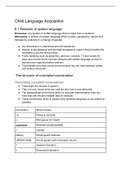
Child Language Acquisition
8.1 Features of spoken language
Discourse: any spoken or written language that is longer than a sentence
Utterances: a section of spoken language which is often preceded by silence and
followed by a silence or a change of speaker
● Our discourse is in utterances and not sentences
● Speech is spontaneous and we need strategies to make it flow smoothly (it's
inevitable to say the wrong thing)
● Public speaking such as speeches, sermons, lectures, TV and scripts for
plays and movies share common features with written language as they’re
planned and organised before delivery
● Texts,tweets and other online communication blur the lines between written
and spoken discourse
The structure of unscripted conversation
Transcribing unscripted conversational
● Transcripts are records of speech
● They not only record what was said but also how it was delivered
● The standardised conventions allow for accurate representation from any
transcript and ensures reliable data for analysis
● These conventions allow to capture and represent language as accurately as
possible
Convention What it shows
(1) Pause in seconds
(.) Micropause for breath
underlined Stressed sounds/syllable
// overlap
[italics] Paralinguistic features
UPPER CASE Words spoken with increased volume
↗ Upward intonation
↘ Downward intonation
, /WIV/ Phonemic representation of speech sounds
°word° Words spoken with decreased volume
How to transcribe speech
● Listen to the recording at least 3 times before transcribing, discourse
(especially informal) has many overlaps of different speakers which can be
hard to record at first
● You should not follow the conventions of literary speech (no quotation marks,
new lines shouldn’t start with capital letters)
● The speaker’s name must be written in capital letters on the left hand side,
use a colon to separate the speaker from the utterances
● Use conventional spelling not phonetic spelling for representing speech
● Where words are unclear use (xxxxxx)
● When there’s an overlap indicate it with //, some transcripts use brackets to
show that two or more speakers are speaking at the same time
● Only words and phrases with distinct change in tone need to be marked with
the intonation symbol
Discourse features
Opening greetings:
● Conversation openings usually have a standard form to help ease participants
into the conversation
● Greetings such as hi, hiya, good morning establish feelings of mutual ease
● These standard greetings often is accompanied by body language and
gestures such as handshakes, hugs and kisses
● Participants who are strangers will usually introduce themselves
Body language: communication using non-verbal gestures to put across meanings
Turn-taking: in conversations, people usually wait for their turns to speak, some
may interrupt out of eagerness or rudeness, the norm is for one speaker to yield the
floor by prolonging a pause or glancing at the elected next speaker who then takes
their turn
● Conversation is usually cooperative with participants taking turns but
speakers often overlap
● This has to be done with sensitivity as it can be seen as rude
● When a conversation isn’t cooperative participants adopt very different
strategies which can have an unpleasant outcomes eg. arguments
Adjacency pairs: dialogue that follows a set pattern of an utterance from one
speaker and a response from the other (eg. greetings)
, ● Statement and response form the basis of a conversation
● Consists of a question/exclamation/declaration from Participant A, followed by
a response from participant B and by any others
● It can expand to a three/part exchange, which is when the first speaker
responds and the conversation continuous
Conversational floor: speaking until you have finished what you wanted to say or
until someone interrupts you
● In discourse, the person who is talking is holding the conversational floor
● We use a variety of strategies to determine who will take over and when they
will do so:
○ Name them (Anna was there, she knows)
○ Complete what we are saying (and so I got soaked)
○ Hesitate - a longer pause than usual could result in someone else
talking, silence makes discourse tense
○ Use sounds and body language - our voices may start to fall and we
might start looking at those who are about to take their conversation
turn
Clashing:
● When two people start to speak at the same time and the clash is
acknowledged, one participant must stop and the other continuous
● Status and context are important as having a conversation is related to the
context and to the relative status of the speakers
Repairing:
● During discourse, participants are constantly monitoring themselves and
those whom they’re talking to
● A speaker may repair what they say by correcting themselves or using
phrases to acknowledge the mistakes (eg. I mean, no, I wanted to say)
● There is instant updating of information and self-correction in conversations
● Sometimes another participant will correct the speaker’s mistakes for them
Topic-shift: the point where people move from one topic to another
● Conversations are dynamic and spontaneous
● We talk about all sorts of topics and people that change frequently
● Management of topic change is achieved with impressions like ‘By the way’
Conversation ending:
● Closing a conversation has formulaic utterances with standard phrases like
‘see you later’, ‘bye’ or ‘see you next week’
● Body language reinforces the discourse, we may check the time, start to pack
away belongings, stand up or turn away
8.1 Features of spoken language
Discourse: any spoken or written language that is longer than a sentence
Utterances: a section of spoken language which is often preceded by silence and
followed by a silence or a change of speaker
● Our discourse is in utterances and not sentences
● Speech is spontaneous and we need strategies to make it flow smoothly (it's
inevitable to say the wrong thing)
● Public speaking such as speeches, sermons, lectures, TV and scripts for
plays and movies share common features with written language as they’re
planned and organised before delivery
● Texts,tweets and other online communication blur the lines between written
and spoken discourse
The structure of unscripted conversation
Transcribing unscripted conversational
● Transcripts are records of speech
● They not only record what was said but also how it was delivered
● The standardised conventions allow for accurate representation from any
transcript and ensures reliable data for analysis
● These conventions allow to capture and represent language as accurately as
possible
Convention What it shows
(1) Pause in seconds
(.) Micropause for breath
underlined Stressed sounds/syllable
// overlap
[italics] Paralinguistic features
UPPER CASE Words spoken with increased volume
↗ Upward intonation
↘ Downward intonation
, /WIV/ Phonemic representation of speech sounds
°word° Words spoken with decreased volume
How to transcribe speech
● Listen to the recording at least 3 times before transcribing, discourse
(especially informal) has many overlaps of different speakers which can be
hard to record at first
● You should not follow the conventions of literary speech (no quotation marks,
new lines shouldn’t start with capital letters)
● The speaker’s name must be written in capital letters on the left hand side,
use a colon to separate the speaker from the utterances
● Use conventional spelling not phonetic spelling for representing speech
● Where words are unclear use (xxxxxx)
● When there’s an overlap indicate it with //, some transcripts use brackets to
show that two or more speakers are speaking at the same time
● Only words and phrases with distinct change in tone need to be marked with
the intonation symbol
Discourse features
Opening greetings:
● Conversation openings usually have a standard form to help ease participants
into the conversation
● Greetings such as hi, hiya, good morning establish feelings of mutual ease
● These standard greetings often is accompanied by body language and
gestures such as handshakes, hugs and kisses
● Participants who are strangers will usually introduce themselves
Body language: communication using non-verbal gestures to put across meanings
Turn-taking: in conversations, people usually wait for their turns to speak, some
may interrupt out of eagerness or rudeness, the norm is for one speaker to yield the
floor by prolonging a pause or glancing at the elected next speaker who then takes
their turn
● Conversation is usually cooperative with participants taking turns but
speakers often overlap
● This has to be done with sensitivity as it can be seen as rude
● When a conversation isn’t cooperative participants adopt very different
strategies which can have an unpleasant outcomes eg. arguments
Adjacency pairs: dialogue that follows a set pattern of an utterance from one
speaker and a response from the other (eg. greetings)
, ● Statement and response form the basis of a conversation
● Consists of a question/exclamation/declaration from Participant A, followed by
a response from participant B and by any others
● It can expand to a three/part exchange, which is when the first speaker
responds and the conversation continuous
Conversational floor: speaking until you have finished what you wanted to say or
until someone interrupts you
● In discourse, the person who is talking is holding the conversational floor
● We use a variety of strategies to determine who will take over and when they
will do so:
○ Name them (Anna was there, she knows)
○ Complete what we are saying (and so I got soaked)
○ Hesitate - a longer pause than usual could result in someone else
talking, silence makes discourse tense
○ Use sounds and body language - our voices may start to fall and we
might start looking at those who are about to take their conversation
turn
Clashing:
● When two people start to speak at the same time and the clash is
acknowledged, one participant must stop and the other continuous
● Status and context are important as having a conversation is related to the
context and to the relative status of the speakers
Repairing:
● During discourse, participants are constantly monitoring themselves and
those whom they’re talking to
● A speaker may repair what they say by correcting themselves or using
phrases to acknowledge the mistakes (eg. I mean, no, I wanted to say)
● There is instant updating of information and self-correction in conversations
● Sometimes another participant will correct the speaker’s mistakes for them
Topic-shift: the point where people move from one topic to another
● Conversations are dynamic and spontaneous
● We talk about all sorts of topics and people that change frequently
● Management of topic change is achieved with impressions like ‘By the way’
Conversation ending:
● Closing a conversation has formulaic utterances with standard phrases like
‘see you later’, ‘bye’ or ‘see you next week’
● Body language reinforces the discourse, we may check the time, start to pack
away belongings, stand up or turn away