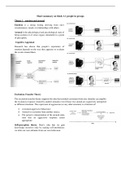
Short summary on block 1.1 people in groups
Theme 1 – emotion and arousal
Emotion is a strong feeling deriving from one's
circumstances, mood, or relationships with others.
Arousal is the physiological and psychological state of
being awoken or of sense organs stimulated to a point
of perception.
Cognitive Appraisal
Research has shown that people’s experience of
emotion depends on the way they appraise or evaluate
the events around them.
Excitation-Transfer Theory
The excitation-transfer theory supports the idea that residual excitement from one stimulus can amplify
the excitatory response created by another stimulus even if those two stimuli are cognitively interpreted
as different emotions. The expression of aggression (or any other emotion) is a function of:
• A learned aggressive behaviour;
• Arousal or excitation from another source;
• The person’s interpretation of the arousal state,
such that an aggressive response seems
appropriate.
Self-perception theory: Bem’s idea that we gain
knowledge ourselves only by making self-attributions:
we infer our own attitudes from our own behaviour.
,Theme 2. Bystander and audience
Social Influence and the Bystander Effect
Bystander effect, The tendency for people to help less when they know others are present and capable
of helping. The effect was initially thought to be the result of apathy and a selfish unwillingness to get
involved, but research suggests a number of cognitive and social processes, including diffusion of
responsibility and misinterpretation that help is not needed, contribute to the effect.
Why do people in groups not help as
much as individuals:
I. Situations that have no
obvious response causes
bystanders to search for
information by looking at
other, if no one knows what to
do and just move on, its sends
a message that it is ok to do
nothing.
II. Most people like to stay out of
other’s affaires and
business(to minimize the
chance of embarrassment)
unless they know the person
or they belong to the same
“group”.
III. Diffusion of responsibility, a
reduction of personal
responsibility experienced by individuals in groups and social collectives.
IV. Pluralistic ignorance, when people think that their behaviour/feelings are different from the
rest, as a result each member wrongly interprets the other’s inaction as reflecting their better
understanding of the situation.
V. Audience inhabitation, not wanting to help for fear of making yourself look bad.
Other influencing factors on helping behaviour
• The bystander effect is weaker in dangerous situations because the response is clear, there is
more physical support and there are enough people to help.
• Time pressure can have a real influence of helping behaviour.
• Location can also affect helping behaviour, as big city’s tend to be less helpful.
• One’s culture can also influence this as Spanish or Latin cultures have helping more embedded
in their lifestyle(simpatia).
• The better the economic rank, the lower the rate of helping.
• People are much more likely to help in a good mood, like in the sunshine or when it smell
pleasant.
• People will donate more often to people far away.
• personal attractiveness and personal responsibility for the position of needing assistance.
• Kind of help different: women more helpful in supporting people, social. Men when it comes
to physical support, strength.
• Bystander calculus: cost and benefits of helping. People want to solve negative arousal.
, Social impact theory, the more people there are in comparisons to the target person(s), the bigger the
social influence. Influence is determined by the following:
• The strength of a source is determined by the status, ability or relationship to a target.
• The immediacy refers to the distance in time and space to the target
• The number of sources relative to the target
Terror management theory, the human motion to reduce the terror of death. (ethnic cleansing vs
killing everybody of a certain culture)
Just-world hypothesis, people need to believe that the world us a just place where one gets what they
deserve. As evidence of undeserved suffering undermines this belief, people may conclude that victims
get what they deserve.
Theme 1 – emotion and arousal
Emotion is a strong feeling deriving from one's
circumstances, mood, or relationships with others.
Arousal is the physiological and psychological state of
being awoken or of sense organs stimulated to a point
of perception.
Cognitive Appraisal
Research has shown that people’s experience of
emotion depends on the way they appraise or evaluate
the events around them.
Excitation-Transfer Theory
The excitation-transfer theory supports the idea that residual excitement from one stimulus can amplify
the excitatory response created by another stimulus even if those two stimuli are cognitively interpreted
as different emotions. The expression of aggression (or any other emotion) is a function of:
• A learned aggressive behaviour;
• Arousal or excitation from another source;
• The person’s interpretation of the arousal state,
such that an aggressive response seems
appropriate.
Self-perception theory: Bem’s idea that we gain
knowledge ourselves only by making self-attributions:
we infer our own attitudes from our own behaviour.
,Theme 2. Bystander and audience
Social Influence and the Bystander Effect
Bystander effect, The tendency for people to help less when they know others are present and capable
of helping. The effect was initially thought to be the result of apathy and a selfish unwillingness to get
involved, but research suggests a number of cognitive and social processes, including diffusion of
responsibility and misinterpretation that help is not needed, contribute to the effect.
Why do people in groups not help as
much as individuals:
I. Situations that have no
obvious response causes
bystanders to search for
information by looking at
other, if no one knows what to
do and just move on, its sends
a message that it is ok to do
nothing.
II. Most people like to stay out of
other’s affaires and
business(to minimize the
chance of embarrassment)
unless they know the person
or they belong to the same
“group”.
III. Diffusion of responsibility, a
reduction of personal
responsibility experienced by individuals in groups and social collectives.
IV. Pluralistic ignorance, when people think that their behaviour/feelings are different from the
rest, as a result each member wrongly interprets the other’s inaction as reflecting their better
understanding of the situation.
V. Audience inhabitation, not wanting to help for fear of making yourself look bad.
Other influencing factors on helping behaviour
• The bystander effect is weaker in dangerous situations because the response is clear, there is
more physical support and there are enough people to help.
• Time pressure can have a real influence of helping behaviour.
• Location can also affect helping behaviour, as big city’s tend to be less helpful.
• One’s culture can also influence this as Spanish or Latin cultures have helping more embedded
in their lifestyle(simpatia).
• The better the economic rank, the lower the rate of helping.
• People are much more likely to help in a good mood, like in the sunshine or when it smell
pleasant.
• People will donate more often to people far away.
• personal attractiveness and personal responsibility for the position of needing assistance.
• Kind of help different: women more helpful in supporting people, social. Men when it comes
to physical support, strength.
• Bystander calculus: cost and benefits of helping. People want to solve negative arousal.
, Social impact theory, the more people there are in comparisons to the target person(s), the bigger the
social influence. Influence is determined by the following:
• The strength of a source is determined by the status, ability or relationship to a target.
• The immediacy refers to the distance in time and space to the target
• The number of sources relative to the target
Terror management theory, the human motion to reduce the terror of death. (ethnic cleansing vs
killing everybody of a certain culture)
Just-world hypothesis, people need to believe that the world us a just place where one gets what they
deserve. As evidence of undeserved suffering undermines this belief, people may conclude that victims
get what they deserve.